Parenting Mistakes: 5 Best Ways to Avoid the Worst Shame Spiral
Parenting mistakes can make even the most ordinary Tuesday feel like evidence in a court case.
You raised your voice. You rushed bedtime. You forgot the form. You were too soft, too strict, too distracted or too tired. Later, when the house is finally quiet, your brain whispers, “Well done. That will be the thing they talk about in therapy.”
Lovely.
So let’s talk about the title before anyone panics. How Not to F*ck Up Your Kids Too Bad is provocative, yes. It is also the sort of dark little joke many parents make because we are trying to laugh at something that secretly scares us. Most of us are not trying to ruin our children. We are trying to love them while carrying our own limits and unfinished bits.
This post is not a therapy replacement. It is not for situations where a child is unsafe, harmed or living with ongoing fear. If you are dealing with abuse, trauma, serious mental health concerns, addiction or anything beyond ordinary family repair, please get proper support from qualified people. That is not failure. That is care.
This is also not a post blaming mothers. Parents of all genders carry this. Carers, step parents, grandparents, solo parents, adoptive parents, foster parents and exhausted humans doing their best carry this too.
This is a post about ordinary parenting mistakes, the ache of guilt and the hopeful idea that rupture is not the end of the story. Repair matters. Most parenting mistakes need repair more than theatre. They need a steady adult who can notice, apologise and return without making the child carry the adult’s shame.
This is why it sits so naturally beside my reflection on Mon ado, ma bataille: the question is not how to control a child into calm, but how to stay adult enough to repair, listen and return.
Table of Contents
How Not to F*ck Up Your Kids: Why Parenting Mistakes Feel So Frightening
How Not to F*ck Up Your Kids Too Bad is a 10-episode Audible Original series that arrived in my library at exactly the right time. It is not a neat expert manual with one author page I can summarise in the usual way, so I am not pretending this is a full sourced breakdown of every episode. I am treating it as a personal reflection prompted by the series title and its central parenting question: what happens when good-enough parents get it wrong?
That source background matters because this is not about polishing someone else’s theory into a perfect lesson. It is about the very real fear behind ordinary parenting mistakes. Am I repeating things I promised I would not repeat? Am I giving enough love, enough boundaries, enough freedom, enough softness and enough clean socks?
If perfection is the standard, we are all finished by breakfast.
Children are not raised by pristine theories. They are raised in real homes, by real people, with real nervous systems, real bills, real histories and real limits. That does not mean our behaviour does not matter. It means perfection and responsibility are not the same thing.
Perfection says, “A good parent never gets it wrong.” Responsibility says, “When I get it wrong, I come back.”
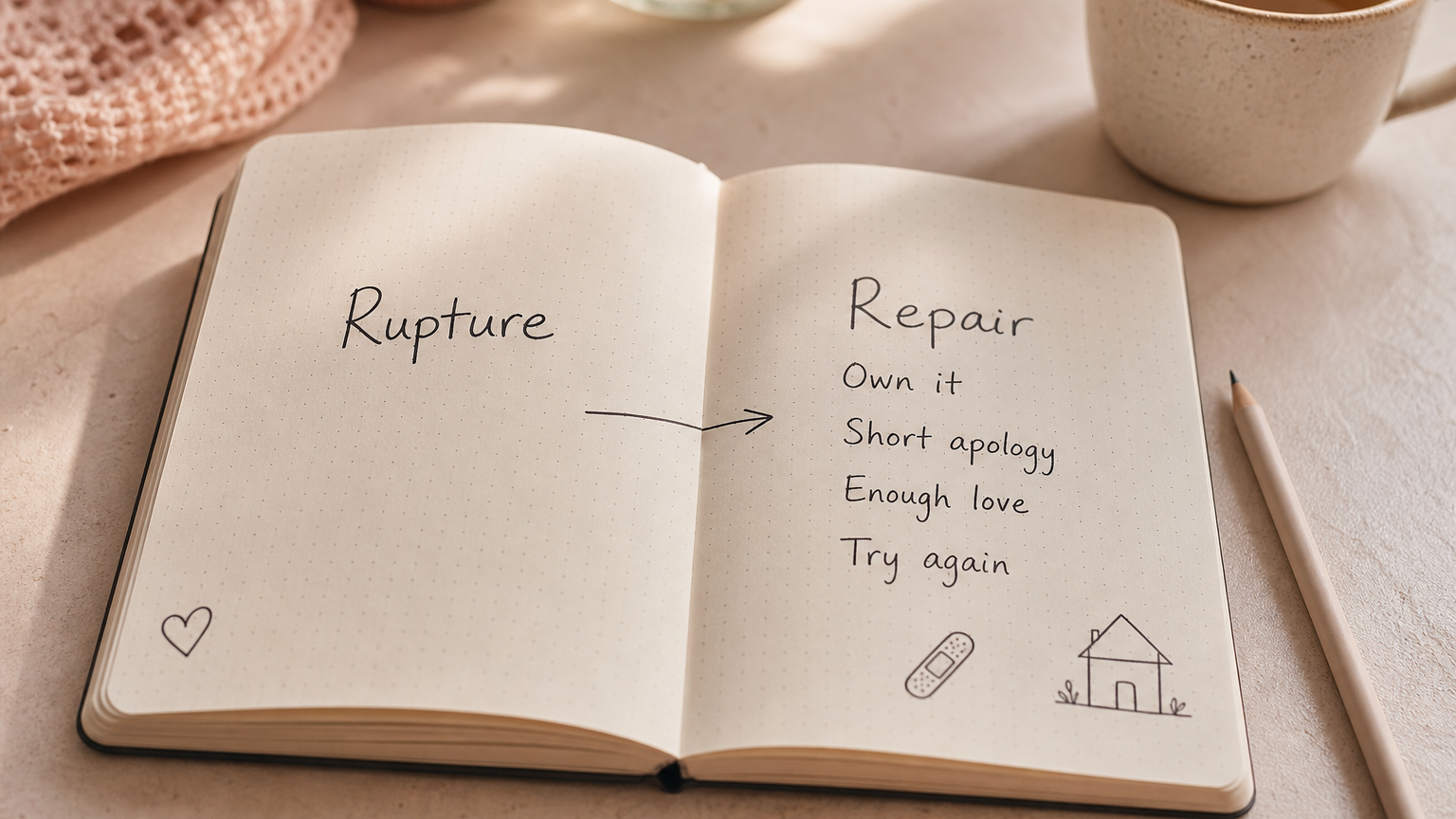
Rupture and Repair
Rupture is the moment of disconnection. It might be shouting, snapping, dismissing a feeling, misunderstanding, overreacting or making a decision from stress rather than steadiness. Sometimes it is loud. Sometimes it is the look on their face when you realise they needed comfort and you offered a lecture.
Repair is what happens after.
It is not a grovelling performance. It is not making your child responsible for your guilt. It is not collapsing into, “I am such a bad mum” so they have to comfort you. That is emotional admin for a child, and they do not need another job.
Repair is simple, honest and age appropriate. It can sound like:
“I shouted. That was not okay. I am sorry.”
“You were trying to tell me something and I did not listen properly. Can we try again?”
“I still mean the boundary, but I wish I had said it more calmly.”
You can apologise for your tone and still keep the boundary. You can be warm and still be firm. You can say, “I love you, and the answer is still no.” That is not confusing when done with steadiness. It is actually quite safe.
Guilt Can Be Useful, but Shame Is a Swamp
Parenting guilt is not always bad. Sometimes guilt is the little signal that says, “That was not aligned with the parent I want to be.” It can help us pause, apologise, learn and choose differently next time.
But shame is different. Shame says, “I am bad.” Shame makes us hide, defend, over explain or swing between too harsh and too permissive because we are trying to escape the feeling rather than respond to the child in front of us.
A shame spiral after parenting mistakes might sound like this: I snapped, I am becoming exactly what I feared, they will remember this forever, I have ruined everything.
The child usually does not need our entire psychological excavation in that moment. They need repair, consistency and the felt sense that the adult can handle being wrong without falling apart.
Children Are People, Not Projects
One of the easiest parenting traps is treating children like projects.
We do it lovingly. We want them to be confident, kind, brave, polite, emotionally intelligent, independent, grateful and preferably able to put their shoes on the correct feet without a national incident. We want to give them what we did not have and protect them from our old wounds.
That care is beautiful. But children are people, not self improvement projects with snack breaks.
They arrive with temperaments, sensitivities, humour, stubbornness, fear, brilliance and their own way of moving through the world. Our job is not to sculpt them into the child who makes us feel successful. Our job is to know them, guide them and notice when our agenda is louder than their actual personhood.
This is hard because children trigger us. Their anger can trigger our discomfort with anger. Their sadness can trigger our panic. Their independence can feel like rejection. Their neediness can feel like being swallowed whole.
None of that makes us bad. It makes us human with unfinished bits. The work is noticing when we are responding to the child in front of us and when we are responding to an old story inside us.
The Parenting Mistakes Worth Watching
If we are talking about parenting mistakes, some patterns deserve attention. Not for self attack, but because children live inside patterns more than isolated moments.
A one-off bad morning with repair is different from a home where nobody ever apologises. A stressed tone with acknowledgement is different from a child being repeatedly blamed for adult feelings. A firm boundary is different from humiliation. A parent needing rest is different from emotional abandonment.
The question is not, “Did I ever mess up?”
The question is, “What is the pattern, and am I willing to notice it?”
It is worth watching if we often make the child responsible for our mood. If apologies never happen. If affection is withdrawn as punishment. If we need to be right more than we need to understand. If we mock their feelings. If we use guilt to control them. If we expect them to meet emotional needs that belong with adults.
Again, this is not for self attack. It is for honesty. Honesty is where repair begins.
A Simple Repair Script
When you are not sure what to say, keep it clean and small.
- Name what happened
- Take responsibility for your part
- Reassure them they are loved
- Restate the boundary if needed
- Say what you will try next time
For example:
“Earlier, I shouted when you spilled the drink. I was frustrated, but shouting was not okay. I am sorry. You are not in trouble for accidents. Next time I am going to take a breath before I speak. Let’s clean it up together.”
Or:
“I said no to the screen, and the no still stands. But I used a sharp voice. I am sorry for the sharp voice. I love you even when you are angry with me.”
This does not need to be perfect. The point is connection, not performance.
Practical Takeaways
- Parenting mistakes are inevitable. Repeated refusal to repair is the bigger problem.
- Perfection is not a useful standard. Responsibility is.
- Guilt can guide you, but shame usually makes repair harder.
- Repair should not make the child responsible for comforting the parent.
- Children are people, not projects, proof of our worth or extensions of our image.
- Watch patterns more than isolated moments. Patterns are where children learn what is normal.
- If anything feels unsafe, chronic or beyond ordinary repair, seek qualified support. You do not have to manage it alone.
The fear of messing up our children often comes from love, but fear is not a brilliant parenting strategy. Children do not need flawless adults. They need adults who are safe enough, loving enough and willing to repair.
Parenting mistakes are not automatically the end of the story. Very often, they are the doorway into one of the most important lessons we can offer: we can hurt each other, take responsibility and come back with love.
You are not meant to parent like a perfect machine. You are meant to keep choosing love with your very human hands.
Why This Belongs in Heart
Heart is where I put the work of relationships, repair, boundaries and love that is honest enough to survive real life. This post belongs here because parenting mistakes are not just behaviour problems. They are relationship moments, and repair is one of the ways love becomes practical.
*Notes from Soph | Learning, not perfection.*
Et toi? What is one repair sentence you want to keep close for the next imperfect parenting moment? Come and share it in the Notes from Soph community on Skool.
Source Details
How Not to F*ck Up Your Kids Too Bad, Audible Original audio series and personal reflection on parenting mistakes, repair and good enough love.

