How to Find Your Element: What Ken Robinson Changed for Me
How to find your Element sounds like one of those enormous life questions that should end with a dramatic answer. I did not finish Ken Robinson’s book with a neat label for myself or each of my children. I finished it with better questions, which may be more useful.
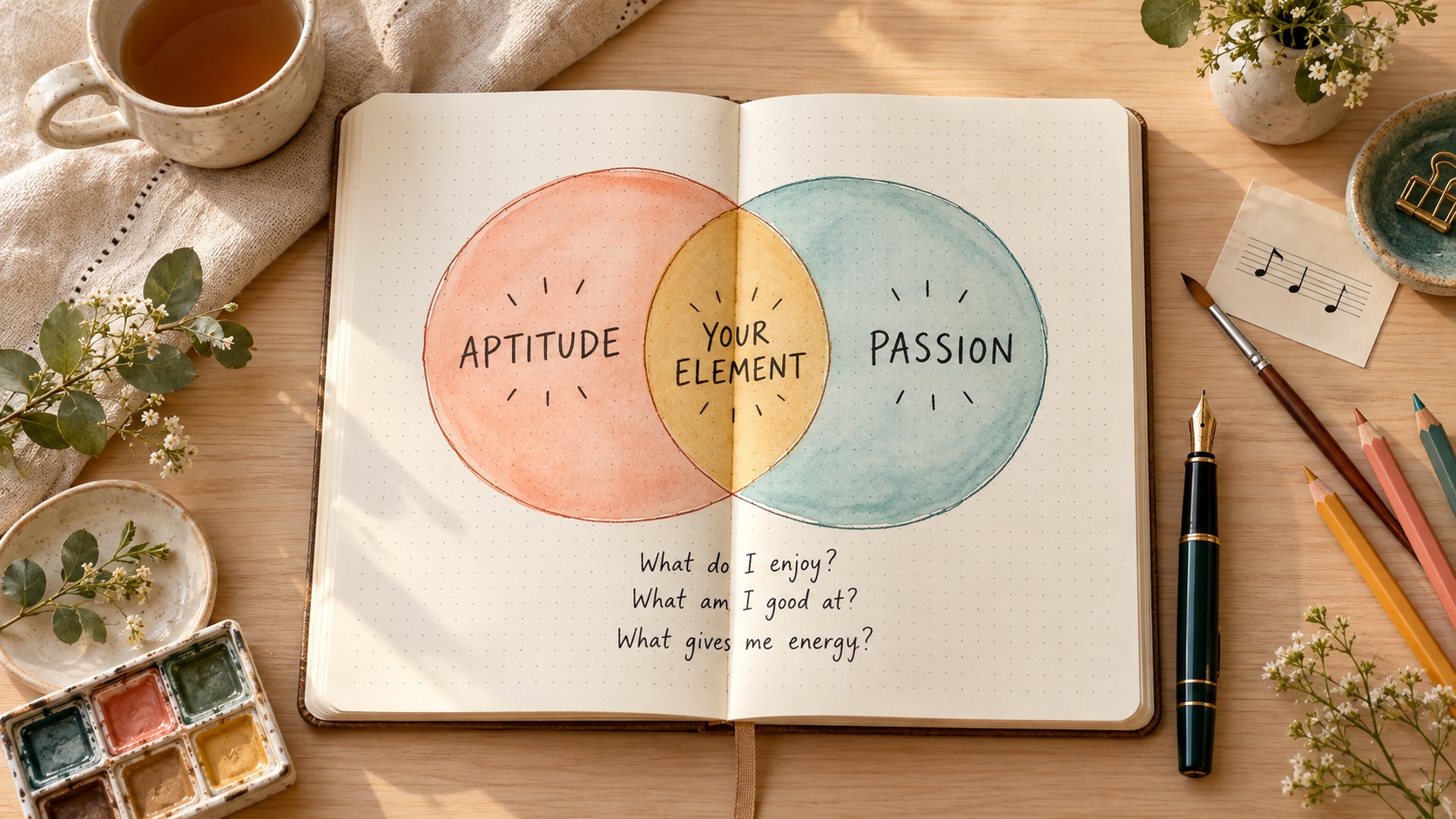
What do I genuinely enjoy? What am I naturally good at, or becoming good at? What gives me energy rather than only taking it? What have I not tried yet?
The last question may be the most important. My strongest thought while reading was not, “We need to identify everyone’s one special talent immediately.” It was, “We may not have found it yet.” That feels hopeful. It gives me permission to keep exploring and reminds me to offer the same permission to my children and learners.
This is why the book has stayed with me. It does not only ask what we can do. It asks what happens when aptitude meets passion, then adds the attitude and opportunity needed to let that combination grow. I can use that in parenting, teaching and my own life. There is more to life than doing what is expected reasonably well. We are all entitled to look for what helps us enjoy and thrive.
Table of Contents
How to Find Your Element Without Forcing an Answer
Sir Ken Robinson was an educator and an international voice on creativity and human potential. Written with Lou Aronica, The Element was first published in 2009. The publisher’s description of The Element defines it as the place where natural talent meets personal passion.
Robinson gives that meeting point four useful questions: I get it. I love it. I want it. Where is it? They represent aptitude, passion, attitude and opportunity.
I like the simplicity, but I do not read it as a quick personality test. “I get it” does not have to mean effortless brilliance. It can be the beginning of a natural feel for something that still needs practice. “I love it” does not mean every moment is easy. It means there is enough real enjoyment to make the effort worth returning to. “I want it” asks whether I am prepared to do something with the possibility. “Where is it?” reminds me that potential cannot appear if it never gets a chance.
That final part matters when I think about children. We can only notice an interest in music, movement, making, speaking, numbers, animals, cooking, drawing or technology if there is some opportunity to encounter it. Nobody can show a spark for a medium they have never been allowed to touch.
The answer is not to fill every hour with activities. It is to make room for low-pressure experiments and pay attention to what happens. Enjoyment, aptitude and energy are evidence. So is indifference. Nothing has been wasted if an activity teaches us, “Not this one.”
“How Are You Intelligent?” Is a Better Question
One of Robinson’s strongest challenges is to stop asking only, “How intelligent are you?” and ask, “How are you intelligent?”
He describes intelligence as diverse, dynamic and distinct. We think in words, images, sounds, movement, relationships and patterns. Our abilities interact rather than sitting in sealed compartments and each person’s combination is different. A narrow measure can tell us something, but it cannot tell us everything about a human being.
This connects closely with what I took from Creative Schools and the need to motivate learners. The earlier book makes the question personal. If a child, student or adult does not shine through the method in front of them, that is not automatic proof that the ability is absent. The medium may be wrong. The opportunity may be missing. Confidence may have been damaged long before we arrived.
Declaring that one child is “the creative one” and another is “the academic one” would narrow them again. The useful stance is curiosity: what am I not seeing yet? How does this person understand, express or solve things when they are not trying to fit a single expected format?
Robinson’s phrase “We don’t know who we can be until we know what we can do” landed deeply for me. The only way to gather that knowledge is to try, notice, practise and sometimes change direction.
The Zone Gives Us Clues
The Element becomes most visible in what Robinson calls the zone: the absorbed state where skill and passion meet, self-consciousness quietens and time behaves strangely. We look up and an hour has disappeared. The activity may require concentration or leave the body tired, but it gives something back.
Learning how to find your Element therefore means noticing energy as well as ability. Enjoyment is not a decorative extra. It is part of the evidence.
This is a more useful clue than asking only what someone is good at. Many of us become competent at things that drain us. Praise, training or responsibility can keep us doing them for years. Ability without love is not the Element.
I want to notice the energy afterwards. When did I lose track of time? What left me feeling more alive when I finished? What do my children choose when nobody is directing them or waiting to approve the result? Robinson’s “left to their own devices” idea makes observation more valuable than interrogation.
There is an Owl lesson in this for me too. I often need time to process before I know what I think. The insight may arrive later, often in the car, rather than while I am sitting obediently with the book. That does not make the learning less real. It may simply be part of how I am intelligent.
The same thought sits beside what I learnt from Jim Kwik’s Limitless: learning works better when I understand my own mind instead of repeatedly criticising it for not behaving like someone else’s.
Children Need Exploration, Not a Verdict
My biggest application for this book is in parenting. I want to question my children about what they enjoy and what they think they are good at, but I do not want the questions to feel like a careers interview at the kitchen table.
For me, how to find your Element as a parent is not about announcing the answer for a child. It is about making exploration possible and paying attention without rushing to a verdict.
The point is not to demand that a teenager announce her purpose. It is to create enough safety and opportunity for interests to emerge. A trial lesson, a small project, a club, a new responsibility or a return to something once enjoyed can all provide information. Afterwards, the questions can stay simple: Did you enjoy it? Did you want to get better? Did it give you energy? Would you like to try again?
I also want to protect some unstructured time. When every hour is organised, there is less chance to see what someone drifts towards without being told. Boredom is not always a problem that needs to be solved immediately. Sometimes it is the empty space before curiosity chooses a direction.
This does not mean every interest needs lessons, equipment or a future career attached to it. Some passions belong in life because they make life richer. Turning each spark into a performance target could extinguish exactly what I am trying to protect.
Mentors Can Notice What Tests Miss
Thinking about how to find your Element also makes me value mentors. Robinson gives them four roles: recognition, encouragement, facilitating and stretching. Recognition comes first. A mentor may see an aptitude or possibility before the person can name it for themselves.
That is powerful in teaching, parenting and coaching because noticing costs very little. A specific sentence such as “You explain that clearly,” “You saw a connection nobody else mentioned” or “You kept going when the first approach failed” can become evidence someone carries forward.
Encouragement helps self-doubt not win too early. Facilitating creates an opening, then allows enough stumbling for the person to learn. Stretching refuses to let “good enough” become a hiding place. Together, those roles are far more human than a test result.
They also make me think about the people whose approval can become a constraint. Robinson describes personal, social and cultural circles of resistance: our own fear, the concern of people close to us and the unwritten rules about what someone like us is supposed to do. Those voices are not always malicious. Sometimes they are sensible. But they deserve to be identified before they quietly make every decision.
When I feel resistance, I can ask whose fear I am hearing and whether it contains useful information or only an inherited limit.
Your Element Does Not Have to Become Your Job
This may be the part that makes the idea workable for ordinary adult life. Finding your Element does not require abandoning your responsibilities and turning a passion into a business.
It also changes how to find your Element in adult life. Instead of asking whether a passion can replace my job, I can first ask whether it has a regular, protected place in my week.
Robinson distinguishes leisure, which is passive rest, from recreation, which actively re-creates us. Both matter. Rest is not laziness, full stop. But the Element often lives in the activity we choose because doing it restores a part of us.
A few hours a week can be meaningful. An Element may influence paid work, sit beside it or change over time. It can be found later in life. Experience may even become an advantage. I do not need to monetise everything I love for it to count.
That is where my warm scepticism helps. “Find your passion” can become unhelpful when it is sold as a single hidden answer that will make work easy forever. Robinson’s fuller idea is kinder: there can be more than one Element, discovery needs opportunity and fulfilment does not guarantee wealth. The aim is not a perfect life. It is a life with enough space for what feels genuinely ours.
Practical Takeaways
- Draw two circles. In one, write what you enjoy. In the other, write what you are good at or want to become good at. Look at the overlap without forcing a final answer.
- Use the four questions. Ask: Do I get it? Do I love it? Do I want it? Where can I find an opportunity to try it?
- Run one small experiment. Choose a class, project, medium or responsibility with low pressure, then notice enjoyment, aptitude and energy afterwards.
- Watch what happens without instructions. Notice what you or your children drift towards, ask about and lose track of time doing.
- Name a strength specifically. Offer recognition before advice: describe the ability, connection or persistence you genuinely observed.
- Check the source of resistance. Is the constraint personal fear, someone else’s concern or a cultural rule you have never questioned?
- Protect recreation. Keep an energising activity in the week even if it never becomes paid work. Fulfilment does not need to become a side hustle.
Why This Belongs in Purpose
Purpose, for me, is not only a grand mission or a job title. It is the direction created when what matters to us meets what we can contribute. The Element belongs here because it makes that direction exploratory rather than fixed.
My three answers to Jim Kwik’s questions now form a simple plan. How can I use this? By questioning myself and my children about what we enjoy and do well, then continuing to explore because we may not have found it yet. Why must I use it? Because satisfaction and fulfilment grow when we can do things we enjoy and become good at. When will I use it? In parenting, teaching and life in general.
For me, how to find your Element is not about closing the book with a family chart that assigns everyone an Element. I am closing it with permission to stay curious. There is no turning back from seeing that ability is wider than the measures we inherit and that enjoyment is not a frivolous extra.
We may not have found it yet. Good. That means there is still more to try.
Notes from Soph | Learning, not perfection. Soph x
Et toi? What activity makes you lose track of time or leaves you with more energy than you started with? Come and share it inside the Notes from Soph community on Skool. Perhaps somebody else will recognise a spark you have been overlooking.
Book Details
The Element: How Finding Your Passion Changes Everything by Ken Robinson with Lou Aronica. First published in 2009. UK Penguin paperback published 7 January 2010, ISBN 9780141045252.
Amazon UK: The Element by Ken Robinson and Lou Aronica
Disclosure: this is an affiliate link. If you buy through it, I may earn a small commission at no extra cost to you.

