How to Get Things Done Without Losing Yourself
Cal Newport is one of those productivity voices I trust because he does not make productivity sound like a personality disorder.
His conversation with Mel Robbins on how to get things done, stay focused and be more productive landed for me because Cal Newport productivity is not really about cramming more into the day. It is about taking back enough control of your attention to actually live the life you keep saying matters.
I need that reminder constantly. I can be very good at being busy. Busy checking things. Busy opening tabs. Busy moving a task from one place to another and calling it progress. Busy thinking about what I should do instead of simply doing the next useful thing.
And yet, when I am honest, the problem is not always laziness. Sometimes it is noise. Too many inputs. Too many open loops. Too many tiny decisions. Too much invisible work sitting in my head demanding to be remembered.
That is why Cal Newport’s productivity feels so practical. It brings the conversation back to attention, time and a calmer relationship with work.
Table of Contents
Who Is Cal Newport?
Cal Newport is an American computer science professor at Georgetown University and the author of several books about productivity, focus and the relationship between deep work and a meaningful life. His book Deep Work made the case that the ability to focus without distraction on cognitively demanding tasks is becoming both increasingly rare and increasingly valuable. Digital Minimalism followed with a practical argument for reducing digital noise so that the things you actually care about can get the attention they deserve. You can find his writing and podcast at calnewport.com.
He is not a productivity guru in the hustle culture sense. He does not tell you to optimise every minute or track your output obsessively. His argument is quieter and, I think, more useful: if you want to do work that matters, you need to protect the conditions that allow deep thought to happen. Most of us never do.
Why Cal Newport productivity starts with attention
The modern problem is not only that we have too much to do. It is that we are constantly being interrupted while trying to decide what matters.
For me, this is where productivity becomes a wellbeing topic, not just a work topic. A scattered mind is tiring to live inside. It also connects with my notes on Pierre-Emmanuel Branger’s performer framework, because both remind me that energy, attention and recovery are part of the work, not rewards we earn afterwards.
Focus is not something we find after the day becomes calm. Focus is something we protect by designing the day differently.
The ritual matters more than the mood
One useful idea from the episode description is the daily ritual that creates focus. I love that because it takes motivation off the pedestal.
A ritual gives the brain a doorway. It says: we are doing this now.
For me, that might be writing down the three things that matter, closing the tabs, putting my phone away, setting one clear block of time and deciding what “done enough” means before I start.
Time blocking without becoming a machine
Calendar organisation can sound cold, especially if you like flexibility, creativity and room to breathe. But there is a kind version of time blocking. Not “control every minute”, more “stop making your brain carry the whole day”.
Writing the day down, even roughly, reduces negotiation. It lets the brain see the shape of the work and the limits around it.
The Notes from Soph version
The question inside Cal Newport productivity is not “how can I squeeze more out of myself?” The better question is: “What structure would help me stop leaking energy?”
That is the version I can actually use. Not a perfect productivity system with a beautiful calendar and a secret new personality, but a small, honest way of stopping the day from running me before I have even chosen what matters. I do not need more pressure. I need fewer open loops, clearer decisions and enough quiet to hear myself think.
So my Notes from Soph version is this: choose the focus before opening the noise, write the day down so my brain does not have to carry all of it and protect the kind of attention that makes life feel less frantic. Productivity is only useful to me if it gives energy back, not if it quietly turns me into a better organised stress ball.
The invisible cost of scattered work
What I find most useful about this kind of productivity is that it names the invisible cost of scattered work. It is not just that a task takes longer when I keep interrupting myself. It is that I finish the task feeling strangely frayed, as if the whole day has been leaking through tiny holes.
This is especially true with writing. A blog post is not heavy in the same way carrying boxes is heavy, but it asks for a particular kind of presence. I need enough quiet to follow a thought from the first sentence to the end of the paragraph. I need enough attention to hear whether the voice sounds like me or like someone trying too hard. I need enough space to notice when a source is actually touching real life, not just becoming another tidy summary.
When I am constantly switching, that depth disappears. I can still produce words, but they feel thinner. I can still tick a box, but I do not always feel connected to the work. That is the difference Cal Newport keeps pointing towards for me: productivity is not only output. It is the quality of attention that creates the output.
And that matters because I do not want Notes from Soph to become a content machine. I want it to stay a learning practice – the reason I keep coming back to Limitless. That means protecting the conditions that allow real thought to happen.
A kinder way to organise the day
The kinder version of productivity begins by admitting that the brain is not endless. There is only so much decision making, switching, remembering and emotional processing I can do before everything starts to feel louder than it is.
So the practical question becomes very small: what can I take out of my head and put somewhere visible?
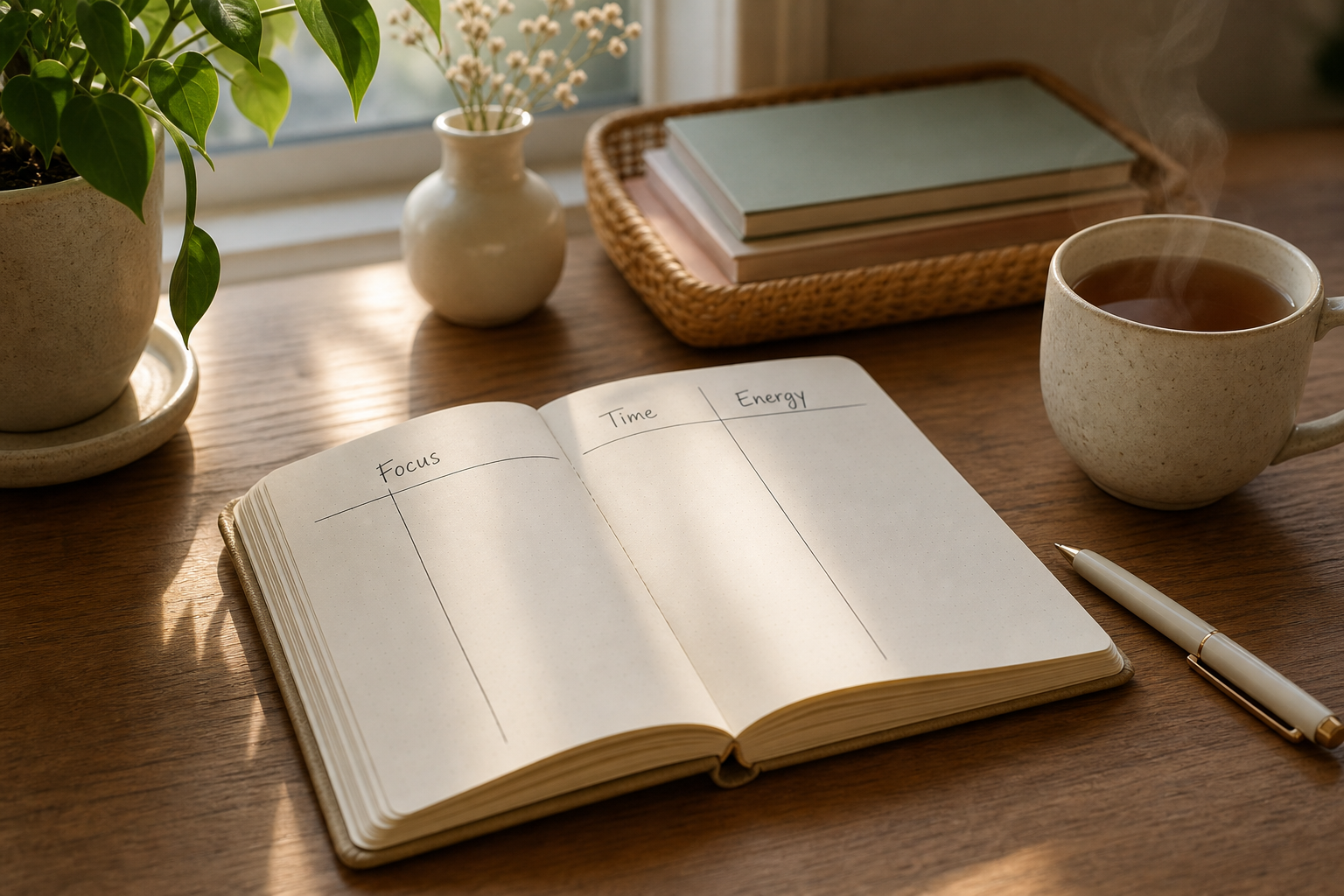
A notebook page with Focus, Time and Energy columns may look almost too simple, but that is the point. Focus asks: what actually matters today? Time asks: where will it live? Energy asks: what state am I bringing to it and what support do I need?
That last column matters. A beautiful plan built on no sleep, poor food, stress and resentment will not feel beautiful inside the body. Cal Newport productivity, filtered through my real life, needs to include the nervous system. It cannot just be about slots and tasks. It has to ask whether the day is humanly possible.
Sometimes the most productive choice is not adding another block. It is removing one. Sometimes it is doing the hard thing first. Sometimes it is accepting that a task needs fresh attention tomorrow rather than the scraps of tonight.
What I am actually going to try
I am taking three experiments from this rather than a whole new system.
First, I want to choose the focus before opening the noise. That means not letting email, messages or random admin decide the emotional weather of the morning before I have chosen what matters.
Second, I want to time block with honesty. Not the fantasy version where I pretend I can write, edit, upload, cook, parent, exercise, reply, learn and rest in the same tiny window. The honest version where I see the limits and make adult choices.
Third, I want to protect transition time. I often forget that finishing one thing and beginning another takes a little landing space. Without that, I drag the previous task into the next one and wonder why I feel tense.
None of this is revolutionary. But that is probably why it might work. The ordinary things are often the things I skip while looking for a more exciting solution.
Practical Takeaways
- 1. Write down what matters before the noise starts.
- 2. Use a small focus ritual. Let the ritual carry you when motivation is absent.
- 3. Time block kindly. A plan is not a prison.
- 4. Close open loops. Capture what keeps shouting in your head.
- 5. Protect deep work from shallow noise. Thinking takes space.
- 6. Decide what “done enough” means.
- 7. Use productivity to serve your life.
Why This Belongs in Purpose
Purpose is not only the big life mission. It is also the way we organise the ordinary days that carry us towards it.
Cal Newport productivity reminds me that focus is a form of care. It is how we make room for the work, the people and the life we say we want.
Notes from Soph | Learning, not perfection.
Et toi? What is one tiny focus ritual that could make your next working day feel calmer? Come and talk about it in the Notes from Soph community on Skool.
Source Details:
The Mel Robbins Podcast, “How to Get Things Done, Stay Focused, and Be More Productive” (feat. Cal Newport)
Mel Robbins | 2025
🎙 Listen on Apple Podcasts or search “The Mel Robbins Podcast” on Spotify
📚 Cal Newport: calnewport.com

