Three Questions to Finally Get Honest About What You Want From Your Life
Mel Robbins “what you really want” questions landed because they made clarity feel practical, not mystical. I have thought I knew what I wanted and then done something that contradicted it entirely. I have given answers to “what do you want?” that were actually answers to “what should I want?” or “what is realistic for someone like me?”. What you really want can be surprisingly hard to hear when fear, duty and old decisions are all speaking at the same time.
Mel Robbins ran this solo episode around three questions drawn from the Stanford life design work of Bill Burnett and Dave Evans, a framework I have spent time with before in the How to Design Your Life episode. But this takes a different angle. Less the full framework, more three specific questions that cut through the noise.
That is what made this episode useful. It did not ask for a perfect five-year plan. It asked for honesty. And honesty is sometimes much more confronting than ambition. Ambition can still perform for other people. Honesty has to admit what is already true.
I also liked that the questions come from life design rather than pure manifestation. There is room for longing, but there is also structure. You are not just asking the universe for a sign. You are looking at the path you are actually on and comparing it with the paths you keep pretending not to see.
Table of Contents
Mel Robbins What You Really Want Is Hard to Hear
Most people do not lack direction because they are lazy or undisciplined. They lack it because clarity is uncomfortable to find.
Getting clear about what you really want means sitting with the gap between where you are and where you want to be. It means confronting what you have been avoiding. It means letting go of the version of yourself that other people expect.
Mel Robbins points out that most of us navigate life on autopilot : not chosen, not examined, just continuing. The path we are on often got started for good reasons that may no longer apply. We are following a script that someone else partly wrote, and we are so close to it that we cannot see it.
The three questions are an attempt to create distance. To step back far enough to see the whole thing, including what you really want when the noise drops.
The uncomfortable part is that confusion can be protective. If I stay vague, I do not have to choose. If I keep saying “I am not sure yet”, I can avoid the risk of wanting something clearly and then having to change something in response.
That is why “what do I want?” is not always the best first question. Sometimes the better first question is “what am I afraid I will have to admit if I let myself know?”. Because often the answer is not hidden. It is buried under practicality, guilt, money fear, family expectations and the desire not to disappoint anyone, including the version of yourself who made earlier choices.
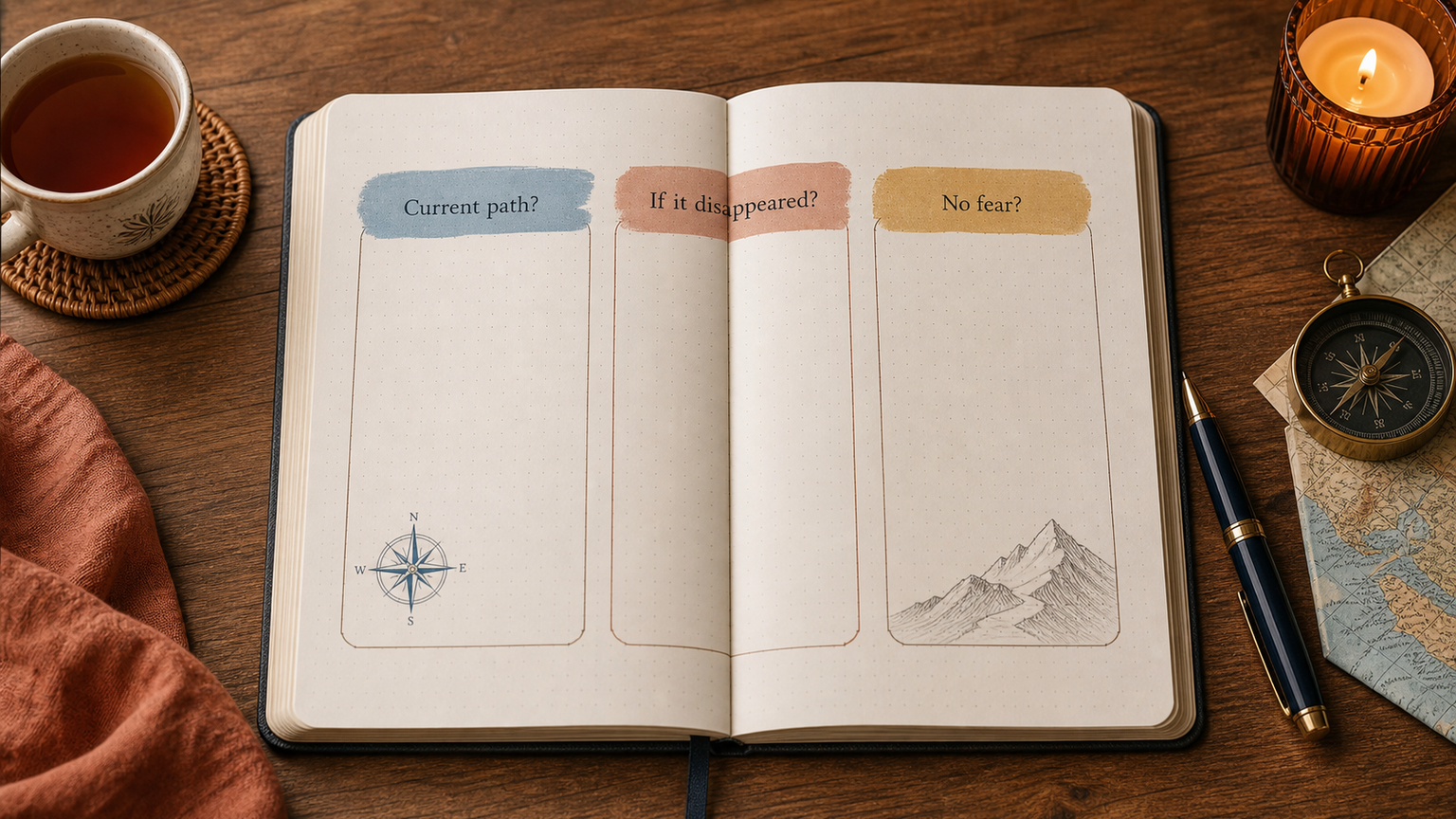
The Three Questions
One. What does your life look like if you stay on this exact path?
Not the idealised version. The honest one. Five years from now, ten years from now, if nothing changes, what actually happens? What does the morning look like? What do the relationships look like? What does the body feel like?
This question is not designed to frighten. It is designed to create honesty. Staying on any path is a choice and most people make it unconsciously.
Two. What would you do if your current path suddenly disappeared?
What if the job ended, the plan failed, the assumed future became unavailable? What would you actually do? Not what you would be forced to do but what you might choose if the path you have been on simply was not there anymore?
This question is often where the buried things surface. The career not pursued, the project not started, the version of yourself that got parked for practical reasons.
Three. What would your life look like if nothing held you back?
No money worry. No fear of what people think. No anxiety about failing. Just what would you actually choose?
This is the wildcard question. The one most people answer with either fantasy or silence – and both the fantasy and the silence are informative.
The first question is a reality check. If I keep doing exactly what I am doing, what compounds? That includes the good things too. Some choices are building a life I genuinely want. Some are slowly building a life I will resent if I refuse to look at them.
The second question is a permission slip. When the current path disappears, you find out what else has been waiting in the wings. I do not think every answer needs to become a plan, but every answer deserves to be heard.
The third question is the most revealing because it removes the socially acceptable excuses. Money, fear, failure, judgement. If none of those held me back, what would I choose? The answer may not be immediately practical, but it tells me what direction feels alive.
The Notes from Soph Version
I sat with these three questions for a long time after listening to this episode in the car.
The current path question was uncomfortable. I could see, honestly, that some things I am building now are fragile in ways I have been avoiding looking at. And some things are stronger than I let myself believe.
The disappears question: I wrote two pages. Things surfaced that I had been politely ignoring.
The nothing-holds-me-back question: the answers were not as outlandish as I expected. A house by the sea. Teaching in a way that genuinely matters. Writing things that help. More time for the people I love. No financial anxiety. None of that is impossible. That observation was useful.
What Mel Robbins emphasises is that the point is not to action all three answers immediately, or to turn what you really want into another pressure project. The point is to get clear. Because clarity is what precedes direction, and direction is what precedes purpose. This connects with what I took from Think and Grow Rich : the idea that definiteness of purpose changes how the brain filters for opportunity. And with Hell Yeah or No which is the practical filter for what to pursue once you know.
What you really want is often quieter than the dramatic life overhaul we imagine. It might be more space. A different kind of work. A home that feels safe. A body with more energy. A creative project that finally gets protected time. More money, not as status, but as breathing room.
The question I am taking with me is: what answer keeps returning when the noise drops? Not the impressive answer, not the sensible answer and not the answer I can justify immediately. The returning answer. That is usually where the signal is.
That is why I do not want to treat these questions as a one-off journaling exercise. They are the sort of questions that need revisiting whenever life starts to feel like it is happening by default. Not to create panic, but to restore authorship.
For me, that makes clarity less like a lightning bolt and more like a weekly practice of telling the truth before life gets too loud again.
Practical Takeaways
- Answer question one honestly. Not the version you are proud of – the version that is actually happening. The present path is a choice, even when it does not feel like one.
- Let question two surprise you. The things that surface when the assumed path disappears are usually things you already knew, you had just decided they were not allowed.
- Do not dismiss question three as fantasy. What you really want often arrives first as something that sounds impractical. The specifics matter. When nothing holds you back, what do you actually choose? That is data about what you genuinely want.
- Write the answers down. All three, one after another. Things you cannot see in your head become visible on paper. The notebook is not optional.
- Notice the gap between your current path and the wildcard path. That gap is not a source of shame. It is a direction of travel.
Why This Belongs in Purpose
Purpose is where I explore how to build a life that means something, not in the grand, abstract sense, but in the everyday sense of making choices that point in the direction I actually want to go. These three questions belong here because they are tools for honest self-examination that create the clarity needed to act with intention.
The Stanford framework that Mel Robbins draws from is not about becoming a different person. It is about knowing yourself well enough to make better choices with the person you already are.
Notes from Soph | Learning, not perfection.
Et toi? Which of the three questions felt most uncomfortable when you tried it? That is probably the most useful one. Come and share in the Notes from Soph community on Skool.
Source Details
The Mel Robbins Podcast – “3 Questions to Ask Yourself to Figure Out What You Really Want” (Episode 339) Mel Robbins | November 2025
🎙 Listen on melrobbins.com or search “The Mel Robbins Podcast” on Apple Podcasts / Spotify

