Things to Tell Yourself Every Night: 7 Mel Robbins Notes for Bedtime
I used to end my days the same way, with no clear things to tell yourself every night except the harshest leftovers from the day. Lying there, running through everything I had not finished, everything I had got wrong, everything I was worried about for the next day. Not intentionally. Just the brain going where it always goes when the lights go out.
I never thought of this as a habit. But Mel Robbins says it is. And she says it is one of the most powerful habits we have because the things we say to ourselves in those final minutes before sleep are landing in a very receptive part of the mind.
There is something very particular about the mind at night. During the day, I can distract myself with logistics. I can move from lunchboxes to work to messages to dinner and pretend the background noise is not there. But at night, when everything goes quiet, the same thoughts become louder. That is why this episode felt less like a motivational trick and more like a small piece of hygiene I had been missing. If I brush my teeth before bed because I do not want yesterday sitting in my mouth, why would I let yesterday’s harshest thoughts sit untreated in my nervous system?
Table of Contents
Why the Last Ten Minutes Before Sleep Matter
The brain shifts into a different state as you drift off. It becomes more open, more receptive, less defended. What you put in during that window: worry, criticism, the replay of bad moments, goes straight in. So does the opposite.
Mel Robbins frames this episode around something simple: most of us use those final ten minutes to mentally replay what went wrong. We go over the argument, the email we should have sent differently, the way we snapped at someone, the things still on the list. We fall asleep in that state. And we wake up already weighed down by it.
But if those ten minutes are so receptive, what if we chose differently?
The important distinction for me is that this is not about pretending the hard parts of the day did not happen. That would never work. My brain would spot the lie immediately. It is about choosing the last voice in the room. If the day contained a mistake, I can acknowledge it without letting it become the final verdict on me. If tomorrow contains pressure, I can name it without mentally living through it three times before I have even slept.
That is a very different kind of positive thinking. It is not glossy. It is not telling yourself everything is perfect. It is saying, kindly and firmly, this day is allowed to end. You are allowed to rest before you fix anything else.
Things to Tell Yourself Every Night
The seven phrases Mel Robbins shares are not affirmations in the glassy-eyed sense. They are more like things you would say to someone you actually care about. Permission slips and reframes, said quietly before sleep. That is why I like the phrase things to tell yourself every night: it makes the practice feel ordinary, repeatable and small enough to use when you are already tired.
I am proud of you for today. Not because everything went perfectly but because you showed up.
You did the best you could with what you had.
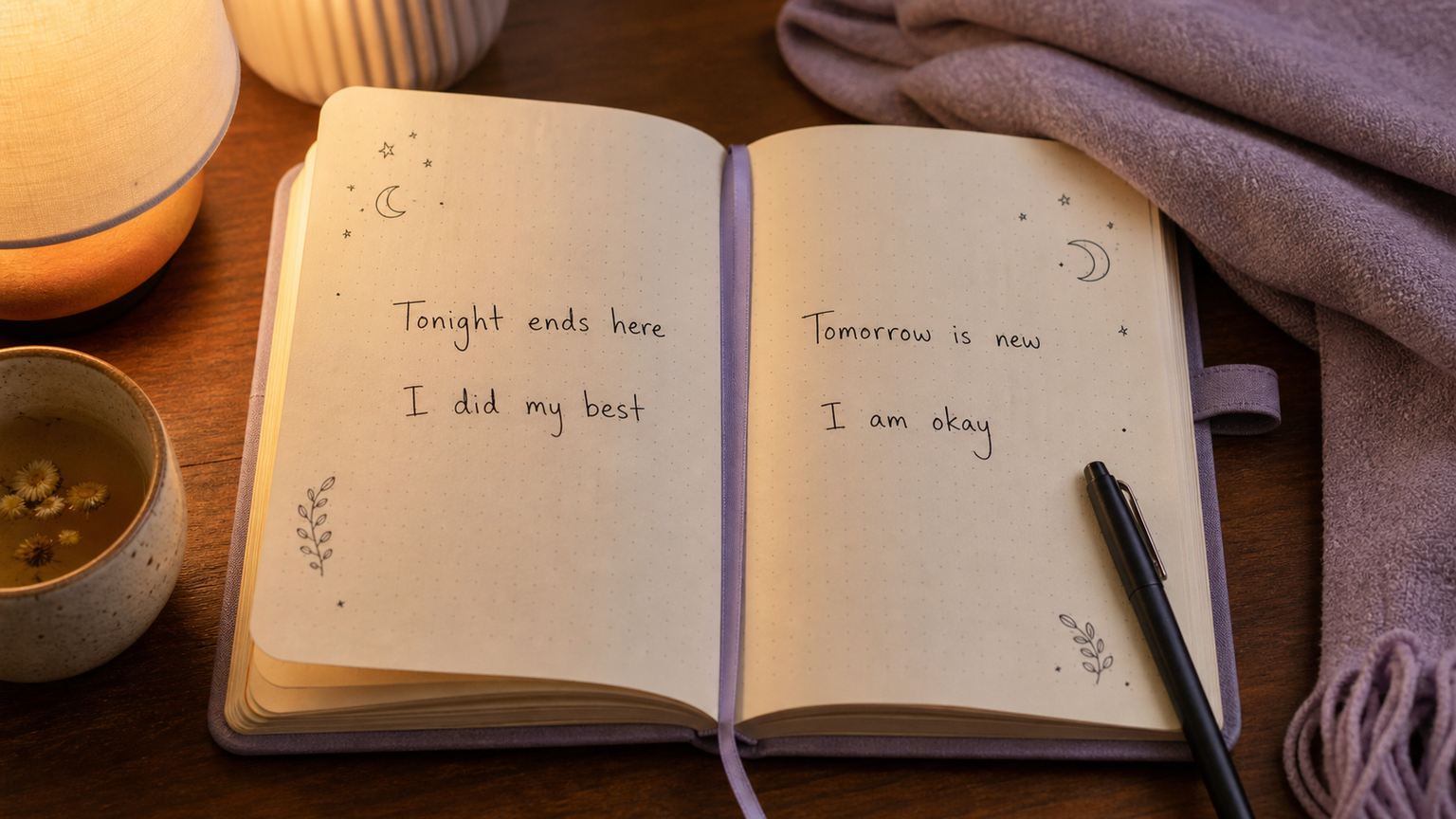
Tomorrow is a new start. Tonight ends here.
I am grateful for one specific thing. Make it real. Not grateful for my family in a vague sweep, but grateful that my daughter laughed at dinner. Specific matters.
I love you. Said to yourself, the way you would say it to a child who was sad and needed to hear it. This one is harder than it sounds.
I am becoming who I want to be. Not arriving. Becoming. The direction matters more than the destination.
I am okay. Right now, in this moment, I am okay.
What I like about these phrases is that they sound almost too simple until you try to say them honestly. “I am proud of you for today” can bring up immediate resistance. Proud of what? The laundry still there? The message unanswered? The moment I lost patience? But that resistance is the point. It shows how conditional the inner voice has become.
I do not think the practice is to force all seven sentences every night like homework. For me, things to tell yourself every night are more useful when they are chosen honestly, not performed perfectly. The useful version is to choose the sentence that feels most unavailable. Some nights it is gratitude because I am stuck in complaint. Some nights it is “I did the best I could” because I am replaying something with a courtroom in my head. Some nights it is simply “I am okay” because the body needs reassurance before the mind can believe anything bigger.
The Notes from Soph Version
I do morning affirmations. I have for years and this practice feels even better since reading The Secret. The core idea in that book is that what you hold in mind consistently shapes what you attract and experience. The morning version has become a real practice for me.
But the evening version? I was leaving those ten minutes to the hamster wheel! The Secret also reinforced that the evening practice is equally as important, maybe more…
What I took from this episode is that it is not just about what you start the day with. It is about the things to tell yourself every night too. The evening is the handover. You are passing something to the sleeping version of yourself. What do you want her to wake up carrying?
The phrase I have started using most is the simplest one. I did the best I could today. Said kindly. Not defensively. Just true. It turns out that is harder than it sounds and more useful than I expected.
The more I sit with it, the more I think the evening version may be the missing half of the morning version. Morning affirmations point me towards the day I want to create. Evening self-talk decides whether I end the day as my own enemy or my own witness.
It also gives me a practical answer for the nights when I cannot switch my brain off. Instead of arguing with every thought, I can give the mind one clear place to land. One sentence repeated with enough warmth can become a boundary: we are not doing the whole trial tonight. We are resting. We can return to the useful part tomorrow.
That matters because sleep is not just recovery for the body. It is also the place where the mind consolidates what it has been rehearsing. If I spend the last ten minutes rehearsing fear, criticism or failure, I should not be surprised when those grooves feel familiar in the morning. The practice is tiny, but the repetition is not.
That is the version I can actually use. Not a perfect routine. Not a long script. Just a small nightly handover: this is what happened, this is what I learned, this is what I am putting down and this is the kind voice I am choosing to fall asleep with.
For now, I am starting with the one sentence that changes the feeling of the room: tonight ends here. It is short enough to remember when I am tired and strong enough to stop the replay loop.
That is also why I keep connecting this back to nervous-system work. If the mind is running anxious loops at night, the job is not to bully it into silence. It is to offer a steadier sentence, the same practical kindness I wrote about in Addicted to Anxiety and The Biology of Belief.
Practical Takeaways
- Choose what goes in during the last ten minutes. The brain is receptive before sleep – that window is either working for you or against you.
- Try one phrase to begin. Things to tell yourself every night do not need to become another performance. Not seven at once. The one that costs most to say is usually the one you need most.
- Make gratitude specific. “I am grateful for the quiet after the kids were in bed” lands differently than a vague nod to being lucky.
- Say it like you mean it to someone you love, because you are. The way you talk to yourself before sleep is a form of care. Or it is not.
- Link the evening to the morning. What you send yourself to sleep with shapes what you wake up feeling. The two are not separate habits. They are the same conversation.
Why This Belongs in Soul
Soul is where I track the inner work: what I am building inside, what I am choosing to believe, what I am telling myself about who I am and what is possible. Evening self-talk sits squarely here because it is not about productivity or plans. It is about the relationship you have with yourself at the end of the day, when no one is watching and there is nothing left to perform.
How you speak to yourself before sleep is one of the quietest and most consistent acts of self-care or self-attack that most of us never examine. This episode made me examine mine.
Notes from Soph | Learning, not perfection.
Et toi? What do you tell yourself before you fall asleep? Do you even notice? Come and share in the Notes from Soph community on Skool.
Source Details
The Mel Robbins Podcast – “7 Things to Tell Yourself Every Night for More Happiness and Positivity” Mel Robbins | 15 June 2026
🎙 Listen on Apple Podcasts or search “The Mel Robbins Podcast” on Apple Podcasts / Spotify

