ADHD Parenting Support: What Barkley Helped Me See Differently
When I asked myself how I would use Russell Barkley’s 12 Principles for Raising a Child with ADHD, my answer was not theoretical. I wrote that I wanted to better understand and parent my three ADHD children. That is not a small sentence. That is the kind of sentence you write when you have already had too many evenings where love is real, but patience has run out before bedtime.
My second answer mattered even more: I must use this because I now understand that my job is being a shepherd. Not an engineer. Not a designer of perfect outcomes. Not the person who can force every brain in this house into a tidy system if I just try hard enough. A shepherd keeps the child safe, finds better conditions and keeps coming back with warmth, even after a hard day.
And when will I use it? In all the situations where I feel at a loss and frustrated with their behaviour. In other words, not in the calm, tidy, notebook version of parenting. In the actual real life version. The shoes by the door, the forgotten homework, the emotional explosion, the repeated instruction, the moment where I can feel the lecture forming in my mouth even though some part of me already knows it will not help.
That is where this book landed for me. ADHD parenting support is not about having one more script. It is about understanding why the old scripts fail.
Table of Contents
ADHD Parenting Support Starts at the Point of Performance
Russell A. Barkley is one of the best-known researchers and clinicians in the ADHD field. In 12 Principles for Raising a Child with ADHD, he gives parents a short, practical guide to what ADHD actually changes in daily family life. His central point is uncomfortable and relieving at the same time: ADHD is not mainly an attention problem. It is a disorder of self-regulation and executive functioning.
That means the difficulty is not simply listening, trying harder or remembering the rule. It is the brain’s ability to pause, hold a goal in mind, manage time, regulate emotion, stay motivated and organise behaviour in the moment. Barkley calls ADHD a disorder of performance, not knowledge. The child may know exactly what they are supposed to do and still not manage to do it when the moment arrives.
This is the part I need tattooed on my parenting brain, frankly. More explaining does not fix a performance gap. More lectures do not create working memory. More moral pressure does not build a missing pause between impulse and action.
Barkley’s line that stayed with me is that effective help happens at the point of performance. Not two hours before in a calm conversation. Not afterwards in a long debrief. At the place and time where the child needs to act. A timer in the child’s hand. A card beside the task. A shoulder touch and one sentence. A visual reminder where the problem happens.
This connects with what I have already learned from How to Talk So Kids Will Listen, but Barkley gives it a neurological spine. Feelings first matters. Less blame matters. But ADHD also needs external structure, because the missing structure cannot always be summoned from inside the child.
The 30% Rule Changed My Expectations
One of Barkley’s most practical ideas is the 30% rule. Children with ADHD often function about 30% behind their chronological age in executive functioning. A ten-year-old may need the self-regulation support of a seven-year-old. A teenager may be bright, articulate and funny, while still needing far more scaffolding than their age suggests.
This is not an insult to the child. It is not lowering expectations. It is matching the support to the actual developmental need.
That distinction matters in a family. Without it, it is very easy to look at a child and think, “You are old enough to know this.” And perhaps they are old enough to know it. But knowing and doing are not the same thing. If working memory, time perception, inhibition and emotional regulation are lagging, then the request may be age-appropriate on paper but too unsupported in practice.
For me, this is where ADHD parenting support becomes less about control and more about design. Not designing the child, but designing the environment. If time is invisible, make time visible. If instructions evaporate, put them on paper. If transitions trigger chaos, plan the transition before everyone is already dysregulated. If a task is too large, make it smaller, then probably smaller again.
I can feel how this changes the atmosphere. “Why can’t you just do it?” becomes “What part of this needs to be outside your head?” That is a very different question. It is less shaming. It is also more useful.
Shepherd, Not Engineer
The phrase “shepherd, not engineer” may be the emotional heart of the book for me. An engineer designs an outcome. A shepherd does not design the sheep. The shepherd protects, guides, finds better pasture, adjusts to the needs of the flock and keeps showing up.
As a parent, I find that both freeing and difficult. Freeing, because it tells me I am not responsible for sculpting each child into a particular shape. Difficult, because it removes the fantasy that if I just discover the perfect method, I can prevent all struggle.
Barkley is not saying parenting does not matter. He is saying it matters differently. It matters as safety, structure, advocacy and relationship. It matters as the environment around a developing nervous system. It matters as the repeated act of creating conditions in which the child can do better.
This links beautifully, and painfully, with what I took from Creative Schools. Children are not identical products moving along a line. They are living beings who need the right conditions to grow. At home, that means I have to keep asking what conditions would help this child right now. More movement? Less verbal instruction? A visible timer? A calmer transition? A smaller step? A parent who stops talking before the lecture becomes fuel for resistance?
I do not always manage this. Obviously. I am writing notes, not sharing expertise. But the shepherd image helps me come back to the right job.
Touch More, Reward More, Talk Less
Principle 7 is probably the one I will need in real life most often: touch more, reward more and talk less. Barkley’s five-step approach is almost embarrassingly simple. Go to the child physically. Touch them gently on the shoulder or arm. Look at them. Say one sentence. Leave with affection.
One sentence. That is the hard bit.
Because when I am frustrated, I want the sentence to become a paragraph. Then a case for the prosecution. Then a moral essay about respect, responsibility and how many times I have already asked. Barkley’s point is that ADHD children are not usually missing the information. They are missing the executive function to perform the information reliably.
Talking more can also create more resistance, especially when oppositional patterns are part of the picture. And don’t I know about ODD! That does not mean there are no boundaries. It means the delivery matters. Fewer words. More physical presence. Clearer expectation. Warmth afterwards, because the relationship must not become one long correction.
The reward piece is also important. Barkley frames rewards as a prosthetic for a real motivational deficit. That is useful, because it takes the moral sting out of it. A reward is not bribery if the child’s internal motivation system genuinely struggles with delayed outcomes. It is support, like glasses for sight or a hearing aid for hearing.
This is where paper, tokens, cards and timers stop feeling childish and start feeling kind. If the ADHD brain needs consequences to be visible, immediate and concrete, then the loving thing is to make them visible, immediate and concrete.
Forgiveness Is Not Optional
The part I did not expect to affect me so much was forgiveness. Barkley does not treat forgiveness as a sentimental closing note. He treats it as a daily necessity. Your child will make mistakes. You will make mistakes. The family will have days where everyone is tired and nobody responds beautifully.
Forgiveness is what stops one hard moment from becoming the whole story.
I found this especially moving because ADHD family life can create so many little ruptures. The repeated reminders. The emotional spikes. The parent guilt. The child shame. The feeling that everyone is trying and somehow the same scene keeps happening anyway.
Barkley’s approach does not pretend this is easy. He names the stress. He says parents need renewal, support and self-care. He also gives small rituals: look at a photo of your child at their best, write down the day’s grievances and let them go, watch your child sleeping and remember their innocence.
That last one sounds almost too soft until you have had the kind of day where you need it.
For me, forgiveness also includes forgiving myself for not having understood sooner. For the times I mistook “can’t” for “won’t”. For the times I used too many words. For the times I expected executive skills that were not available yet. I cannot redo those moments, but I can repair. I can learn. I can come back warmer.
Before the practical notes, a small but important reminder: I am not a doctor or ADHD clinician. These are my personal reading notes and family reflections, not medical advice. If ADHD, medication, behaviour, school support or children’s health are part of your situation, please speak to a qualified professional who knows your child and your context.
Practical Takeaways
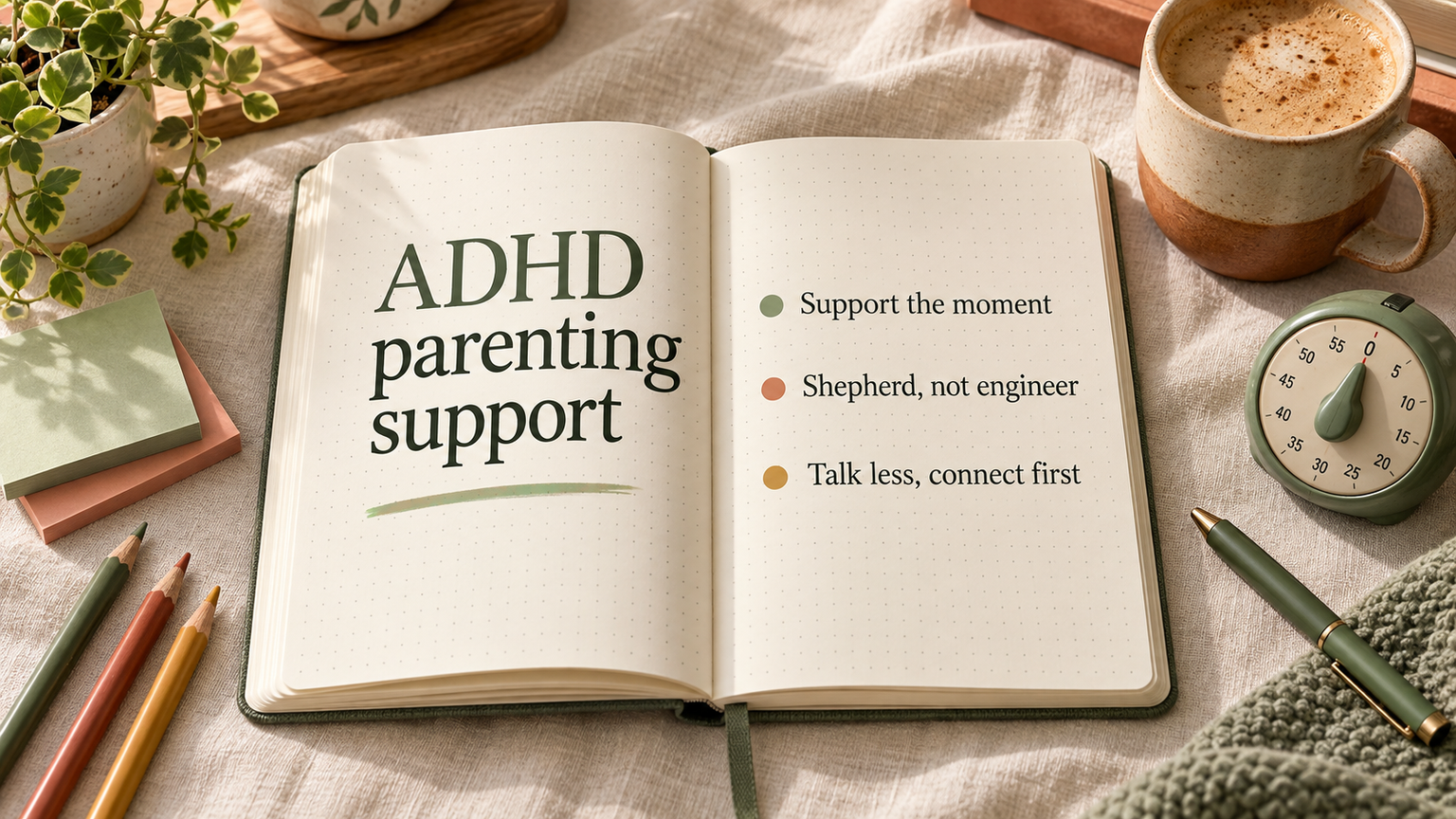
- Support the moment, not only the memory. If the difficulty happens at the shoes, desk, door or bedtime routine, put the support there too.
- Use executive age, not just chronological age. Ask what level of scaffolding this child actually needs, not what their birthday says they should manage alone.
- Talk less at flashpoints. Go to the child, touch their shoulder, use one sentence and leave with warmth. Save the discussion for a calmer moment if it is needed at all.
- Make invisible things visible. Use timers, cards, paper lists, sticky notes, tokens and concrete steps. Paper can be more helpful than another app.
- Practise repair and forgiveness daily. ADHD family life creates many small ruptures. Warmth, apology, letting go and starting again are part of the support system.
Why This Belongs in Heart
This belongs in Heart because it is about how love behaves when daily life gets difficult. It is easy to love your child in the abstract. It is harder to love well in the moment where everyone is dysregulated, the clock is ticking and the same problem has happened again.
Barkley gives me a way to be more practical and more compassionate at the same time. Not softer in the sense of having no expectations. Softer in the sense of seeing the nervous system underneath the behaviour, then building the support around that reality.
The Notes from Soph version is this: my job is not to win every battle. My job is to protect the relationship, create better conditions and help each child practise the next step that is actually possible. Sometimes that will look like structure. Sometimes it will look like silence. Sometimes it will look like a timer, a sticky note or a hand on a shoulder.
And sometimes it will look like forgiving the day, then trying again tomorrow.
Notes from Soph | Learning, not perfection. Soph x
Et toi? If you parent, teach or support a child with ADHD, what helps you move from frustration to support? Come and share your experience in the Notes from Soph community on Skool. I would love to hear what has helped in real life.
Book Details
12 Principles for Raising a Child with ADHD by Russell A. Barkley.
Published by The Guilford Press, 2020. Paperback ISBN 9781462542550.
Disclosure: affiliate link, if you buy through this, I may earn a small commission at no extra cost to you. Thank you!

