Small Moments of Awe: Finding Meaning in Everyday Life
I already write down things I am grateful for. Ten of them, because three did not feel like enough for me. Pen on paper, something specific to notice and a little space before the day starts making demands. So when the subject of small moments of awe comes up, part of me thinks: am I already doing this? Is this gratitude with a slightly grander name?
Dacher Keltner’s conversation with Mel Robbins gave me a useful distinction. Gratitude helps me recognise something good. Awe invites me to encounter something that feels bigger than my usual understanding. There is overlap, of course. But I like the possibility that I do not always need another answer about my life. Sometimes I might need to look beyond the questions I keep asking about myself.
Table of Contents
Who Is Dacher Keltner?
Dr Dacher Keltner is the founding director of the Greater Good Science Center at UC Berkeley and the author of Awe: The New Science of Everyday Wonder and How It Can Transform Your Life. In episode 414 of The Mel Robbins Podcast, he talks about happiness, purpose and our capacity to find beauty even when life feels overwhelming. This post comes from that conversation, not from a claim that I have read his book.
What I appreciate is that he does not discuss wonder as someone untouched by difficulty. He speaks about anxiety and the grief of losing his younger brother. His invitation to notice beauty sits alongside that experience, not above it. That matters to me. I am much more willing to consider a small practice when it is offered as support for real life, rather than proof that I should be feeling better already.
What Small Moments of Awe Actually Mean
Keltner describes awe as an emotion we feel when we encounter something vast and mysterious, something we cannot immediately fit into our existing understanding. His examples include a lightning storm, powerful music and witnessing extraordinary generosity. The vastness does not have to mean physical size. Someone’s courage or kindness can also make our ordinary way of seeing things feel too small.
That helps me avoid calling every pleasant thing awe. A nice cup of coffee can be a pleasure without becoming a profound encounter with existence. We do not need to upgrade every good moment. But a piece of music that makes us wonder how another human being created it, or an act of generosity that changes what we believe people are capable of, might open a different door.
I find this a helpful companion to my notes on Florence Servan-Schreiber’s 3 Kifs par Jour. That book encouraged me to notice specific moments of delight rather than rely on a general gratitude list. Keltner adds another question: did anything take me beyond my usual concerns today? Not every kif will be awe. Both feel worth making room for.
A Little Less Me in the Middle of Everything
In the episode, Keltner explains that awe can quiet activity in the default mode network, which he connects with our self-focused thinking. He describes the mental lists, ambitions and concerns becoming less dominant while we feel part of something larger. I am not a neuroscientist, so I am taking this as his explanation of the research, not turning it into a promise about what one minute outside will do to anyone’s brain.
The everyday version is easier for me to hold. There is a difference between looking at the sky while mentally rehearsing tomorrow and actually looking at the sky. Same person, same place, different attention. The first keeps everything organised around my own concerns. The second allows something else to matter for a moment, without needing to be useful to me.
I do not hear that as an instruction to make myself insignificant. My responsibilities still matter. So do yours. It is more that they do not have to occupy the entire view all the time. I like the idea of being a person within a living world, not simply a person trying to manage a list. There is room for both responsibility and a little wonder.
Not Another Morning Routine to Get Right
When Mel asks how to practise awe, Keltner starts simply: pause, put away devices, open your mind and take a breath. He then suggests possible sources, including nature, music, inspiring people and visual beauty. He does not require everyone to find the same thing moving. That is reassuring, because being told exactly what should amaze me would probably make me resist it.
My version would be to choose one doorway rather than build a programme. Listen to a song without replying to messages. Look at the shape of a tree rather than simply register that there is a tree. Think about someone whose kindness genuinely moves me. These are experiments I can try in the life I already have, without needing to rearrange everything first.
I have written about protecting space for myself in The Hour Before Everything Starts, my reflection on The 5 AM Club. But I would not want awe to become another condition for a successful morning. No early alarm is required here. If a moment catches my attention in the afternoon, I can meet it then. The point is to be available, not perfectly organised.
Walking Without Turning Everything Into a Task
One of the most practical parts of the conversation is Keltner’s description of an awe walk. In the research he discusses, people were encouraged to notice both small details and larger patterns: bark on a tree, clouds across the sky or a raindrop within a storm. They were also invited towards curiosity and places that could awaken childlike wonder. The shift was in how they attended to the walk.
I like the movement between close and wide. It gives me something concrete to try without requiring a special destination. On an ordinary walk, I could notice one small detail, then look at what surrounds it. I do not need to identify the tree or research the cloud. As an eager learner, I need that reminder occasionally. Looking does not always have to turn into studying.
Mel shares her own variation: looking for naturally occurring heart shapes, including in clouds, leaves and marks on the ground. She says her family group chat now includes these finds. That is her practice, not mine, but I understand its appeal. It makes noticing playful. My version could be different, or I could simply leave the phone away and let a moment belong to me without collecting it.
Wonder Is Not a Demand to Be Positive
Keltner discusses research linking awe practices with benefits for wellbeing. I find that encouraging, but a moment of beauty is not a replacement for mental health care, rest or help with difficult circumstances. Nor does failing to feel moved mean that someone has approached the exercise incorrectly.
What feels useful is the permission for two things to be true. A day can be difficult and contain something beautiful. Noticing one does not cancel the other. Towards the end of the episode, Keltner returns to beauty in ordinary people and the world around us while acknowledging hardship. That is a much gentler invitation than insisting that everything is wonderful if we only change our attitude.
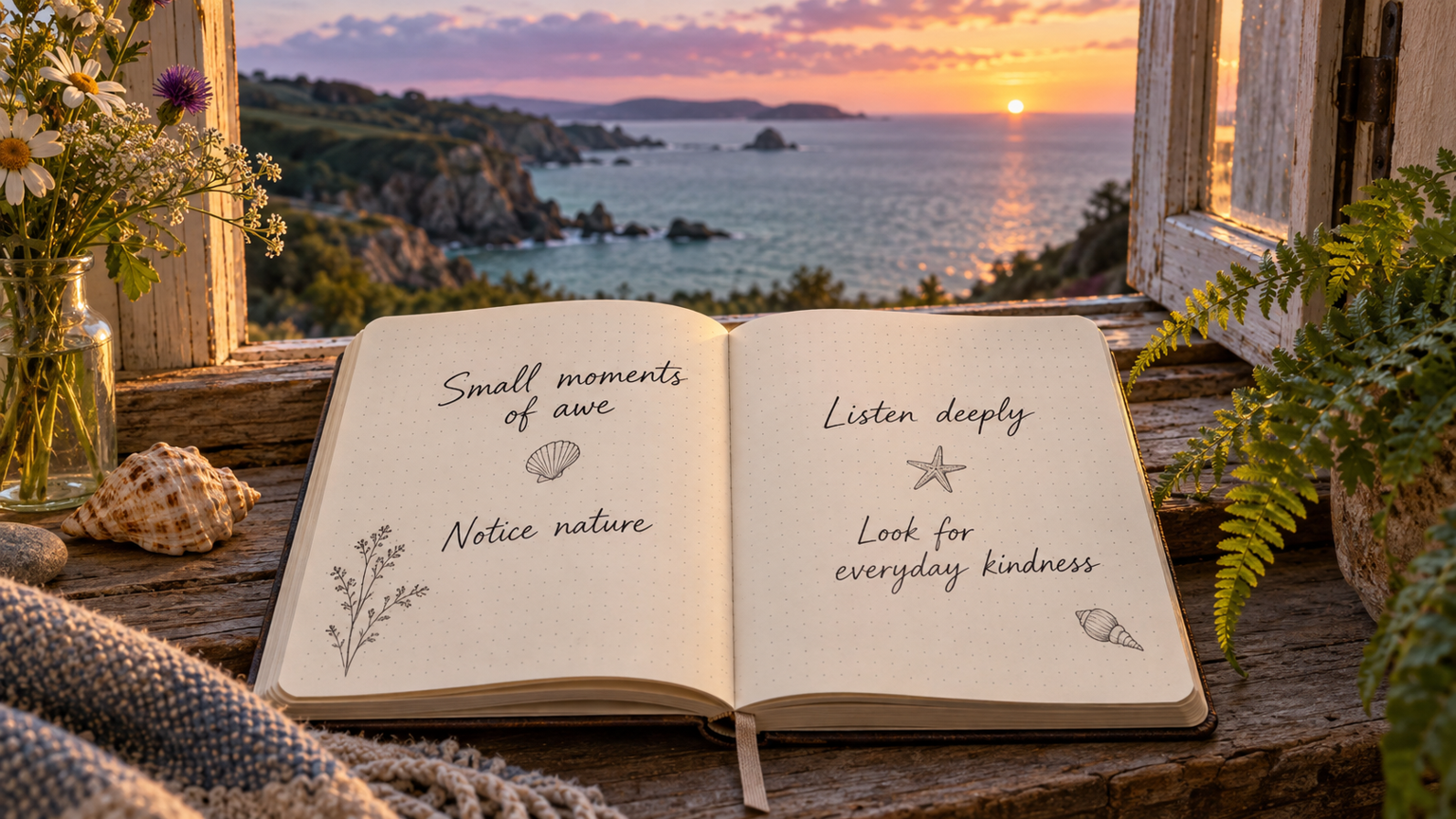
For my notebook, I would keep the question small: what made me pause today? If the answer is nothing, I do not need to manufacture a meaningful paragraph. Perhaps I was tired. Perhaps I was busy. Perhaps tomorrow I will notice something different. Learning, not perfection, applies to this too. Especially to this, actually, because wonder sounds much less inviting when it becomes a performance.
Practical Takeaways
- Choose one possible source. Try music, the sky, art or the memory of someone whose actions inspire you. Start with something that genuinely interests you rather than something you think should.
- Give it your attention briefly. Put the phone aside and allow a little space. Keltner suggests a minute of awe practice, but I would treat that as an invitation to pause, not a timer that must produce an emotion.
- Look close, then look wider. On a walk, notice a small detail and then the larger scene around it. Stay curious rather than searching for something impressive enough to count.
- Let people be part of it. Awe is not limited to landscapes. Someone’s generosity or courage might remind you that human beings are capable of more than the headlines suggest.
- Write one honest sentence if it helps. My adaptation is: “Today I paused when…” No score, no streak and no requirement to find a life lesson. The noticing comes first; the notebook is optional.
Why This Belongs in Soul
Soul, in my Tree of Life, is where I put questions about meaning and the inner life that supports everything else. Small moments of awe belong here because they ask something different from productivity. They do not ask how much I finished. They ask whether I was present enough to encounter something beyond the things I was trying to finish.
The wider conversation connects purpose with something larger than the self. I am not expecting a cloud or a song to tell me what to do with my life. But noticing what moves me might help me understand what I care about. Beauty, kindness and curiosity are not a complete life plan. They can still be useful clues about what deserves more space in it.
That is what I want to take from this: less pressure to find a spectacular revelation, more willingness to notice an ordinary opening. I can keep my gratitude notebook and leave a little room for surprise. Merci, Dacher. Not for another thing to get right, but for a different question to carry into the day.
Notes from Soph | Learning, not perfection. Soph x
Et toi? What makes you pause for a moment: music, nature or something quietly wonderful that another person does? Come and share one small moment in the Notes from Soph community on Skool. I would love to hear what you notice.
Source Details
The Mel Robbins Podcast, episode 414, “Feeling Lost or Behind in Life? The #1 Happiness Expert Explains How to Find Your Purpose”, with Dr Dacher Keltner, published 13 July 2026. Official episode and transcript. Main passages used: 36:59–47:40 on awe and practice, 58:21–01:01:41 on awe walks and 01:01:41 onwards on everyday beauty. The official page’s 47:40–58:21 transcript chapter is blank, so this reflection does not cover that exercise.

