Perimenopause and SIBO: What Nearly Six Months Changed
Perimenopause and SIBO became connected in my own life when I read a book written by a doctor I was about to meet.
It is a rather strange experience. You arrive at the appointment already knowing how this person thinks, what he notices and what he is likely to recommend. In my case, I had read Hormones, arrêtez de vous gâcher la vie ! by Dr Vincent Renaud and Véronique Liesse before meeting Dr Renaud as the functional doctor I hoped might finally help me make sense of my perimenopause symptoms.
The book made me feel both informed and slightly apprehensive.
At the time I was following strict keto. The book strongly supports the importance of protein and explains why fats and cholesterol matter for hormone production, which fitted well with much of what I had already learned. But its natural remedies are also very plant based. It recommends foods such as legumes, soya and certain grains that I am not comfortable adding to my own diet because of the way I currently approach lectins, oxalates and blood sugar.
Table of Contents
I was also disappointed that hormone replacement therapy, or HRT, was not properly part of the conversation in the book. After reading Hormone Repair Manual and Menopausing, I had hoped that meeting a doctor who understood hormones might lead to a treatment recommendation for the symptoms that were making parts of every month feel almost unmanageable.
Still, I keep an open mind. I also prefer, where possible, to put as little unnatural stuff into my body as I can. So I decided to try his approach properly before deciding what I thought of it.
Nearly six months later, the honest answer is not a neat yes or no.
Who Wrote Hormones, arrêtez de vous gâcher la vie !?
Dr Vincent Renaud is a doctor and nutritionist who practises and teaches functional and micronutritional medicine. Véronique Liesse is a dietitian and nutritionist who specialises in the microbiome. Their book presents hormones as an interconnected system rather than a collection of isolated numbers on a blood test.
The image they use is an orchestra. Each hormone has its own instrument and timing but the music only works when the whole group is in balance. Thyroid hormones, cortisol, insulin, progesterone, oestrogen, testosterone and DHEA do not operate in separate rooms. Stress can affect sleep. Sleep can affect appetite and energy. Digestion and nutrient absorption can affect the raw materials the body has available. One struggling section can change the sound of the entire orchestra.
That systems view is what attracted me to functional medicine in the first place. I did not want another appointment where each symptom was treated as an unrelated inconvenience. I wanted someone to look at the pattern.
The authors explain that hormones influence metabolism, mood, sleep, muscle, bones, reproduction and much more. They also offer questionnaires, nutritional guidance and natural ways of supporting different parts of the hormonal system. The current French edition and author information are available from Éditions Leduc.
The Hormone Lesson That Made the Whole Book Click
The clearest lesson for me was that hormones are built through a cascade. Cholesterol is not simply the villain it has often been made out to be. It is a starting material for steroid hormones including cortisol, progesterone, oestrogen and testosterone.
The book explains how chronic stress can push more of the body’s resources towards cortisol. Whether or not every popular explanation of this process is perfectly phrased, the practical point made sense to me: a body under constant pressure is not working with the same priorities as a body that feels safe, rested and well nourished.
The sections on progesterone were particularly relevant. Progesterone tends to fall during perimenopause and it is connected with calm, sleep and the second half of the menstrual cycle. That helped give me language for a pattern I already knew very well. I can feel relatively steady, then reach the luteal phase and feel as though I am turning absolutely mental. During my menstrual phase, the mood volatility eases but I can become deeply lethargic.
Those experiences are not small changes in attitude. They affect how capable I feel, how I react and how much energy I have for normal family life. Understanding a possible mechanism is reassuring because it moves the question away from “What is wrong with me?” towards “What is happening in my body at this point in the cycle?”
Understanding is not the same as resolving it, though. That distinction has become very important in my experience of this book and the treatment that followed.
Where the Book Agreed With My Keto Approach
I expected a largely plant-based book to clash with strict keto from the first page, but it was more nuanced than that.
The authors repeatedly stress the importance of adequate protein. Amino acids are needed to make neurotransmitters and support many of the processes behind energy, motivation and mood. They also tell readers not to fear good fats or cholesterol, because the body needs them as building materials. Eggs, quality meat, oily fish, olive oil and micronutrients such as magnesium, zinc, selenium and B vitamins all have a place in the wider picture.
That reinforced choices I was already making. Keto had already taught me to take protein, fats, electrolytes and blood sugar stability seriously. I did not need persuading to remove refined carbohydrates or to stop treating dietary fat as the enemy.
Where I remain uncomfortable is with some of the plant recommendations. Legumes, soya, oats and other foods may work perfectly well for many people, but I am not ready to reintroduce something simply because it appears on a general list of natural hormone support. “Natural” does not automatically mean right for every body.
I took the principles rather than copying every food recommendation: eat enough protein, give the body the nutrients it needs, care for the microbiome and pay attention to the whole system. That felt more intelligent than turning the book into another rigid protocol.
The Missing HRT Conversation
My biggest disappointment was what the book did not explore. It gives detailed explanations of female hormones and perimenopause, yet HRT was not presented as a meaningful part of the treatment conversation I was hoping to have.
I understand the book’s purpose. It is explicitly focused on nutrition, micronutrition, plants and lifestyle. Those options interest me too. But when someone is struggling badly with cyclical mood and energy symptoms, I do not think natural support and medical treatment need to be opposing camps.
The NHS guidance on treatment for menopause and perimenopause explains that HRT is one option for managing symptoms, alongside non-hormonal treatments and lifestyle support. It is an individual medical decision with benefits, risks and contraindications to discuss with a qualified clinician. I am not arguing that everyone should take it. I wanted it to be part of an informed conversation rather than missing from the room.
This is where Hormones sits differently from Hormone Repair Manual and Menopausing. Those books made me feel more prepared to ask about HRT. This one made me more prepared to ask about thyroid function, cortisol, micronutrients, the microbiome and the interactions between them. I value both lenses. I am simply not convinced one replaces the other.
What Happened When I Met the Doctor Behind the Book
Despite my reservations, I came out of my appointment feeling confident that Dr Renaud could help me. He diagnosed me with SIBO and prescribed a six-month programme of plant-based supplements from two different laboratories. The full prescription cost about €700.
That is a substantial amount of money and six months is a substantial commitment. I followed it because I wanted to give the process a fair chance, not take it for three weeks and declare that functional medicine did or did not work.
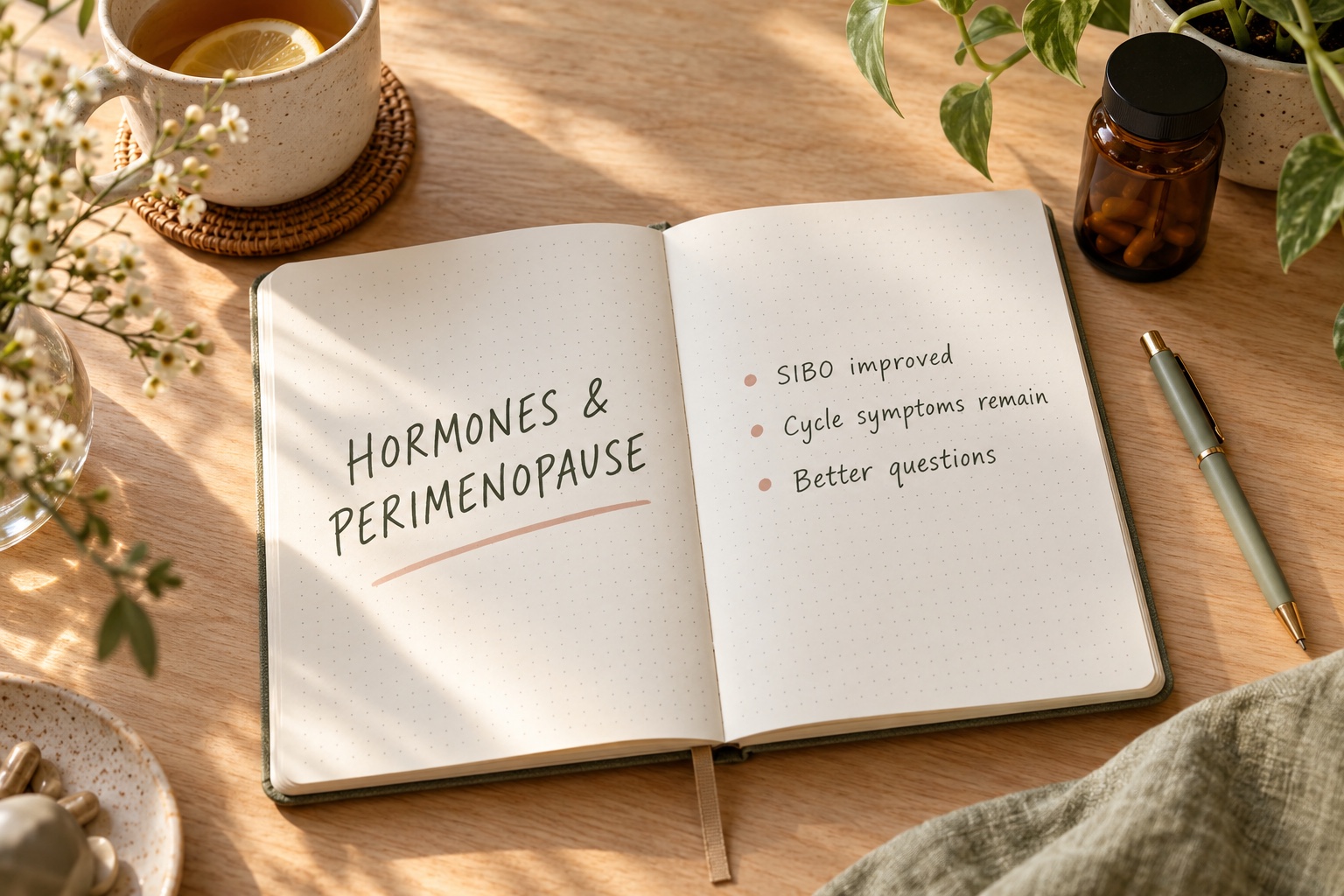
As I write this, I have about two weeks left. On the SIBO and digestive side, I am rather happy. My bowel movements have improved massively. That is a real change in normal daily life and I do not want to understate it simply because the outcome was not the one I initially went looking for.
On the hormonal side, I am much less convinced. I still experience severe emotional volatility during the luteal phase and marked lethargy during my menstrual phase. Nearly six months of the protocol has not made me feel that my perimenopause symptoms are properly under control. Actually, I do not think they have improved at all.
It would be easy to force this into one conclusion. Either the protocol worked or it did not. But I know that real bodies are messier. My digestion improved considerably. My cyclical hormonal symptoms did not improve enough for me to feel satisfied. Both things can be true.
That is why perimenopause and SIBO cannot be reduced to one tidy verdict in my experience: the same functional medicine programme helped one set of symptoms far more than the other.
It is also important to say that this is one person’s experience, not evidence that the same protocol will or will not work for someone else. SIBO, menstrual symptoms and perimenopause deserve proper clinical assessment. Supplements can interact with medicines and “plant based” does not mean risk free.
What I Think Now About Perimenopause and SIBO
I have not lost faith in functional medicine. If anything, the improvement in my digestion confirmed the value of looking beyond isolated symptoms and paying attention to the microbiome. Perimenopause and SIBO have made me more precise about what has changed and what still needs attention. I am grateful that something tangible has changed after months of effort.
But I am also less willing to let one medical philosophy claim the whole answer. I can prefer natural interventions and still ask about HRT. I am particularly interested in discussing body-identical options with a qualified clinician rather than dismissing all HRT as somehow unnatural. I can appreciate a doctor and still question an omission in his book. I can complete a protocol faithfully and still say that it did not solve the problem that matters most to me. Well, actually both mattered dearly to me but having lived all my life with microbiome problems made it somehow a part of me that I was willing to put to one side. Now that it is better, what was I thinking?!
That is probably the real lesson I am taking from Hormones, arrêtez de vous gâcher la vie !. Keep the orchestra in view but listen carefully to the instrument that is still out of tune.
My next conversation needs to start there.
This post shares my personal reading notes and experience, not medical advice. Please speak to a qualified health professional before changing medication, supplements, diet or treatment, especially if you have symptoms or a diagnosis.
Practical Takeaways
- Track symptoms across the whole cycle. Mood, energy, sleep, digestion and concentration can reveal a pattern that a general “How have you been?” cannot.
- Treat food advice as individual, not universal. I kept the book’s emphasis on protein, good fats and micronutrients without automatically adopting every recommendation for legumes, soya or grains.
- Judge a protocol by more than one outcome. My digestion improved substantially while my cyclical mood and energy symptoms remained. A useful treatment can still be incomplete.
- Ask what is missing from the treatment conversation. Natural approaches and HRT do not have to be ideological opposites. The right options depend on the person and should be discussed with an appropriately qualified clinician.
- Give a planned treatment enough time, then reassess honestly. Nearly six months gave me far more useful information than a quick trial would have done. It also gave me permission to ask what comes next.
Why This Belongs in Body
Body is where I try to understand what my physical self is telling me without turning every symptom into a personal failure.
This book belongs here because hormones are not a small specialist subject. They touch sleep, digestion, energy, mood, muscle, metabolism and the ability to feel like yourself. The most useful health books do not hand me a perfect answer. They help me ask better questions and notice more clearly what actually changes when I try something.
My functional medicine experiment has not given me the ending I expected. It has given me better digestion, a more precise understanding of my cycle and a clearer sense of the medical conversation I still need to have. That is not everything, but it is not nothing either.
Notes from Soph | Learning, not perfection.
Et toi? Have you ever tried a treatment that helped one part of your health but left the problem you cared about most untouched? Come and share your experience inside the Notes from Soph community on Skool.
Book Details
Hormones, arrêtez de vous gâcher la vie ! Le programme 100 % naturel pour rétablir votre équilibre by Dr Vincent Renaud and Véronique Liesse. Éditions Leduc. First published in 2019; updated French edition published in 2025.
Amazon UK: Hormones, arrêtez de vous gâcher la vie ! by Dr Vincent Renaud and Véronique Liesse
Disclosure: this is an affiliate link. If you buy through it, I may earn a small commission at no extra cost to you.

