I Read the Most Famous Self-Help Book 35 Years Late. Here’s What Hit Me.
Let me just say it: I read Stephen Covey’s The 7 Habits of Highly Effective People in 2025.
The book was published in 1989. I was nine years old. It has sold over 40 million copies. It is arguably the most-read personal development book of all time. And I got to it thirty-five years later, slightly sheepish, carrying a stack of other books I’d read first and wondering what I’d missed.
Quite a lot, as it turns out. And also – maybe – nothing. Because I’m not sure I would have been ready for it sooner.
Table of Contents
Who Is Stephen Covey?
Stephen Covey was an American educator, author, and businessman. He wrote this book in 1989 and spent the rest of his life teaching its principles to organisations and individuals around the world.
What makes the book different – and what has made it last – is that Covey is not selling productivity hacks. He is not giving you a morning routine or a five-step shortcut. He is arguing something much more uncomfortable: that sustainable effectiveness comes from character. From who you actually are, not from how you come across.
He calls it character ethics versus personality ethics. Character ethics is the slow work – building your values, your integrity, your self-awareness. Personality ethics is the shortcut – the script, the technique, the impression management.
The world is full of personality ethics books. This one goes deeper. That’s why it’s still here.
The Private Victory First
Stephen Covey structures the seven habits as a progression. You can’t build good relationships (the Public Victory, habits 4–6) on a shaky foundation. So the first three habits are about winning the battle with yourself first.
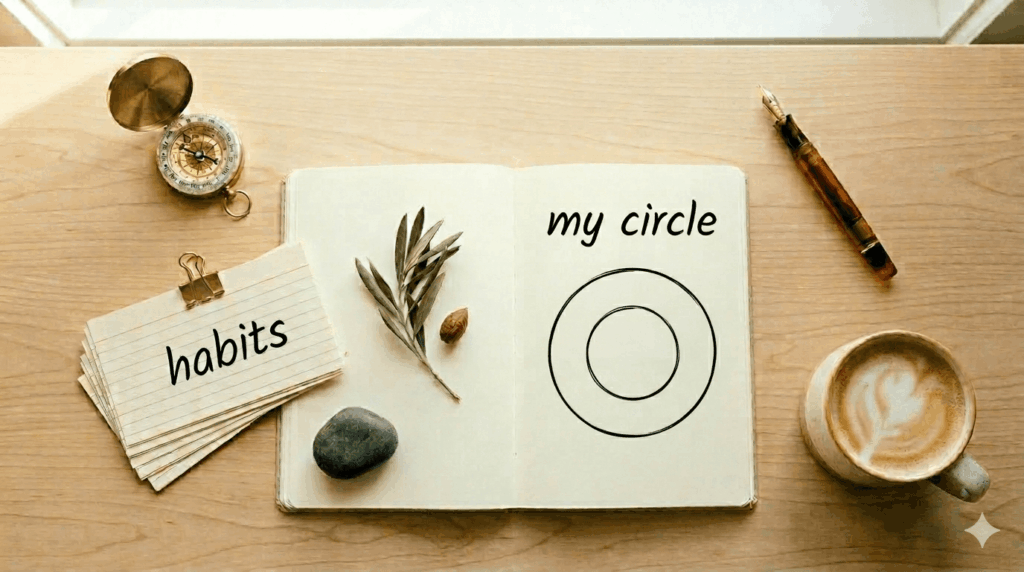
Habit 1: Be Proactive. You are not your circumstances. You are your response to your circumstances. Covey introduces two circles: the Circle of Concern (everything you worry about) and the Circle of Influence (what you can actually affect). Proactive people put their energy into the circle of influence. Reactive people pour their energy into the circle of concern – and slowly shrink their influence as a result.
I sat with this one for a long time. I spent years frustrated by things I could not change – a system that didn’t recognise my qualifications, an institution that moved at its own pace regardless of what I did, other people’s choices. All Circle of Concern. All energy I could have redirected. This habit is not a cure. But it is a compass.
Habit 2: Begin With the End in Mind. Know where you’re going before you start moving. Covey’s exercise here is memorable – he asks you to imagine your own funeral and think about what you want people to say about you. That, he argues, is your mission statement, written backwards.
I’ve done this work in different forms – my manifestation journal, my vision board, the values work I’ve been doing for a couple of years now. This habit validated all of it. The instinct was right. It just needed the framework.
Habit 3: Put First Things First. This is the one that stopped me cold.
Stephen Covey presents a time management matrix with four quadrants. Quadrant 1: urgent and important – crises, deadlines, fires. Quadrant 2: not urgent but important – planning, relationships, developing yourself, building something. Quadrant 3: urgent but not important – other people’s interruptions, most notifications. Quadrant 4: not urgent, not important – scrolling, passive distraction.
Most of us bounce between Quadrant 1 (fires) and Quadrant 4 (numbness). The secret, Covey says, is Quadrant 2.
Here’s the thing about Quadrant 2: nothing puts you there. There is no deadline. There is no alarm. Nobody will chase you for it. You have to choose it, deliberately, against the pull of everything else.
Notes from Soph lives in Quadrant 2. Full stop.
Building this blog, writing these posts, developing an online business I can work from anywhere – none of it is urgent. All of it is important. And if I don’t protect time for it actively, it simply won’t happen. Not because I failed, but because urgent things will always crowd it out if I let them.
This framework is now how I think about my week.
The NVC Moment
Habit 5: Seek First to Understand, Then to Be Understood.
If you’ve read my post on Non-Violent Communication, you’ll feel this one immediately. Covey argues that most of us listen to respond, not to understand. We’re already formulating our reply while the other person is still talking. Empathic listening – really hearing someone before speaking – is rare. And transformative.
This is Covey coming at NVC from a different direction. Same destination. The moment I read this chapter, I thought: there it is again. The same truth, wrapped differently. That’s how you know something is true – it keeps showing up. And the more I read self-help books, the more I love seeing these connections. It’s like revisiting important points with a slightly different angle. You know, same, same but different!
Sharpen the Saw – And Why I’ve Been Doing This All Along
Habit 7: Sharpen the Saw.
The metaphor: if you’ve been sawing for hours and the saw is blunt, stopping to sharpen it is not laziness – it’s how you actually get the tree down. Renewal is not a reward after the work. Renewal is the work.
Covey identifies four dimensions of renewal: physical (exercise, nutrition, rest), social and emotional (relationships, service to others), mental (reading, writing, learning), and spiritual (values, contemplation, whatever connects you to something larger).
I’ve been doing this for five years. The keto, the fitness, the reading, the journaling, the EFT tapping, the NVC, the MindfulSouls practice – all of it. I just didn’t have a word for it.
Sharpening the saw. That’s what it’s been.
There is something quietly satisfying about reading a book and discovering you’ve been living one of its central principles without realising it. Not perfectly – Far from it, trust me! – but intentionally. The saw is sharper than it was. I’m still working on it.
The Three I Come Back To
If I’m honest, three habits have become part of how I actually think now:
Habit 1 – Be Proactive. When I feel stuck or frustrated, I ask myself: is this in my Circle of Influence? If not, I try to redirect the energy. (I said try. I’m still figuring it out.)
Habit 3 – Put First Things First. Quadrant 2 planning is now a weekly practice. I ask: what’s important but not urgent this week? That’s where I start.
Habit 7 – Sharpen the Saw. I protect the renewal time. Reading, movement, stillness. Not as a treat. As infrastructure.
The other four habits are not less important – but these three are the ones I return to most.
Practical Takeaways
- Draw your two circles. What’s in your Circle of Concern that you’ve been giving energy to, but actually can’t change? Name it. Then ask: what can I influence?
- Try the funeral exercise. It’s uncomfortable. Do it anyway. What do you want people to say? That’s your mission, backwards.
- Map your last week against the four quadrants. Where did your time actually go? Where do you want it to go?
- Block Quadrant 2 time in your calendar this week. Even one hour. Nothing will book it for you.
- Think about your own version of sharpening the saw. Are you renewing across all four dimensions – physical, emotional, mental, spiritual? Which one is most neglected?
Why This Belongs in Purpose
This is the third post in what has quietly become a trilogy for me.
First: questioning hustle culture and what we think effectiveness looks like. Then: choosing your purpose deliberately, rather than inheriting it by default. And now: the practical framework for living that chosen purpose – with integrity, with clarity about where you put your time, and with the discipline to actually renew yourself so you can keep going.
Covey sits at the intersection of all three. He is not asking you to hustle harder. He is asking you to be clearer – about who you are, what you stand for, and where your energy actually goes.
That’s purpose work. That’s why this book belongs here.
Forty million copies. Thirty-five years after publication. Still being read, still being cited, still being argued about.
I used to think reading a classic late meant you’d missed something. I’m not sure that’s true anymore. Maybe I needed all the other reading first – the neuroscience, the NVC, the habit research, the spiritual practice – to really hear what Covey was saying.
Or maybe some books just find you when you’re ready. Turns out I was ready.
Et toi? Have you read it? Did a particular habit land harder than the others? I’d love to know which one – leave a comment or come and find me in the Notes from Soph community on Skool. That is where I want to build those conversations.
Notes from Soph | Learning, not perfection.
If this resonated, you might also enjoy my posts on Non-Violent Communication and on habit stacking with James Clear’s Atomic Habits – both living in the same space as this one: the slow, imperfect, very worthwhile work of building a life you actually chose.
And if you haven’t read The 7 Habits yet – no shame. Pick it up. It’ll find you when you’re ready.
Book Details:
The 7 Habits of Highly Effective People – Stephen Covey
Published 1989 | Simon & Schuster (30th Anniversary Edition available)
📚 Amazon https://www.amazon.co.uk/dp/1471195201/?tag=websitenote0f-21
🎧 Audible https://www.audible.co.uk/pd/The-7-Habits-of-Highly-Effective-People-Audiobook/B004FTLW1I
Disclosure: affiliate links – if you buy through these, I earn a small commission at no extra cost to you. Thank you!

