La Routine des Audacieux: The Body Notes I’m Actually Taking From This French Book
La Routine des Audacieux by David Nicolas is the kind of book that makes health feel less like a personality transplant and more like a return to common sense.
It is one of those French personal development books that could easily become intense if you tried to do everything at once. Morning light, cold showers, breathwork, fasting, movement, sleep rituals, nutrition, deep work, sauna, reviews, goals. It is a lot.
But what I am taking from it is much simpler.
Not a perfect routine. Not a biohacker checklist. Not another reason to feel behind before 8am.
More like this: my body is not separate from my energy, focus, hormones, mood or patience. If I want to feel steadier in my day, especially as a mum, teacher, lifter and person trying to build something meaningful, I need to stop treating sleep, food and movement as optional extras.
This post is my Body category version of La Routine des Audacieux. Not a full summary. Just the practical notes I would actually use.
Table of Contents
La Routine des Audacieux: Your Body Likes Rhythm
The phrase that stayed with me from the notes is that we are still, deep down, hunter gatherers in modern clothes.
David Nicolas comes back to this idea again and again. We live in comfort, abundance and constant stimulation, but the body still responds to very old signals: light, darkness, movement, hunger, rest, heat, cold, touch, breath and food that looks like food.
That is the lens I found most useful.
Instead of asking, “What is the most optimised protocol?” I am asking:
What signal am I sending my body?
When I wake up and look at my phone indoors, that is a signal.
When I go outside for two minutes of morning light, that is a signal.
When I eat in front of my laptop, that is a signal.
When I sit on the floor, lift heavy, walk after lunch or make the bedroom dark and cool, those are signals too.
I like this because it makes health feel less like a moral test and more like communication. Le corps écoute: the body is listening.
Morning Rhythm: Water, Light and One Tiny Win
The morning routine section could become a whole project on its own, but the bits I am taking are very small.
First: water.
After a night of sleep, the body is naturally dehydrated. The book suggests starting the day with a large glass of filtered water, with a pinch of salt for sodium balance. For someone doing keto, this immediately makes sense to me because electrolytes are not a tiny detail. They can be the difference between feeling clear and feeling oddly flat.
Second: morning light.
David Nicolas explains the morning light habit as a way of helping the body set its clock. Cortisol rises in the morning to help us wake and around 12 to 14 hours later, melatonin prepares the body for sleep. The practical suggestion is simple: go outside for 2 minutes within 2 hours of sunrise, or about 10 minutes if it is cloudy.
This is the kind of habit I can imagine actually doing. Not a huge wellness ceremony. Just stepping outside with my water, maybe before the school chaos fully begins, even if I am still in a cardigan and not quite ready for the day.
Third: delay the coffee.
The book suggests waiting 90 to 120 minutes after waking before having caffeine. I can see the logic and it sits perfectly with my 5am club routine. If my body is already trying to wake itself, maybe I do not need to jump in immediately with coffee and then wonder why my energy feels strange later.
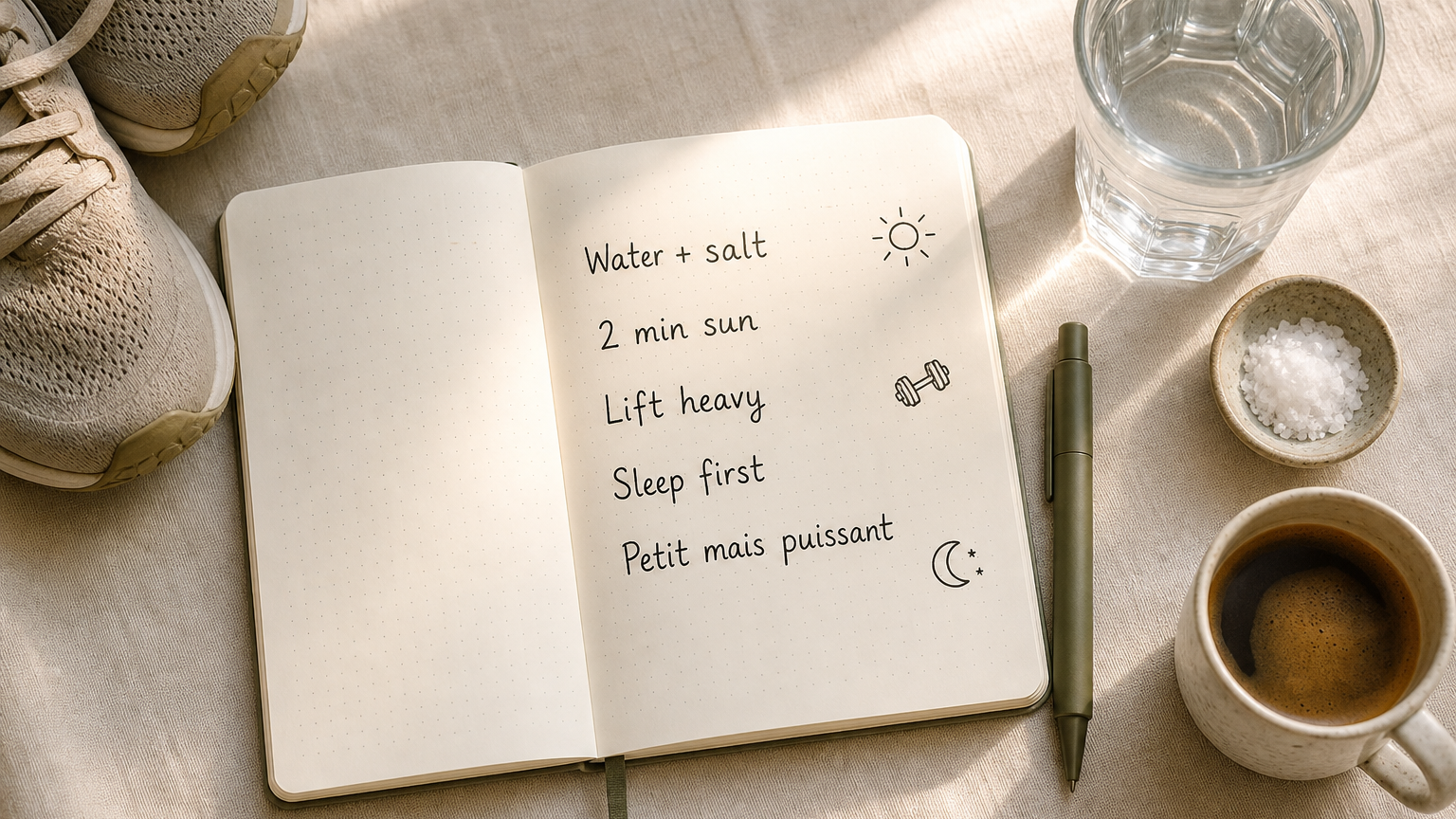
My realistic morning routine from this book would be:
- Move my joints
- Water with a pinch of salt
- Two minutes outside
- Coffee later, not instantly
That is enough. Petit mais puissant.
Food: Keep It Real and Do Not Overcomplicate It
The nutrition section of La Routine des Audacieux is full of strong claims and protocols, but the principle I liked most was beautifully simple:
If it does not run, swim or grow, do not eat it.
That line is easy to remember. It is not about perfection, it is about direction.
For my own strict keto life, I am not reading this as “add lots of new foods” or “change everything again”. I am reading it as a reminder to keep meals based on real food: meat, fish, eggs, good fats and the vegetables that work for me.
A few food notes stood out.
The book talks about digestion beginning before the food even reaches the stomach. Sit down. Slow down. Chew properly. Do not eat in front of a screen. Take 20 minutes if you can.
I needed that reminder because it is very easy to make a perfect keto plate and then eat it like a stressed raccoon between tasks.
The book also suggests starting meals with protein or raw vegetables to support blood sugar, then walking for 10 minutes after eating. I already care about blood sugar because of keto – Jessie Inchauspé’s Glucose Revolution goes deep on the science of this – but La Routine des Audacieux gives me a more relaxed everyday frame. It does not have to be complicated. Eat protein. Walk a little. Let the legs do their job.
There are also notes on olive oil, bone broth, omega 3, organ meats and avoiding ultra processed food. I am taking these as “foundations to return to”, not a shopping list to complete by Friday.
What I am taking from the nutrition section:
- Keep food simple and recognisable
- Prioritise protein and minerals
- Remember electrolytes, especially with keto
- Eat without screens when possible
- Walk after meals when life allows
- Do not make fasting dogmatic, especially around training and perimenopause!
That last point matters. The notes mention intermittent fasting and 16:8, but also adapting the fasting window around intense morning training. I like that. Health advice becomes unhelpful when it ignores real life, hormones as a woman in her late forties, heavy lifting and recovery.
Movement: The Body Wants More Than Workouts
This was probably my favourite Body lesson from the book.
The book does not treat movement as only “doing sport”. It talks about walking, hanging, sitting on the floor, breathing through the nose, moving every 30 minutes, rucking, lifting, zone 2 cardio and generally not outsourcing your whole physical life to one workout.
That is useful for someone like me because I can lift heavy and still be sedentary for too much of the day.
The notes include a line that stuck: sport may be optional, but movement is vital.
For my current life, I am taking four things.
First, walking.
A 20 minute daily walk is not glamorous, but it is one of the most realistic nervous system habits I know. Walk after a meal. Walk without a podcast. Walk when the brain is buzzing. Walk because the dogs need it and because I probably do too.
Second, move between the big things.
The book suggests moving every 30 minutes, even briefly. This does not have to mean a full workout. It can be squats while waiting for coffee, stairs, stretching, carrying shopping bags, standing up between writing blocks or doing a few slow shoulder circles before teaching.
Third, sit on the floor.
This one is so simple it almost feels silly, which probably means it is worth trying. The book suggests 20 to 30 minutes on the floor in the evening, varying positions like deep squat, 90/90, cross legged or seiza.
I like this because it turns mobility into ordinary life. Not another app. Not another class. Just: get down to the floor and let the body remember it has hips.
Fourth, strength still matters.
The book includes several strength ideas, including EMOM bodyweight work and kettlebells. I am reading that through my own current 3×5 heavy lifting lens. The exact programme matters less than the principle: progressive overload, enough recovery and consistency over time.
For me, the Body takeaway is not “do more”. It is “make the whole day less still”.
Sleep: The Superpower That Is Annoyingly Non Negotiable
I keep coming back to sleep because I know it affects everything and La Routine des Audacieux confirms what I already understood from Matthew Walker’s Why We Sleep: sleep is not a passive state, it is active recovery.
Patience. Hunger. Training. Hormones. Mood. ADHD management in the house. The ability to not turn one small problem into a full internal drama.
David Nicolas treats sleep as a foundation, not a bonus. The notes mention regular sleep and wake times, evening light, caffeine timing, room temperature, screens, alcohol, digestion and the different sleep stages.
The most practical part for me is the H-4 to H-0 evening structure.
H-4: dinner calmly, stop emails, stop work.
H-2: reduce light, use warm lamps, stop drinking too much fluid.
H-1: phone on airplane mode.
H-30 minutes: no screens, fiction or something gentle.
H-5 minutes: cave mode, a dark room and a calming routine.
This is the kind of structure that sounds obvious until I look at the reality of a normal evening. One child needs something. A message arrives. A school thing is remembered. I think I can “just quickly” check something and suddenly my brain is no longer in sleep mode.
So I am not taking this as a perfect evening timetable. I am taking it as a direction of travel.
Less bright light. Less phone. Earlier dinner where possible. No caffeine after lunch. Cooler bedroom. Body scan or slow breathing when my mind is noisy.
The book also mentions mouth taping and nasal breathing at night. That is something I would treat carefully and personally, especially if someone has breathing issues, congestion or sleep apnoea concerns. For now, the broader reminder is enough for me: nasal breathing, calm evenings and proper darkness matter.
Recovery: Not a Luxury, Part of the Training
One thing I appreciated in these notes is that recovery is not presented as soft or optional.
The book talks about sleep, protein, hydration, heat, cold, breathwork, NSDR and nervous system regulation. Some of those things may be more realistic than others depending on your life. I do not have a private sauna waiting for me every evening, for example.
But the principle is still useful.
If I want to lift heavy, think clearly, parent with more steadiness and build Notes from Soph without burning out, recovery has to be planned, not hoped for.
The notes say that a protein rich meal, hydration and a full night of sleep do most of the work. I love that because it pulls me back from gadget brain.
Before buying another thing, ask:
Did I sleep?
Did I eat enough protein?
Did I drink water and get electrolytes?
Did I walk?
Did I make the evening calmer?
That is not glamorous, but it is a very good start.
Practical Takeaways
Here is what I am actually taking from La Routine des Audacieux for my Body habits:
- Start the day with water and a pinch of salt
- Go outside for 2 minutes of morning light, 10 if cloudy
- Delay coffee when possible, rather than drinking it instantly
- Keep keto simple: real food, protein, good fats and minerals
- Eat without a screen when I can
- Walk for 10 minutes after meals when life allows
- Move briefly every 30 minutes during desk or writing days
- Sit on the floor for 20 minutes in the evening or whenever possible
- Keep heavy lifting simple, progressive and recoverable
- Protect sleep with warmer light, less phone and a calmer wind down
If I had to choose only three to start this week, I would choose:
- Morning light
- Delay coffee for 2 hours
- Floor sitting
Not because they are the most impressive, but because they are realistic.
And realistic is where routines actually begin.
Why This Belongs in Body
This book could sit in Mind because it talks about focus, productivity and goals. It could sit in Soul because it asks how we spend our energy and what kind of life we are building.
But for this part I’ve chosen to focus on today, this post belongs in Body because the central reminder is physical.
The body is not a machine we drag behind our plans. It is the place those plans have to live.
Morning light changes the day. Food changes energy. Movement changes mood. Sleep changes everything. Breath changes the nervous system. Recovery changes how brave we feel tomorrow.
That is the Body lesson for me.
Not perfection. Not rigid protocols. Just learning how to send better signals, one small habit at a time.
Notes from Soph | Learning, not perfection.
If this note helped you think about your own routines, come and join me in Skool where I share the practical systems, book notes and small habits I am building behind Notes from Soph.
Book Details
Title: La routine des audacieux: Sommeil, alimentation, mouvement, organisation : que font les meilleurs pour performer ? Author: David Nicolas Publisher: Eyrolles Year: 2025 ISBN: 9782416021060 Language: French Category on Notes from Soph: Body
📚 Amazon France https://www.amazon.fr/dp/2416021060/?tag=websitenotesf-21
Disclosure: affiliate link. If you buy through this, I earn a small commission at no extra cost to you. Thank you!

