Mother Hunger: You’re Not Broken, You Adapted
Mother Hunger is one of those phrases that can make your whole body tense for a second.
Not because it is neat or trendy or easy to digest. More because it gives language to something many people have felt for years but never quite knew how to name. That ache of wanting to be comforted properly. Protected properly. Guided properly. The sense that you are always trying to earn safety, approval or love, even when you are technically an adult with a life, bills, work and a perfectly functional ability to make dinner.
I listened to Mel Robbins’ conversation with Kelly McDaniel on this with a lot of care, because it is tender territory. It also made me want to read Kelly McDaniel’s book properly, because the conversation felt like a door opening rather than the whole room. It would be very easy to turn a topic like this into mother blaming, or to use it as a diagnosis for every anxious feeling we have always had.
That is not how I want to write about it.
This is not about declaring mothers good or bad. It is not about pretending we can explain every adult pattern with one childhood wound. It is definitely not a replacement for therapy, especially where trauma, addiction, abuse or eating disorders are involved.
But as a lens, Mother Hunger can be incredibly compassionate.
Mother Hunger is useful to me when it softens shame instead of turning the past into another courtroom.
It says: maybe you are not broken. Maybe some of the things you dislike about yourself started as very intelligent ways to stay connected, safe or acceptable.
That is why Mother Hunger needs tenderness, not dramatic self-diagnosis. Mother Hunger works best when it makes the next kind step easier.
What Mother Hunger Means
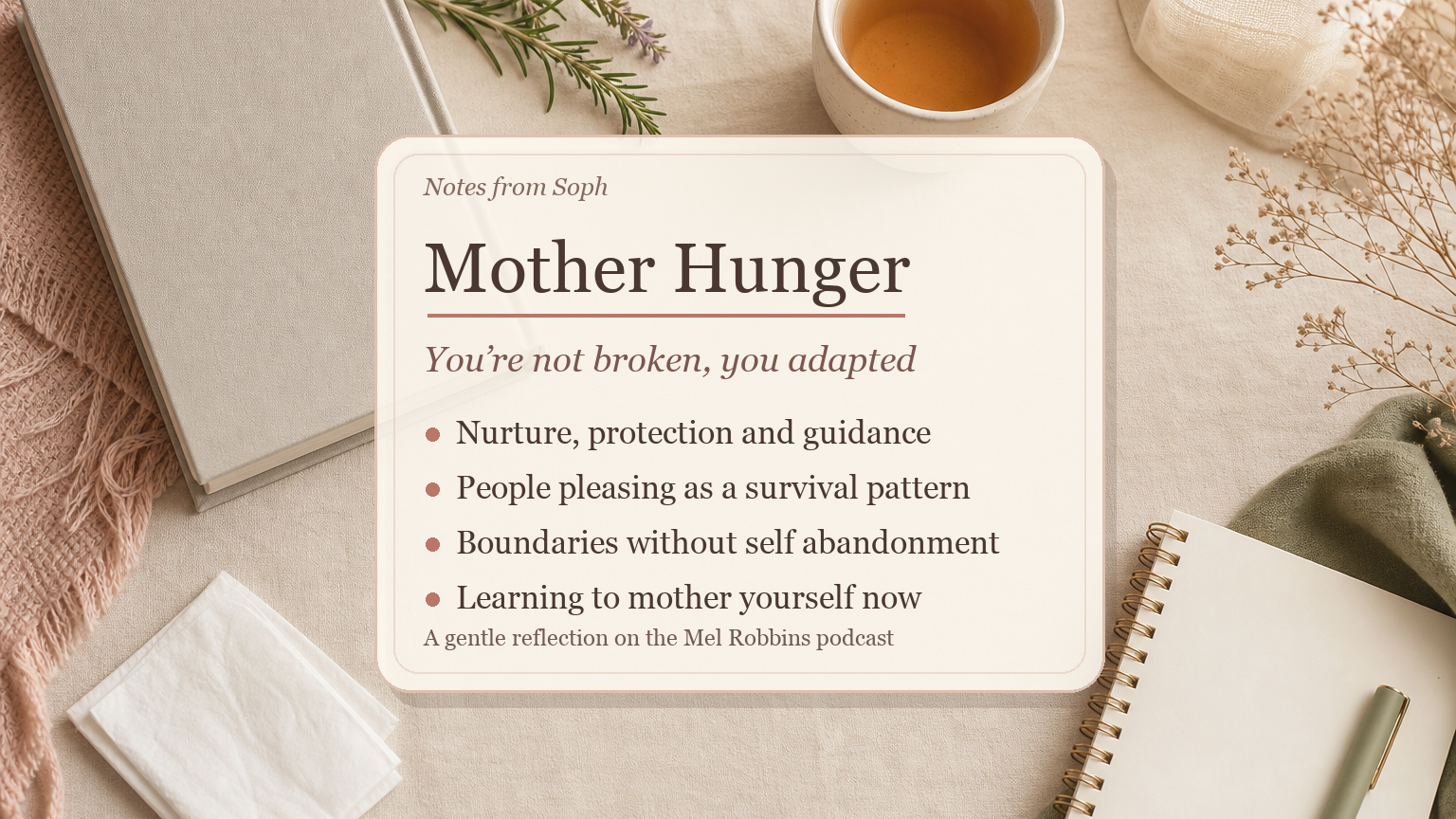
Kelly McDaniel describes Mother Hunger as the wound that can form when a child does not receive enough of three essential kinds of mothering:
- Nurture
- Protection
- Guidance
Nurture is warmth. Being soothed. Being delighted in. Feeling like your feelings are not an inconvenience.
Protection is safety. Boundaries. Someone noticing when something is wrong and stepping in.
Guidance is help making sense of life. Emotions, choices, relationships, your own inner world.
The part I find most important is this: you can love your mother and still tell the truth about what was missing.
Those two things can coexist. A mother may have done her best with what she had. She may have been carrying her own pain, limitations, history or exhaustion. And a child may still have gone without something essential.
Compassion for her does not require denial for you.
That sentence feels like the centre of the whole thing.
Mother Hunger and the Feeling of Never Being Enough
One of the biggest ideas from the episode is that many adult patterns are not random personality flaws. They may have started as adaptations.
People pleasing may have been a way to keep connection.
Perfectionism may have been a way to avoid criticism.
Hyper independence may have been a way to survive emotional unreliability.
Anxiety may have come from having to scan the room and read everyone’s mood before you could relax.
Feeling “never enough” may come from trying to earn love that should have been freely given.
That does not make the patterns harmless. People pleasing can drain the life out of you. Perfectionism can make ordinary days feel like exams. Hyper independence can stop you receiving the very care you long for.
But it does make them understandable.
There is a different kind of healing available when you stop saying, “What is wrong with me?” and start asking, “When did this make sense?”
For me, that question feels much kinder. It does not let me off the hook for changing. But it takes away some of the shame that makes change feel impossible.
The Child Learns to Become Easy
A child depends on connection. Love is not optional to a child. Safety is not a bonus. It is the whole world.
So if love feels unpredictable, cold, critical or conditional, the child adapts. Not consciously, not strategically, not with a tidy little plan. They just learn.
Be easier.
Be useful.
Be impressive.
Be invisible.
Be low maintenance.
Be the funny one.
Be the clever one.
Be the helper.
Be the emotional caretaker.
Over time, this can start to feel like personality. “I’m just the reliable one.” “I’m just bad at asking for help.” “I just hate disappointing people.” “I just need everyone to be okay before I can relax.”
But underneath it, there may be a younger part still trying to secure love by being no trouble.
That is the bit that broke my heart a little. Not in a dramatic way. More in that quiet, kitchen table way where you suddenly see your own coping mechanisms with softer eyes.
The Adult Search for What Was Missing
Mother Hunger can show up later in places that do not obviously look connected to childhood.
It can show up in romantic relationships, where intensity gets mistaken for love.
It can show up in friendships, where you become the listener, fixer and emotional support department but struggle to receive the same care back.
It can show up at work, where approval feels like oxygen and criticism feels like danger.
It can show up in food, achievement, over giving, over explaining, body shame or staying too long where you are not cherished.
The craving itself is not weakness. It is unmet need looking for a home.
That does not mean every craving should be followed. It means it deserves to be listened to, not shamed.
Sometimes the question is not, “Why am I so needy?”
Sometimes the question is, “What kind of care did I learn not to expect?”
Parentification and Guilt Disguised as Love
One of the more painful patterns discussed is parentification, where the child becomes responsible for the parent’s emotional world.
This can happen in obvious ways, but it can also be subtle. The child learns not to upset the parent. Not to have needs that are too inconvenient. Not to make choices that create guilt, disappointment or emotional fallout.
Love starts to feel like self abandonment.
As an adult, this can become very confusing. You may feel guilty for having boundaries. Guilty for resting. Guilty for not answering immediately. Guilty for wanting a life that does not revolve around managing someone else’s feelings.
One of the most practical lines from my notes was:
Notice where guilt is pretending to be love.
That is not always easy. Sometimes guilt is just guilt. Sometimes it is a useful signal. But often, especially for people pleasers, guilt is the emotional hangover of finally choosing yourself.
I kept thinking about this next to my notes on what every dad should know, because both pieces ask the same uncomfortable question: what did a child have to become in order to stay loved?
The Apology Ache
There is also the ache of wanting the person who hurt you, neglected you or failed to protect you to finally understand.
To apologise properly.
To say, “I see it now.”
To say, “You were a child. You should not have had to carry that.”
Of course we want that. It is human. It makes complete emotional sense.
But the hard truth from the episode is that healing cannot depend on getting the perfect apology. Sometimes it comes. Sometimes it does not. Sometimes the person is incapable of giving it. Sometimes they give a version that still misses the point.
The adult self has to begin anyway.
Not because it did not matter. Because it did.
Not because you are “over it.” Because waiting forever to be understood can become another kind of prison.
You can grieve what you did not get without waiting forever to live.
Learning to Mother Yourself Now
The phrase “mother yourself” can sound a bit soft and vague, but I do not think Kelly McDaniel means it that way.
I think it means rebuilding the three functions now.
If you missed nurture, you practise warmth toward yourself. You rest without earning it. You let safe people care for you in small ways. You speak to yourself like someone who is allowed to be human.
If you missed protection, you build boundaries. You leave dynamics where you are repeatedly diminished. You stop over explaining your no. You choose steadier people.
If you missed guidance, you seek support. Therapy, journalling, mentors, books, honest conversations, values, emotional skills. You stop expecting yourself to magically know things you were never taught.
A question I loved from the notes is:
What would a good mother do for me in this moment?
Then do the smallest version of that.
Not the perfect version. Not the expensive retreat version. The smallest version.
Drink water. Go to bed. Put the phone down. Send the email. Cancel the thing. Ask for help. Stop rereading the message. Make soup. Take yourself seriously.
Practical Takeaways
- Mother Hunger is a lens, not a diagnosis.
- You can love your mother and still acknowledge what was missing.
- People pleasing, anxiety and perfectionism may have started as survival strategies.
- The three needs to look at are nurture, protection and guidance.
- Guilt is not always proof you are doing something wrong. Sometimes it is what self abandonment feels like when it is leaving your body.
- Healing may involve grieving an apology you never receive.
- Reparenting yourself is practical. It means learning to nurture, protect and guide yourself now.
- If this brings up trauma, addiction, eating issues or unsafe family dynamics, getting professional support is not overreacting. It is care.
A Gentle Reflection Prompt
If this topic lands somewhere deep, go slowly.
You could journal on just one of these:
- Where do I still try to earn love by being useful, impressive or easy?
- Which did I most need more of: nurture, protection or guidance?
- What do I keep hoping someone else will finally give me?
- Where is guilt making me abandon myself?
- What would it look like to protect myself without becoming cold?
You do not have to answer them all. You do not have to make a dramatic life change by Friday. Sometimes naming the pattern is already a big act of care.
For me, the most hopeful part of this conversation is the title itself: you are not broken.
You adapted.
And if you adapted once, maybe you can adapt again. This time toward tenderness, steadiness and a life where love does not have to be earned by disappearing.
Notes from Soph | Learning, not perfection.
Et toi? Which of the three do you most need to practise now, nurture, protection or guidance? Come and talk about it gently in the Notes from Soph community on Skool.
Source Details: The Mel Robbins Podcast, Ep 397, You’re Not Broken, with Kelly McDaniel Mel Robbins episode page

