The Art of Possibility: A Gentler Way to See What Could Be
There are some books that do not feel like a plan. They feel like someone opening a window.
The Art of Possibility by Rosamund Stone Zander and Benjamin Zander is one of those books. It is not a productivity system. It is not a ten step method for becoming a more impressive person. It is more like a set of invitations: what if the story you are telling about this situation is not the only story available? What if the rules you think you are living under are partly invented? What if there is another way to stand inside the same life?
This made me think about how often the mind turns a moment into a fixed conclusion. A difficult conversation becomes “this will always be hard”. A slow week becomes “I am behind”. A mistake becomes “I am not good at this”. The Zanders are interested in the tiny gap before that conclusion hardens. The gap where possibility can still enter.
That is the part I loved.
Table of Contents
What Is This Book?
The Art of Possibility is written by two people who come at transformation from different but beautifully complementary angles. Rosamund Stone Zander is a family therapist and executive coach. Benjamin Zander is a conductor, teacher and speaker who has spent his life helping musicians play with more freedom, presence and connection.
The book was first published in 2000 and it has that gentle, story led feeling of a classic personal development book before everything became optimised into frameworks and funnels. Each chapter offers a practice, usually through a story from music, teaching, leadership, family life or therapy.
The central idea is simple: many of the limits we experience are not fixed facts. They are assumptions, measurements, comparisons and inherited stories that we mistake for reality.
The Zanders are not saying that anything is possible in the shallow sense. They are not saying ignore grief, money, systems or constraints. They are saying that the way we frame a situation changes what becomes available inside it.
That matters. Because once a situation is labelled as failure, stuckness, competition or proof that we are not enough, the mind starts collecting evidence for that label. But if we can change the frame, even slightly, the next move changes too.
The Practice of Giving an A
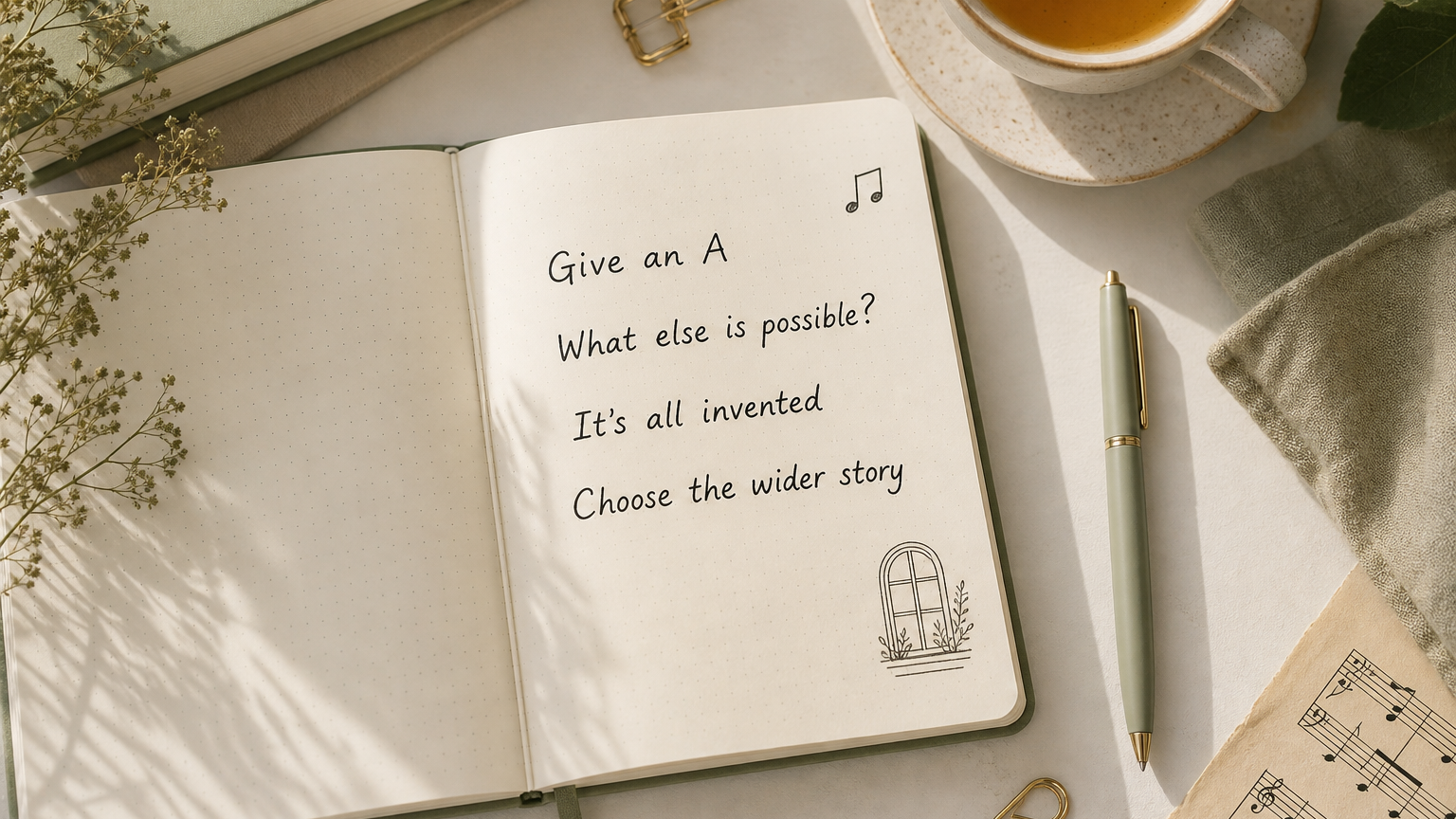
One of the most memorable practices in the book is Benjamin Zander’s habit of giving his students an A at the beginning of the course.
Not after they have proved themselves. Not once they have earned it. At the beginning.
The students are asked to write a letter dated in the future, explaining who they became to deserve that A. The point is not to lower standards. It is to remove the fear of measurement so that the student can grow into their best work rather than perform anxiously for approval.
This made me stop for a moment.
So much of life can feel like waiting to be graded. Parenting. Work. Writing. Fitness. Friendship. Even rest, somehow. We carry an invisible examiner around with us, quietly asking whether we are doing enough, improving fast enough, keeping up properly. And when your very profession is teaching, this idea resonates fully!
Giving an A is a radical interruption of that. It says: what if you started from belonging rather than proving? What if you treated yourself, or someone else, as already worthy of respect and possibility?
That does not mean pretending everything is perfect. It means creating the conditions where growth is more likely.
I keep thinking about how different a morning feels when I start from “I am allowed to learn today” rather than “I must prove I am doing this right”. Same tasks. Different nervous system.
It’s All Invented
Another practice I loved is the idea that “it’s all invented”.
The Zanders are careful here. They are not saying reality is fake. They are saying that the meanings we attach to reality are often invented. The measurement system, the competition, the story about who is ahead, the idea that there is only one respectable path, the rule that says you are late or behind or too much or not enough.
Much of that is made up.
This is such a useful Mind category idea because the mind loves to present interpretation as fact. It says, “They did not reply, so they are annoyed.” It says, “I have not managed this yet, so I am not capable.” It says, “Everyone else knows what they are doing.”
But those are not facts. They are stories.
A practical question from this book is: what am I making this mean?
That one question can soften a whole day. It does not magically solve the problem, but it separates the event from the story. The event might be: the email has not been answered. The story might be: I have done something wrong. Once you can see both, you have more freedom.
This links beautifully with Mindset by Carol Dweck, where the difference between fixed and growth thinking often comes down to the meaning we attach to difficulty. It also sits beside The Chimp Paradox, because sometimes the loudest story in the room is not wisdom. It is the chimp reacting quickly to keep us safe.
Contribution Changes the Room
One of the warmest ideas in the book is the shift from success to contribution.
Success often asks: am I winning? Am I recognised? Am I doing better than I was before, or better than someone else? Contribution asks a different question: what am I here to give?
That question changes the energy immediately.
If I sit down to write and ask, “Will this post perform?” I can feel myself tighten. If I ask, “Who might this help?” something loosens. I still care about doing good work. I still want the post to reach people. But the centre of gravity moves from self protection to service.
The Zanders suggest that contribution is available in almost any situation. You do not have to wait until you are important enough, qualified enough or perfectly ready. You can contribute by listening properly. By bringing steadiness into a tense room. By asking a better question. By doing your small part well.
This made me think about Hell Yeah or No by Derek Sivers, especially his test of whether something is useful to others. Possibility is not just about personal expansion. It is about becoming less trapped in the performance of self and more available to what the moment needs.
That is a much calmer way to live.
Rule Number 6
There is a tiny story in the book called Rule Number 6. The rule is: don’t take yourself so seriously.
I know. Annoying. Also, probably necessary.
The reason this lands is that so many of our mental knots are tightened by seriousness. Not care, which is lovely. Seriousness. The clenched belief that everything depends on this one conversation, this one decision, this one result, this one version of ourselves being seen correctly.
Rule Number 6 is not a call to be careless. It is a call to drop the costume of importance.
I find this useful because it is so physical. You can feel it when you are taking yourself too seriously. The jaw tightens. The shoulders lift. The inner monologue becomes very official. Suddenly everything is a referendum on who you are.
Possibility needs a little air. Humour gives it that air.
A beginner friendly way to practise this is to ask: if this mattered, but not quite as much as I am making it matter, what would I do next?
That sentence has helped me more than once. It keeps the care but removes the panic.
Practical Takeaways
1. Ask what story you are inventing. When something feels heavy, write down the event in one sentence, then write the meaning you have attached to it. Keep them separate. The space between them is where freedom starts.
2. Give yourself an A before you begin. For one project this week, act as if your worth is already secure. Not because the work does not matter, but because fear is rarely the best teacher.
3. Move from success to contribution. Before a task, ask: what can I contribute here? It might be clarity, steadiness, effort, kindness, humour or one useful sentence.
4. Notice measurement traps. Where are you keeping score in a way that makes you smaller? Numbers can be useful, but they are not the whole truth. If the measurement is shrinking your courage, change the frame.
5. Practise Rule Number 6. When you feel yourself becoming very serious, soften your face, breathe and ask: if I did not need to protect my identity right now, what would be possible?
6. Look for the next generous move. Possibility does not always arrive as a grand life change. Often it is one more honest conversation, one creative attempt, one apology, one brave email, one small moment of choosing a better frame.
Why This Belongs in Mind
The Mind section is where I put books that change the way I think, not just the information I have collected.
The Art of Possibility belongs here because it works directly on perception. It asks us to notice the frames we are living inside: the invisible measuring systems, the assumptions about what is allowed, the stories that make us smaller than we need to be.
This book does not offer a louder mindset. It offers a wider one.
That feels important. Because so much personal development can become another way to grade ourselves. Better habits. Better goals. Better morning routines. Better discipline. The Zanders invite something softer and braver: a mind that can pause before it closes, question the story it has inherited and ask, quietly, what else might be possible here?
I think that is a question worth keeping close.
Notes from Soph | Learning, not perfection.
Et toi? Where in your life could you use a little more possibility and a little less proving? Come and share it in the Notes from Soph community on Skool. I love conversations that begin with “what if…”
Book Details: The Art of Possibility: Transforming Professional and Personal Life by Rosamund Stone Zander and Benjamin Zander Published 2000 | Harvard Business School Press
📚 Amazon https://www.amazon.co.uk/s?k=The+Art+of+Possibility+Rosamund+Stone+Zander+Benjamin+Zander&tag=websitenote0f-21 Disclosure: affiliate link. If you buy through this, I earn a small commission at no extra cost to you. Thank you!

