Learn To VIBRATE CORRECTLY: David Bayer on Emotional Frequency and Real Life
I used to hear the word “vibration” and feel a small part of me tense up.
Not because I do not believe in energy. I do. I have walked into rooms and felt the heaviness before anyone said a word. I have sat with someone calm and found my own breathing slow down. I have noticed how one thought can change my entire body in seconds.
But the language can get slippery.
“Raise your vibration” can sound like you are meant to float above ordinary life in linen trousers, drinking green juice and never getting irritated by emails, bills, children, hormones or the washing machine making a noise that sounds financially threatening.
David Bayer’s episode Learn To VIBRATE CORRECTLY And Reality Becomes Yours is stronger than that. Having now checked the transcript, I would describe it less as mystical decoration and more as a conversation about emotional frequency, nervous system habits and the inputs we allow into our lives.
To vibrate correctly, in this episode, is not to become a permanently cheerful human being.
It is to notice the emotional state your body has become used to living in.
Fear or courage.
Shame or self respect.
Stress or presence.
Doom scrolling or real connection.
Old triggers or a more powerful state.
That is where this episode landed for me.
If I use the phrase “vibrate correctly” now, I mean something much more ordinary and embodied than sounding spiritual.
Table of Contents
What David Bayer Means by Vibration
Bayer opens with a strong idea: most of us think we are physical beings in a physical universe, when he sees us as vibrational beings in a vibrational universe.
I would not expect everyone to take that literally in the same way. I am always a bit cautious when spiritual language starts sounding too certain. But practically, the point makes sense.
We all broadcast something.
A stressed person changes the room. A calm person changes the room. A bitter person changes the room. A kind person changes the room. You do not need to see an aura to know that people carry emotional weather.
Bayer’s definition is useful because he connects vibration to the emotional frequency your nervous system has become habituated to. In other words, where do you live most of the time?
Anxiety.
Worry.
Resentment.
Courage.
Faith.
Compassion.
Love.
That question is more helpful than asking whether you are “high vibe” enough. It is less of a spiritual performance and more of an honest inventory.
Where does my body keep returning?
The Map of Consciousness, Held Lightly
A big part of the episode is David Hawkins’ Map of Consciousness from Power vs Force.
Bayer explains Hawkins’ scale as running from 1 to 1,000. In the transcript he gives examples: shame at 20, fear at 100, courage at 200, love at 500 and higher states of enlightenment from around 700 to 1,000.
He also talks about Gandhi and Mother Teresa as examples of people who, in Hawkins’ model, were operating at very high levels of consciousness and therefore affected people around them through presence as much as action.
I want to hold this kind of map lightly.
Do I know whether shame is literally a 20 and courage is literally a 200? No. I do not need to pretend I can verify that.
But as a teaching tool, I find it useful.
Shame feels heavy. Fear narrows the mind. Courage opens something. Love changes what we can see and do. Whether or not I treat the exact numbers as scientific fact, the direction of travel feels real.
The most helpful part for me is the threshold around courage. Bayer describes courage as the place where we begin moving from force into power. That phrase matters.
Force is the clenched jaw version of life.
Power is the steadier version.
Force tries to control everything from fear.
Power acts from a deeper place.
That is a very Notes from Soph distinction, because it is not about pretending everything is fine. It is about noticing whether I am creating from panic or from something more grounded.
Lower States Shrink Your Life
One thing the transcript makes clearer than my first listen is that Bayer is not only talking about thoughts. He is talking about the whole system.
Lower emotional states, like fear, jealousy, guilt, worry and anger, contract the body. They activate stress physiology. They narrow perception. They pull the nervous system into survival mode.
Higher emotional states, like calm, curiosity, joy, courage and love, create more openness. They widen perception. They support the parasympathetic nervous system, which is the rest, repair and regulation side of the body.
That makes vibration less airy fairy.
If I am in chronic stress, my body is not just having an unpleasant feeling. It is allocating energy to threat. It is managing tension, inflammation, cortisol and internal friction. It makes complete sense that creativity, intuition, patience and generosity become harder from that place.
I see this in ordinary life.
When I am stressed, I become very literal. A delayed reply becomes rejection. A messy kitchen becomes evidence that I am failing at adulthood. A small bill becomes a prophecy. My thinking gets smaller, not because I am stupid, but because the state I am in only offers me a small menu of options.
When I regulate first, the same facts look different.
That is the part of vibrate correctly that I can actually use.
The Inputs That Pull Us Down
Bayer is very clear that it is not only limiting beliefs that keep us in lower vibrational states.
He names food, screens, scrolling, rapid shifts of attention, media fear, doom, gloom, alcohol and too much caffeine as examples of inputs that can pull the nervous system down.
This is where the episode becomes practical.
Because sometimes raising your vibration is not about adding one more beautiful morning routine.
Sometimes it is about stopping the thing that keeps dragging you back into the same state.
A seven day digital detox.
More time outdoors.
Friends in person instead of living entirely through screens.
Less alcohol.
Less caffeine if it is hijacking your nervous system.
Less fear content.
Less pretending that the phone in your hand is neutral when it keeps leaving you anxious, scattered or numb.
That is the bit I appreciate. It is very easy to make spiritual growth decorative, but Bayer brings it back to environment.
What am I consuming through my eyes, ears, mouth and nervous system?
And what is it training me to feel?
Five Ways to Vibrate Correctly in Real Life
He gives five clear practices for raising your vibration. These are the parts I would actually write down and test.
1. Heart rate variability breathing
Bayer recommends a simple nasal breathing practice for 10 to 20 minutes.
Inhale through the nose for 5.5 seconds.
Exhale through the nose for 5.5 seconds.
No pause between the inhale and the exhale.
He describes it as a heart rate variability breath practice and says it can reset the nervous system quite quickly.
I like this because it is not glamorous. It is not something you need to buy. It is just breath, rhythm and a body being given a different signal.
2. A hard physical workout
His second practice is intense movement, enough that your mind does not have room to worry.
Weights, running, biking, yoga, cardio, it does not really matter. The point is presence in the body. Bayer calls it an active meditation.
That makes sense to me. When you are working hard physically, you are not usually rehearsing the same anxious thought for the thousandth time. The body interrupts the loop.
3. High vibrational content
Bayer talks about nutrition beyond food. What you see, hear and feel matters too.
He mentions listening to people like Neville Goddard, Les Brown, Eckhart Tolle, Joel Osteen, scripture and New Thought teachings when he was rebuilding his own life.
I would translate this simply: feed your mind better material.
If the first thing I do every morning is let the internet inject outrage into my bloodstream, I cannot be surprised when my nervous system starts the day in defence.
4. Journaling and somatic work
This section was one of the most useful for me.
Bayer describes journaling as a bridge to your emotional world. Instead of holding everything in or bypassing it with coffee, alcohol, screens or distraction, you let yourself touch what is actually there.
He also talks about somatic work, feeling a lower emotion in the body for a few minutes rather than running from it. The idea is that old emotional charges keep coming up until they are properly felt and metabolised.
This is an important correction to the fluffy version of “raise your vibration.”
It does not mean avoiding lower emotions.
It may mean finally feeling them properly so they stop running the whole system from underneath.
5. High vibrational community
The fifth practice is community.
Bayer says raising your vibration is not a do it yourself project. If you want to get good at martial arts, you train with martial artists. If you want to get sober, you spend time with people in recovery. If you want to live in a higher emotional state, you need people around you who practise that too.
I think this matters more than we like to admit.
We become normalised by the rooms we sit in.
If everyone around me is cynical, frantic or addicted to complaint, that becomes the air. If people around me are honest, steady, hopeful and willing to do the work, that becomes air too.
Choose your air.
This also connects with my earlier notes on how to use your thoughts to change reality, because to vibrate correctly is partly about noticing which thoughts keep pulling the nervous system back into the old state.
What I Would Keep From This Episode
The sentence I would keep is this:
Raising your vibration is often less about forcing yourself into a high state and more about stopping what keeps pulling you into a low one.
That is practical.
It makes “vibrate correctly” feel less like a slogan and more like a daily check-in.
It means I can ask:
What keeps lowering my state?
What helps my body return to courage?
What am I consuming that makes me feel less alive?
What do I need to feel instead of bypassing?
What would help me vibrate correctly today, in the most ordinary sense?
Who helps me remember the version of myself I am trying to grow into?
That is enough work for one week, honestly.
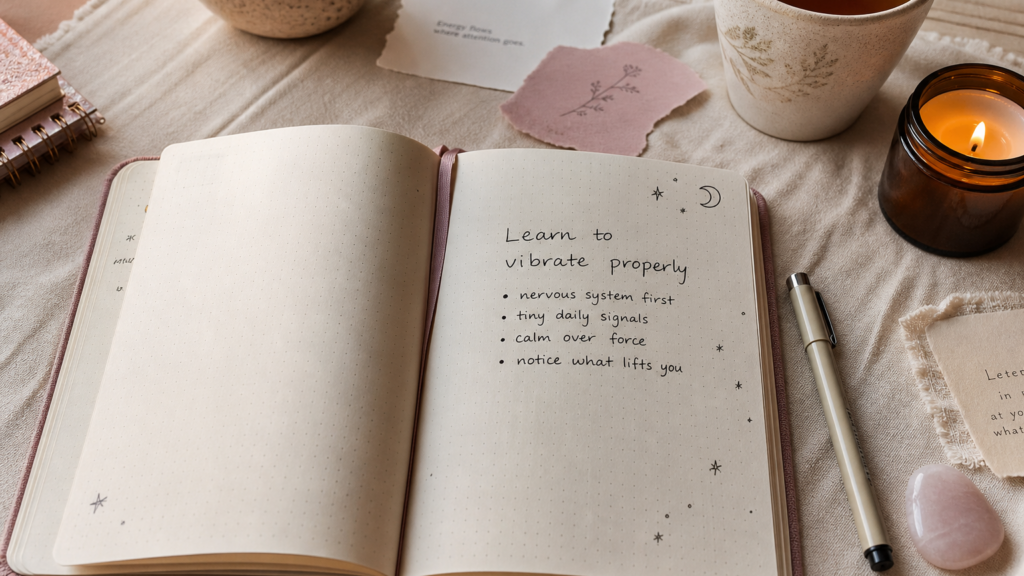
Practical Takeaways
1. Treat vibration as your usual emotional frequency. Do not make it another thing to perform. If you want to vibrate correctly, ask where your nervous system actually lives most days.
2. Use the Hawkins scale as a map, not a religion. Shame, fear, courage and love do feel different in the body. You do not have to worship the numbers to use the direction.
3. Watch your inputs. Food, scrolling, fear content, alcohol, caffeine, screens and constant noise can all train the body into lower states.
4. Regulate before you create. Breathwork, walking, training, journaling or a few minutes of quiet may change the quality of the action that follows.
5. Feel the lower emotion instead of bypassing it. Raising your vibration is not pretending anger or fear are not there. Sometimes the way up is through the body.
6. Build a better room around you. Community is not a bonus. It is one of the environments your nervous system learns from.
Why This Belongs in Soul
This belongs in Soul because it is about the invisible atmosphere of a life.
Not just what we do, but who we are being while we do it.
For me, to vibrate correctly is really to notice the atmosphere I am practising inside my own body.
David Bayer’s episode reminded me that spiritual growth does not have to be vague. It can be as simple as the next breath, the next thing I stop consuming, the next honest journal page, the next walk outside, the next conversation with someone who brings me back to myself.
To vibrate correctly, for me, is not about becoming untouchable.
It is about becoming more conscious of what I am practising.
More conscious of what I am absorbing.
More conscious of the state I am asking my body to live in.
And more willing to choose courage, again and again, until it starts to feel like home.
Not perfectly.
Practically.
Notes from Soph | Learning, not perfection.
Et toi? What is one input, habit or emotional loop that pulls your vibration down? Come and talk about it in the Notes from Soph community on Skool.
Source Details: A Changed Mind, Episode 224, Learn To VIBRATE CORRECTLY And Reality Becomes Yours Apple Podcasts episode David Bayer Transcript source: Captivate transcript linked from the podcast feed, checked 31 May 2026.

