How to Motivate Learners: What Creative Schools Changed for Me
When I asked myself how I could use Creative Schools, my answer was simple: to change my approach to teaching and motivate learners more. I wanted something that could influence what I actually do with the person trying to learn in front of me. But it did more than that, it revived my passion for teaching, which has been dimmed since coming back to France and being immersed in a system that seems to have stayed the same since I left school.
My next answers made that clearer. Why use it? To bring the best out of every learner and unleash their potential and creativity. When? In my teaching, methodology and general approach. Those are quite big ambitions for three small questions, but they gave this book a practical purpose. I was reading for what I could change, not only what I could agree with.
What changed for me was the starting question. Instead of only asking how to get through the content, I want to ask what conditions would help these learners grow through it. That does not remove the need for preparation, practice or effort. It changes what those things are serving.
Table of Contents
1. To Motivate Learners, Start With the Conditions
Sir Ken Robinson was an educator and advocate for creativity and human potential, known for his TED talk Do Schools Kill Creativity? He advised education systems and governments, so his argument was not simply that teachers should make lessons more fun. Written with Lou Aronica, Creative Schools explores how education could work differently, drawing on schools and educators already trying other approaches.
The central contrast is between an industrial model and an organic one. In an industrial model, the temptation is to standardise the input, timetable and expected result. In an organic model, the attention goes towards the conditions that allow living things to develop. Learners have feelings, interests and different starting points. They are not identical objects moving along a production line.
This is where the book became personal for me, not only professional. At home, I have three very different children, and conventional schooling does not always make room for that kind of difference easily. One child may need movement, another may need time, another may need a completely different route into confidence. When I read Robinson’s industrial versus organic metaphor, I thought about classrooms, yes, but I also thought about kitchen-table homework, school meetings, tired evenings and the quiet ache of watching a child be measured by a system that does not always see the whole person.
That does not mean lowering expectations or deciding that everything difficult is unfair. It means asking a better question. Instead of “why is this child not fitting the system?”, I want to ask “what conditions would help this child grow?” That feels much closer to real education, and much closer to the kind of parent and teacher I want to be.
I find this useful because it interrupts a quick judgement. If someone is not engaging, I can ask what is happening before deciding they simply lack motivation. Is the task confusing? Is it too easy? Does the learner understand why it matters? Are they afraid of getting it wrong? Those questions do not magically solve the problem, but they give me somewhere more useful to look.
There is a limit to this too. A teacher cannot control everything affecting a learner, and Ken Robinson acknowledges that. I do not want to turn a hopeful idea into another reason for teachers to blame themselves. Creating better conditions means working with what we can influence, while recognising when support or change is needed beyond the lesson.
2. Curiosity Needs a Reason to Care
One of the strongest threads in the book is the connection between learning and something the learner already values. This is not the same as letting everyone avoid anything difficult. It is about finding a meaningful way into the difficulty. Why should I want to know this? What will it help me do? Where does it connect with my world?
For a language lesson, a possible application would be to begin with a situation rather than a list of rules. Someone needs to ask for help, explain an opinion or organise a visit. What would they need to say? The vocabulary and grammar then have a job to do. That gives me a concrete place to start when I plan the next lesson.
It also connects with what I explored in my notes on Jim Kwik’s Limitless: learning deserves attention as a process, not just an instruction to remember more. Here, the question becomes how I can help someone find a reason to engage before asking them to retain the material. Wanting to learn and knowing how to learn belong together.
To motivate learners, I do not need to become a constant source of entertainment. That sounds exhausting, frankly. I need to make the purpose visible and leave room for curiosity. An interesting question, a small choice or a problem worth solving can be a starting point. The aim is not a room that looks busy. It is learners thinking about something that matters.
3. Good Teaching Is More Than One Method
Ken Robinson describes four roles for teachers: engage, enable, expect and empower. I like this because it does not offer one technique as the answer to everything. Engage means creating interest. Enable means providing the teaching and support needed to progress. Expect means communicating belief in what learners can achieve. Empower means helping them become increasingly capable of learning for themselves.
The second role matters as much as the first. A learner can be interested and still not know what to do. Sometimes the most useful thing is a clear explanation, a model or guided practice. At other times it is space to investigate. The book makes room for both direct instruction and discovery, with the teacher judging what the situation needs rather than defending one method at all costs.
For my methodology, this gives me a way to review a lesson without reducing it to good or bad. Did I create interest but leave the task too vague? Did I explain clearly but keep all the decisions for myself? Did I communicate a high expectation without giving enough support? Each question points towards an adjustment, which feels more useful than simply promising to try harder.
If I want to motivate learners over time, independence has to be part of the picture. I do not want success to depend entirely on my reminders or approval. A small step might be asking learners to choose their next practice task and explain why. That choice still needs guidance, but it starts moving some responsibility into their hands.
4. Potential Needs More Than One Way to Appear
My reason for using this book was not only better engagement. It was bringing out potential and creativity. Ken Robinson challenges the narrowness of the signs we sometimes use to recognise ability. A quick written answer can show something important, but it cannot show everything about a person’s understanding, imagination or capacity to contribute.
That makes me want to look more carefully at the opportunities a task offers. Could a learner demonstrate an idea through an explanation, a conversation or something they have made? If writing is the skill being assessed, writing still matters. But if the goal is understanding a concept, I can consider whether one format is hiding what someone understands rather than revealing it.
Creativity is not an optional decoration after the serious learning. In the book, it involves generating ideas of value, then refining and testing them. In a language task, that might mean creating a conversation for a particular audience, trying it out and changing what is unclear. Learners need knowledge to do this well. Creativity gives them a reason to use that knowledge rather than simply reproduce it.
This links with my reflection on why human intelligence still needs practice. Asking questions, making judgements and communicating clearly need opportunities to develop. To motivate learners without making room for those abilities would feel incomplete. I want the work to help someone discover what they can do, not only confirm whether they can follow my instructions.
5. Feedback Should Open the Next Step
Assessment can sound like the opposite of creativity, but the book does not ask us to stop checking learning. Ken Robinson distinguishes between understanding a learner’s starting point, gathering information during learning and judging achievement at the end. The problem is not that assessment exists. It is what happens when the measure becomes more important than the person or the learning.
The practical distinction I want to keep is between a verdict and guidance. A mark may tell someone how a piece of work performed. It does not necessarily tell them what to do next. Feedback becomes more useful when it identifies what is working, names a manageable improvement and gives the learner a chance to act on it.
For example, I could tell a learner that their meaning is clear but the sequence is difficult to follow, then ask them to revise it using two connecting phrases. That is a proposed feedback approach, not a miracle script. It keeps the standard visible while making improvement concrete. Encouragement and honest correction do not have to compete.
I also want to ask learners what they notice about their own progress. What can they do now that was difficult before? Where are they still getting stuck? If I want to motivate learners, helping them recognise movement matters. Confidence does not have to come from being told everything is wonderful. It can come from seeing that a specific effort helped.
Practical Takeaways
I do not need to redesign every lesson at once. These are the questions I want beside me when planning or reviewing one piece of teaching:
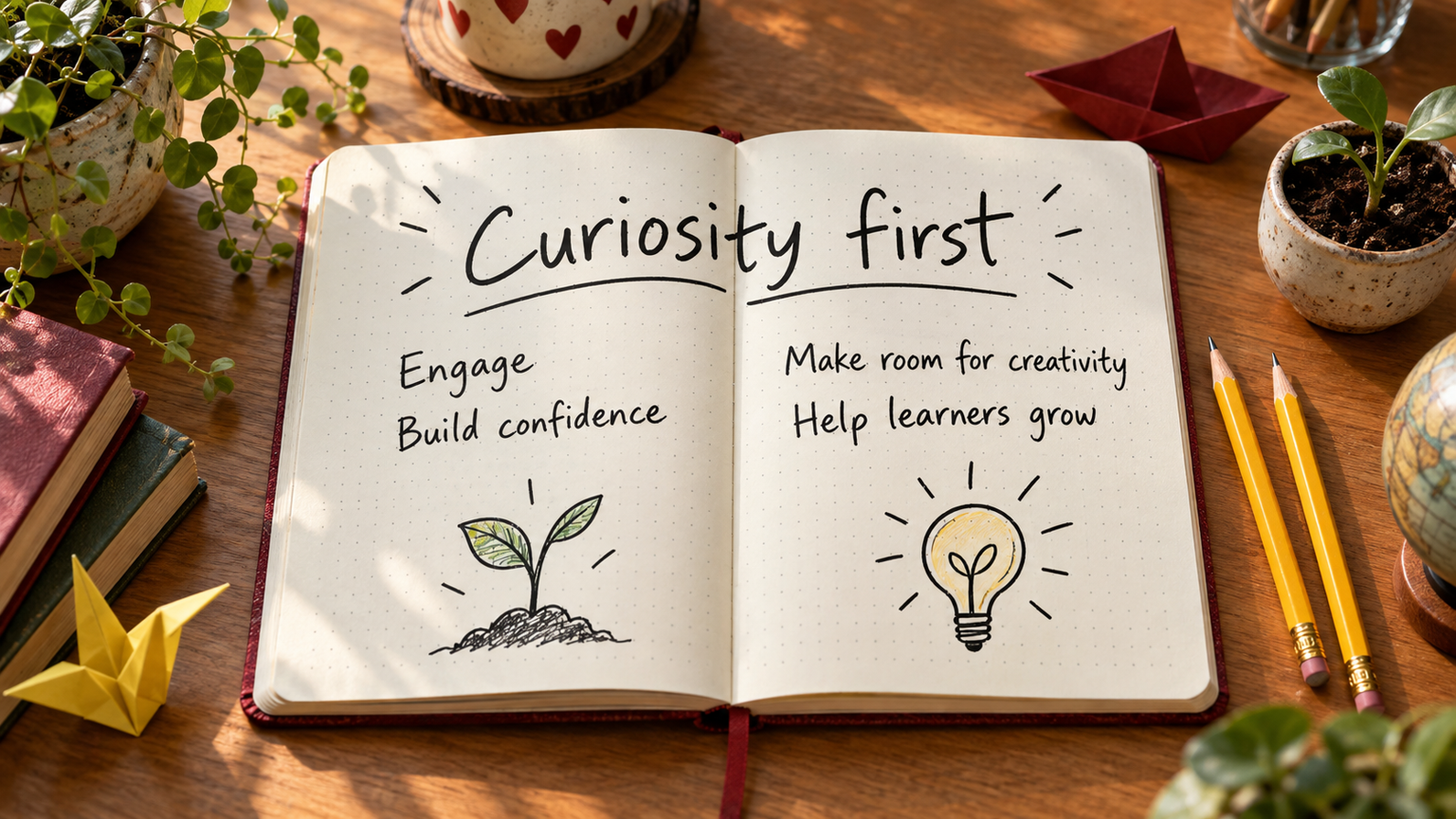
- Make the purpose visible. What will learners be able to do with this knowledge, and have I helped them see why it matters?
- Check the support. Interest is not enough if the next step is unclear. Offer an explanation, example or manageable first attempt.
- Give one meaningful choice. Let learners choose a topic, approach or next practice step within a clear learning goal.
- Create room for application. Ask them to use what they know to make, explain or solve something, then improve it.
- Make feedback usable. Name something that works and one next step, with time to try again rather than just collect a correction.
Why This Belongs in Purpose
This belongs in Purpose because it comes back to what I want my teaching to contribute. Covering material is part of the work, but it is not the whole reason for doing it. Helping someone recognise a strength, ask a better question or feel capable of learning independently is part of that purpose too.
My three answers still hold: change my approach, bring out potential and use what I learn in my methodology. I am not claiming that reading one book has achieved all of that. It has given me a clearer direction and some useful questions to take into the work. That is enough to begin with.
If you teach, support someone learning or are trying to learn something yourself, perhaps start with one question: what would make the next step more meaningful and more possible? We do not need a perfect system before we can make a thoughtful adjustment. Perfection does not exist, and learning is still worth caring about.
Notes from Soph | Learning, not perfection. Soph x
Et toi? What helps you want to learn, and what makes you switch off? Come and share your experience in the Notes from Soph community on Skool. I would love to hear what makes the difference for you.
Book Details
Creative Schools by Sir Ken Robinson and Lou Aronica.
First published 2015. UK paperback published by Penguin, 3 March 2016. ISBN 9780141978574.
Disclosure: affiliate link, if you buy through this, I may earn a small commission at no extra cost to you. Thank you!

