The Power Book: How Rhonda Byrne Helps Me Choose Better Feelings
The Power book by Rhonda Byrne felt like the conversation that The Secret had not finished with me.
The Secret had helped me notice the thoughts I kept rehearsing and the emotional channel I was living from. It taught me to ask what I wanted instead of endlessly repeating what I did not want. The Power felt like the natural next book because it answers the question underneath all of that: what actually helps us change the channel?
Rhonda Byrne’s answer is love.
Not only romantic love or love for your family. She means love as the positive force behind every good feeling: gratitude, excitement, appreciation, hope, kindness, pleasure and joy. Thoughts may point the rocket in a direction, she says, but feelings are the fuel.
Table of Contents
I loved the continuity. The Secret made me watch my thoughts. The Power makes me observe my feelings and gives me games to play when I notice I have slipped into complaint, fear or scarcity.
That playful part matters to me. I do not need another system that tells me to monitor myself perfectly. I need ways to catch the moment, smile at myself and get back onto a more loving and positive track.
How The Power Book Continues The Secret
Rhonda Byrne published The Power in 2010 as the second book in what the publisher calls The Secret Library. Where The Secret helped me change the channel of my thoughts, this book puts much more emphasis on the feeling behind them.
The official publisher description presents love as the power behind relationships, health, money, happiness, work and the life we want to create. Byrne’s claim is much bigger than anything I could prove in a blog post. She describes love as a universal force and the law of attraction as the law of love.
I read that with my usual warm scepticism. I do not believe that every painful thing in a person’s life proves they failed to think or feel correctly. That interpretation can become cruel very quickly. Life includes illness, grief, other people’s choices and circumstances we did not request.
What I find genuinely useful is the practical layer. Feelings affect what I notice, how I speak, what I expect and what I do next. If I spend a week rehearsing that something is impossible, I will behave differently from the version of me who is curious about how it might become possible.
That does not make feeling a magic wand. It makes it a starting position.
Feelings Are Information, Not Identity
One of my favourite ideas in The Power is that a bad feeling is not who you are. Byrne turns bad feelings into wild horses. There is a grumpy horse, a sulky horse, a disappointment horse and probably, in my stable, an overthinking-at-three-in-the-morning horse.
If you climbed onto the horse, you can climb off it.
I like this because it creates a tiny gap between me and the feeling. Instead of saying “I am negative” or “I am anxious”, I can notice that I have climbed onto a particular horse and it is taking me somewhere I do not want to go. I do not need to hate the horse, analyse its childhood or pretend it is not there. I can interrupt the ride.
Byrne says not to fight bad feelings because resistance gives them more attention. Her answer is to put love in. List what you love. Find something to appreciate. Play music that moves you. Remember a person, place or moment that changes your state. The feeling is real, but it does not have to drive for the rest of the day.
This sits beautifully beside what I already use from The Secret: my Secret Shifters, the small things that change my emotional channel. The Power gives them a clearer purpose. They are not ways of pretending. They are ways of returning to love.
The 51 Per Cent Rule
Perfection does not exist, which is why Byrne’s tipping point was such a relief.
Her idea is that we do not need to feel loving and positive in every moment. We need to tip the balance. Fifty-one per cent is enough to move the day in a different direction.
I can work with that. “Be positive all the time” makes me want to rebel. “Look for one more thing to love than to criticise” feels possible.
It also changes the way I see a difficult day. A bad hour does not have to become the story of the whole day. A wobble does not cancel the work. I can notice the direction, add something better and tip the balance back.
The question becomes simple: what am I feeding more often?
Gratitude, Love and Play as Daily Tools
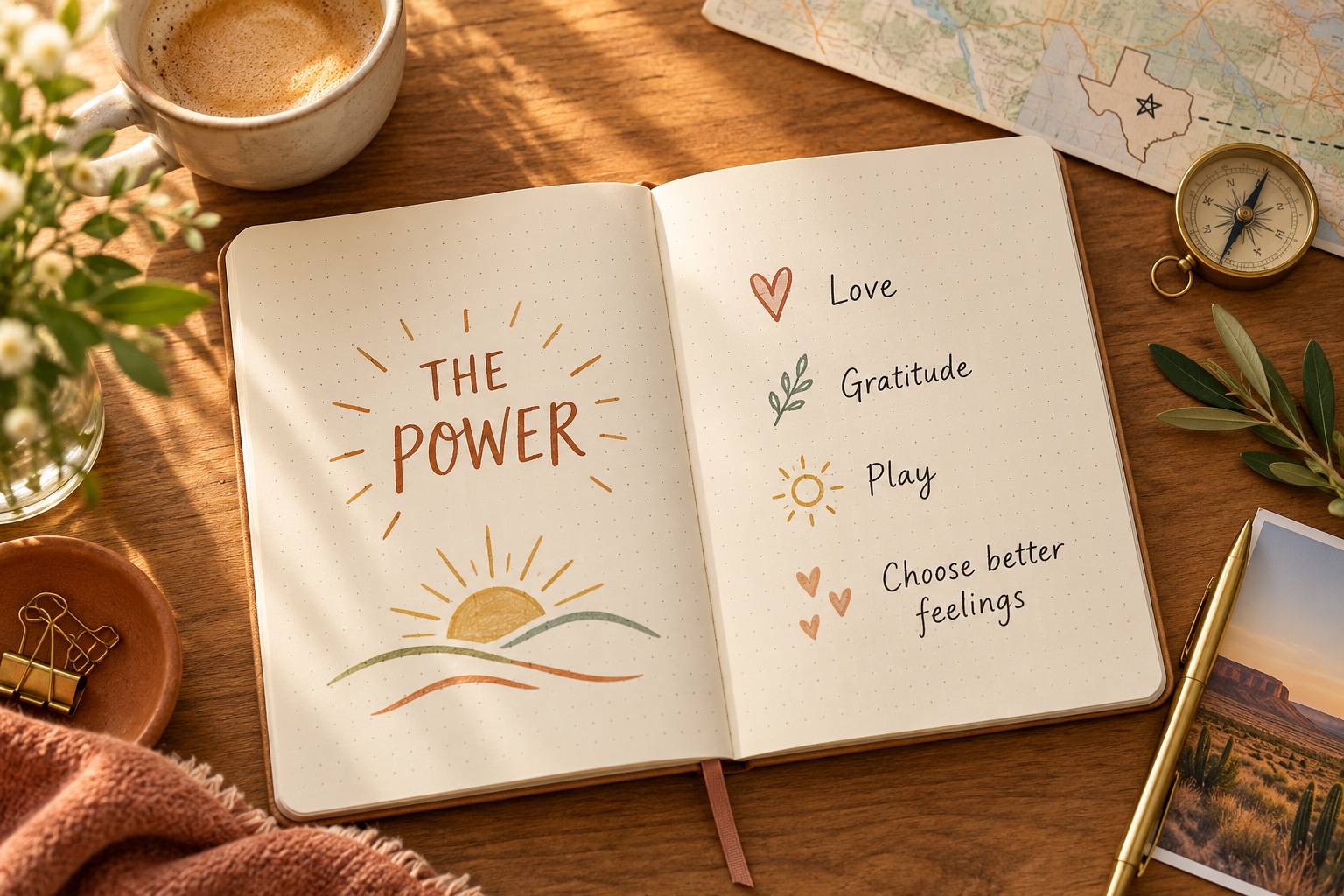
The three keys in the book are love, gratitude and play. They sound almost too simple until you try using them deliberately.
The love practice is to look for what you genuinely love around you. The architecture of a building, a tree, a cup of coffee, a colour, a book, a song, someone’s laugh. Byrne suggests running a quick mental list while walking, dressing or driving. When my mind wants to catalogue everything that is wrong, I can give it a different job.
Gratitude works across three tenses: what I have received, what I am receiving and what I want, imagined as if it has already arrived. The third one is the most challenging because it asks me to feel grateful before I have evidence. It is also the one that makes a future possibility feel less distant.
Then there is play. “Imagine if…” is a game, not a legal contract with the universe. Imagine if the right opportunity appeared. Imagine if the numbers worked. Imagine if this plan became normal life. Use pictures, props and the senses. Let the mind visit the possibility instead of using all its imaginative power to rehearse disaster.
The adult in me can find that a bit silly. The teacher and learner in me know that play changes my state far faster than another lecture from myself.
Our Texas Holiday and the Bigger USA Dream
This book has landed during a period when our life genuinely feels as though it is opening.
In fifteen years of having children, we are finally going on our very first big family holiday … to Texas, USA. We have never felt as financially comfortable as we do now. Even writing those sentences makes me pause because they describe something that felt very far away for a long time.
We also have a much bigger project in our hearts: moving to the USA.
I am not going to claim that reading a book booked the flights, changed our finances or will organise an international move for us. That would be too neat and it would ignore years of work, decisions, saving and ordinary practical effort.
But I do think changing our thoughts has changed the atmosphere in which we make those decisions. Instead of only listing the complications, we let ourselves picture the life. We talk about what we love, what we want. We ask what would have to be true. We notice opportunities. We make the next practical move with more excitement and less defeat already built into it.
The Texas holiday feels both real and symbolic. It is a holiday we have worked towards and it is also a chance to stand inside a country we are imagining as part of our future. The Power encourages me to meet that with love and gratitude now, not to postpone every good feeling until the final plan is complete.
There is a difference between “I will be happy when we move” and “I can love the life we are building while we work out whether and how to move”. The second gives me energy. The first makes the present feel like a waiting room.
A Different Relationship With Money
Money is one of the areas where Byrne’s language can sound most unrealistic if it is separated from practical life. She asks readers to feel good about money even when they want more of it, to appreciate what bills have provided and to celebrate another person’s success instead of meeting it with envy.
I do not think gratitude replaces a budget. I do think fear and resentment can make every money conversation heavier than it needs to be.
Feeling more financially comfortable did not appear overnight. But noticing that comfort matters. If I continue telling the old story that there is never enough, my nervous system will live inside scarcity even when the reality has begun to change.
The practice I am keeping is to acknowledge what money has already made possible: our home, food, the children’s needs, books, experiences and now a big family holiday. Gratitude does not mean becoming careless. It means allowing myself to register that progress is real.
It also helps me look at the USA project as something to plan for rather than something too enormous to touch. Byrne says to imagine a desire as small as a dot. I may not take that literally, but it is a very good antidote to turning a dream into a mountain before I have taken the first step.
The Parts I Hold Lightly
As with The Secret, there are claims in The Power that I hold lightly. Byrne moves from practical emotional awareness into statements about health, physics and the universe that are presented with far more certainty than I would use.
I do not use the book instead of medicine, evidence or practical action. I do not believe someone should be blamed for illness, hardship or trauma because they did not give enough love. I also do not want positive thinking to become another way of rejecting normal sadness, anger or fear.
For me, the better use is this: feelings are visitors and signals but I can influence which ones I repeatedly feed. Love, gratitude and play help me return to possibility. Then I still make the appointment, work on the budget, fill in the form, have the conversation and do the next thing.
That version feels both hopeful and grounded.
Practical Takeaways
- Run a two-minute love list. While dressing, walking or driving, name everything you can see, remember or anticipate that you genuinely love.
- Use the wild-horse question. When your mood drops, ask, “Which horse did I climb onto, and where is it taking me?” Then choose one loving input rather than fighting the feeling.
- Aim for 51 per cent, not perfection. One bad moment does not own the day. Look for the next thought, word or action that tips the balance back.
- Practise gratitude in three tenses. Thank life for something received, something present and something you are working towards as if you can already feel it becoming possible.
- Play “Imagine if…” with a real dream. Let yourself picture it, then pair the feeling with one practical next step. Imagination and action work better together.
- Notice when an old money story is out of date. Keep planning responsibly but allow yourself to recognise the safety, progress and possibility that already exist.
A Small Power Practice to Try
Choose one area of life that feels heavy. Do not force yourself to call it wonderful. Ask three gentler questions:
- What would I love instead?
- How would that feel in my body?
- What is one small action I would take today if I believed movement was possible?
Give the feeling a few minutes, then take the action. Send the email. Put the amount into savings. Open the document. Book the appointment. Speak the kinder sentence.
That is the version of The Power I want to live: not sitting still and waiting for the universe to do my admin, but changing the emotional place from which I meet my life.
Why This Belongs in Soul
Soul is where I explore the invisible part of ordinary life: meaning, attention, love, hope and the inner stories that influence what we do with the visible facts.
The Power belongs here because it has made positive thinking feel less like a performance and more like a practice of returning. I will still complain. I will still worry. I will still climb onto the wrong horse and occasionally gallop it around for far too long.
But now I have more ways to get off.
Our family holiday, our financial progress and our dream of moving to the USA are not proof that I have mastered the law of attraction. They are reminders that life can change and that it feels better to meet possibility with love than to reject it in advance.
Notes from Soph | Learning, not perfection.
Et toi? Is there a dream you have been treating as too big before giving yourself permission to imagine it properly? Come and share it inside the Notes from Soph community on Skool. We can practise hope without pretending practical steps do not matter.
Book Details
The Power by Rhonda Byrne. First published in 2010 by Atria Books / Simon & Schuster. It is the second book in The Secret Library.
Amazon UK: The Power by Rhonda Byrne
Disclosure: this is an affiliate link. If you buy through it, I may earn a small commission at no extra cost to you.

