Tiny Fixes for a Tired Life: Mel Robbins’s Best Solo Episode
Tiny fixes sound too small for a tired life, but that is exactly why this idea landed for me.
There is a particular kind of tired that most of us know very well by now.
It is not the tired that a good night’s sleep fixes. It is the tired that is there when you wake up.
The tired of carrying too many things for too long – the appointments, the worry, the background hum of all the things you meant to do and haven’t, the three conversations you’re still processing from last week, the list that grows faster than you can cross things off it.
I know this tired. I live it every morning when my youngest cannot find his shoes, my middle one is melting down over a hairbrush and my eldest is in her room with the door very firmly closed.
I know it on the evenings when I have been on my feet since 5am and dinner still needs to happen and I have approximately no more self to give to anyone.
This is the tired Mel Robbins is talking about in Episode 19 of her podcast. And her answer – typically – is not the dramatic overhaul I was half-hoping for. It is smaller than that. On purpose.
Table of Contents
What Is This Episode About?
Tiny Fixes for a Tired Life is one of Mel Robbins’s solo episodes: just her, no guest, and a very practical idea to walk away with. It is more personal and more direct than her guest episodes, and for that reason it is also, I think, more useful.
Her argument is simple: we make things worse by thinking we need to overhaul everything. We see the mess, the exhaustion, the chaos, and we conclude that the solution must be equally large – a complete reset, a new system, a fundamental change of approach.
And because a complete reset is overwhelming, we do nothing. And so the tired continues.
Mel’s alternative: tiny fixes. Not a life makeover. Not a perfect system. Tiny fixes. Small, targeted changes to specific moments in your day that have a disproportionate impact on how you feel. Not a new morning routine. One adjustment to your existing one.
Not a productivity system overhaul. One change to how you start your working hours. Not a relationship transformation. One thing you say differently.
Small enough to do today. Big enough to matter. That is what makes tiny fixes useful when you are already tired.
How This Changed My Life
I have, over the past few years, become quite good at building systems. I have morning routines and evening routines and food diaries and weekly reviews. I have a bullet journal and notebooks for every area of my life and a very organised Documents folder.
I am, if I am being honest, perhaps a little too attached to my systems.
What this episode gave me was permission to let the systems be imperfect – and to trust that small adjustments work faster than complete rebuilds.
I have been struggling with after-lunch energy crashes for the last 6-7 years (hard to remember when this really started). Not fatigue exactly, just a consistent need for a nap or to lie down between 2pm and 3pm that made it hard to keep going.
I was tempted to overhaul everything: change my eating window, restructure my workday, redesign my schedule.
Instead – one tiny fix. I stopped eating carbs and sugar (I became keto). That was it. Within two weeks the afternoon crash had gone!
This is Mel’s point.
One change, in the right place, at the right moment, can do more than ten changes scattered across a system you’re already managing. The Slight Edge (Jeff Olson) makes the same argument from a mathematical angle: small consistent adjustments compound.
You do not need to do everything differently. You need to do one thing slightly better for long enough that it adds up.
The Five Areas Mel Focuses On
Mel structures the episode around five areas of daily life where tiny fixes have the most leverage. These are not revolutionary categories – they are the foundations that most of us have been neglecting in the rush to do everything.
1. How you start the morning. Not the whole morning routine – the first five minutes. What is the very first thing you do? Mel argues that the first five minutes set the tone for everything that follows, and that most of us hand that time to our phones.
One tiny fix: keep the phone face-down until you have done one intentional thing. That’s it. Not meditation, not journaling, not a workout. One intentional thing.
2. How you transition between tasks. Most exhaustion is not from the tasks themselves – it is from the failure to fully finish one before starting the next. We carry the last conversation into the next meeting.
We arrive at the school run still half-inside the work email we were reading. Tiny fix: a thirty-second reset between tasks. Three slow breaths. The decision to be done with the last thing. Then start.
3. How you eat – specifically, whether you’re sitting down. This one landed for me. I eat standing up at lunch more often than I sit down. I eat in front of my laptop more often than I eat without a screen. Tiny fix: one meal a day sitting down, phone away.
Not every meal. One. The difference in how full and calm you feel afterwards is, Mel says, measurable. I tested this. She is right.
4. How you end the day. Not an elaborate wind-down routine. The decision to stop. At a specific time. On purpose. Not when everything is done (it never is). Not when you feel ready (you often won’t). At a time you have decided in advance.
Tiny fix: a hard stop at 9pm. Everything after that is evening, not work. Why We Sleep (Matthew Walker) convinced me that sleep is not laziness. Mel’s episode convinced me that the way to protect it is a boundary, not a wind-down ritual.
5. How you talk to yourself when things go wrong. This is the one that surprised me most, because it is the most internal.
When something doesn’t go as planned – you missed the workout, you snapped at your child, you didn’t finish the task – Mel argues that the self-talk in that moment has an outsized impact on what happens next.
The internal pile-on (“you always do this, you’re useless, you’ll never change”) makes the next good choice harder. Tiny fix: “It’s okay. Next time.” Two sentences. That’s it.
This connects directly to the Tapping Solution (Nick Ortner) for me – EFT as a tiny fix for the moments when the internal voice goes loud and unkind. Three minutes of tapping, and the volume drops. Not perfect. Just better.
The Science Behind Why Small Works
Mel references the neuroscience briefly, and it’s worth pausing on. Our brains are wired for the path of least resistance. When we feel overwhelmed, our nervous system activates a threat response and from threat state, we cannot access the kind of clear thinking required to make big changes.
Small actions bypass the threat response. They are non-threatening. They do not trigger the “this is too big, I can’t do this” response that causes us to give up before we start. They accumulate, quietly and without drama, into something real.
Atomic Habits (James Clear) calls these “gateway habits” – the small actions that make the next action easier. Mel’s tiny fixes are exactly this: not endpoints in themselves, but doorways into a slightly better version of the day.
Practical Takeaways
1. Pick one area from Mel’s five and choose one fix. Only one. Not all five. The point of tiny is that you actually do it. Morning starts, transitions, eating, ending the day, self-talk – which one would make the most difference right now?
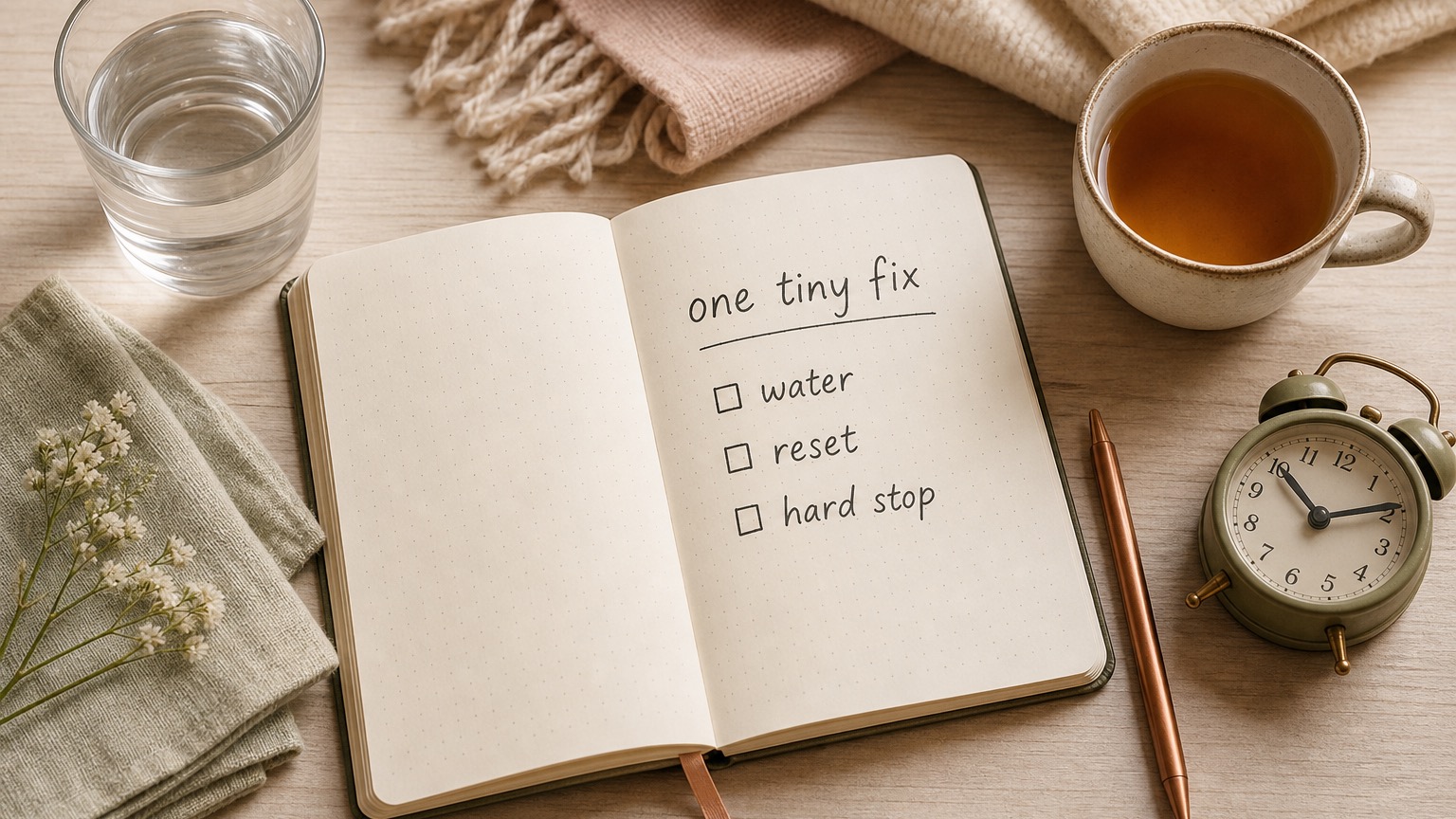
2. Protect the first five minutes. Before your phone, before email, before anyone needs anything: do one intentional thing. Even if it is just drinking a glass of water standing in front of a window. It counts.
3. Try the thirty-second reset. Between tasks, before a difficult conversation, after something goes wrong, three slow breaths and the decision to be here now. This is the smallest possible version of the meditation practices you already know work but haven’t built into your day yet.
4. Set a hard stop. Decide now what time you will stop working today. Write it down. Honour it. Not because everything will be done – it won’t. Because your brain needs the boundary to allow itself to rest.
5. Change “I should be doing more” to “what is the smallest useful thing right now?” This is perhaps the deepest tiny fix of all.
The exhaustion of the tired life is often the exhaustion of measuring yourself against an imaginary version of yourself who does everything. One small useful thing is always available. It is always enough.
Why This Belongs in Roots
Roots is the section of this blog where I put the things that are about foundations – home, daily rhythms, the infrastructure of a life. The Bullet Journal Method (Ryder Carroll) lives here. How to Keep House While Drowning (KC Davis) lives here.
Mel’s tiny fixes live here because they are about the quality of ordinary time. Not the extraordinary. Not the goal-achieving, the breakthrough moments, the transformation. The Tuesday morning. The 2pm slump. The transition from school pickup to making dinner. The moment you stop for the night.
These are the moments that make up most of a life. And a life that works is built in those moments, not in the big plans, but in the small, consistent choices made when no one is watching and nothing is dramatic and everything just needs to get done.
Tiny fixes. Enough.
Notes from Soph | Learning, not perfection.
Et toi? What’s one tiny fix you could make this week – just one – that would make a real difference? Come and share it in the Notes from Soph community on Skool. I love seeing what people come up with when the bar is low enough to actually try.
Source Details: The Mel Robbins Podcast: Episode 19, Tiny Fixes for a Tired Life Mel Robbins | 2024
🎙 Listen on melrobbins.com or search “Mel Robbins Podcast” on Apple Podcasts / Spotify

