Mon ado, ma bataille: When Parenting Becomes a Power Struggle
Mon ado ma bataille is the phrase I am using for this note, because it holds the main idea I want to remember.
There is a particular kind of parenting moment where everyone can feel the battle beginning.
A tone changes. A door closes a little too sharply. A simple request lands as an attack. You say one more sentence because you are trying to help, or because you are worried, or because you cannot quite let it go and suddenly the whole room has shifted.
No one meant to start a battle.
But there you are.
That is why the title Mon ado, ma bataille caught my attention. It names something parents are not always proud to admit: sometimes the relationship with a teenager can start to feel like two people on opposite sides of a line, both trying to be heard and neither quite knowing how to move first.
Emmanuelle Piquet’s book is useful because it does not pretend adolescence is easy. It also does not treat teenagers as the problem. Instead, it looks at the relationship pattern: what keeps repeating, what each person does to protect themselves and how parents can stop feeding the fight without giving up their role.
That feels like exactly the kind of Heart work that matters.
Table of Contents
Who Is Emmanuelle Piquet?
Emmanuelle Piquet is a French therapist, author and founder of the Chagrin Scolaire centres, which use brief strategic therapy to help children, teenagers and families navigate suffering at school and at home.
Her work often focuses on situations where well meaning adult responses accidentally keep a painful pattern going. Bullying, school anxiety, parent child conflict, repeated battles at home. The question is not simply “Who is wrong?” The question is: what is the loop and how do we interrupt it?
Mon ado, ma bataille applies that lens to adolescence.
That is what makes the book different from a lot of parenting advice. It is not a list of perfect phrases. It is not about becoming endlessly calm while everyone else gets to be difficult. It is about seeing the pattern clearly enough to stop participating in the bit that is making things worse.
When Help Starts Feeling Like Pressure
One of the painful things about parenting teenagers is that the things we do because we care can start to land as pressure.
The reminder about homework. The question about sleep. The suggestion about friends. The small comment about the room, the revision, the phone, screens in general, getting fresh air, the tone, the plan.
From the parent side, it can feel like love, guidance and ordinary responsibility.
From the teenager side, it can feel like surveillance, criticism or proof that they are not trusted.
This is where so many battles begin. Not because parents are trying to control every detail. Not because teenagers are trying to be impossible. Because the same sentence is carrying completely different meanings on each side.
This made me think about how quickly we can move from care to correction without noticing. A question that begins as interest can become interrogation if the other person already feels watched. Advice that begins as support can become pressure if the other person is trying to feel capable.
That does not mean we stop parenting. Teenagers still need adults. They need boundaries, steadiness and someone who can see beyond the drama of the moment.
But they also need room to feel that their life is becoming theirs.
That balance is hard. Piquet’s work is helpful because it asks parents to notice the effect of what they are doing, not only the intention behind it.
The Trap of Doing More of the Same
A core idea in strategic therapy is that when something is not working, we often do more of it.
If the teenager withdraws, the parent asks more questions.
If the teenager argues, the parent explains more carefully.
If the teenager ignores a request, the parent repeats it louder, longer or with more emotion.
If the teenager says, “You do not trust me,” the parent produces more evidence that they are only trying to help.
And then everyone feels stuck.
The parent feels exhausted because they are doing so much. The teenager feels cornered because every attempt to create space seems to produce more pursuit. The pattern tightens.
I find this idea both uncomfortable and freeing. Uncomfortable because it means our well meaning efforts might be part of the loop. Freeing because it means we do not have to fix everything at once. Sometimes the first move is simply to stop doing more of the same.
This connects beautifully with How to Talk So Kids Will Listen, which also starts from the idea that connection has to come before correction. And with Hold On to Your Kids, which reminds us that the relationship itself is the foundation.
If the pattern is damaging the relationship, the pattern has to be addressed before the lecture can land.
Stepping Out of the Power Struggle
The phrase “pick your battles” is everywhere in parenting but it can sound a bit resigned. As if family life is always going to be war and the best we can do is choose the least exhausting front.
What I take from Mon ado, ma bataille is more subtle than that.
The point is not to ignore everything.
The point is to stop turning every issue into a contest of wills.
A power struggle needs two people pulling on the rope. If one person changes how they hold the rope, the whole system changes. This does not mean becoming passive. It means becoming strategic.
Sometimes that might mean saying less. Sometimes it might mean stating the boundary once and not entering the ten minute negotiation that usually follows. Sometimes it might mean naming the pattern gently: “I can feel us moving into our usual argument. I do not want to do that tonight.”
Sometimes it might mean letting a small natural consequence teach what a lecture never could.
This is hard because, in the moment, stepping out can feel like losing. Especially when the tone is sharp, or the stakes feel high or your own nervous system is already activated.
But not every refusal to argue is a defeat. Sometimes it is leadership.
Repair Matters More Than Winning
What I appreciated most about this book is that it keeps bringing the focus back to the relationship.
With teenagers, it is easy to get hypnotised by the immediate issue: the homework, the room, the screen, the attitude, the lateness, the forgotten thing. Those things matter. Of course they do.
But the bigger question is: what is happening to the connection while we deal with them?
If every practical issue becomes proof that the other person is wrong, careless, controlling, disrespectful, ungrateful or impossible, the relationship starts to carry too much weight. Ordinary problems become identity statements. Everyone digs in.
Repair is the antidote.
Not a dramatic family meeting every time something goes wrong. Just small returns to connection.
“That came out sharper than I meant.”
“I am not against you. I am worried and I did not express it well.”
“Can we try that conversation again?”
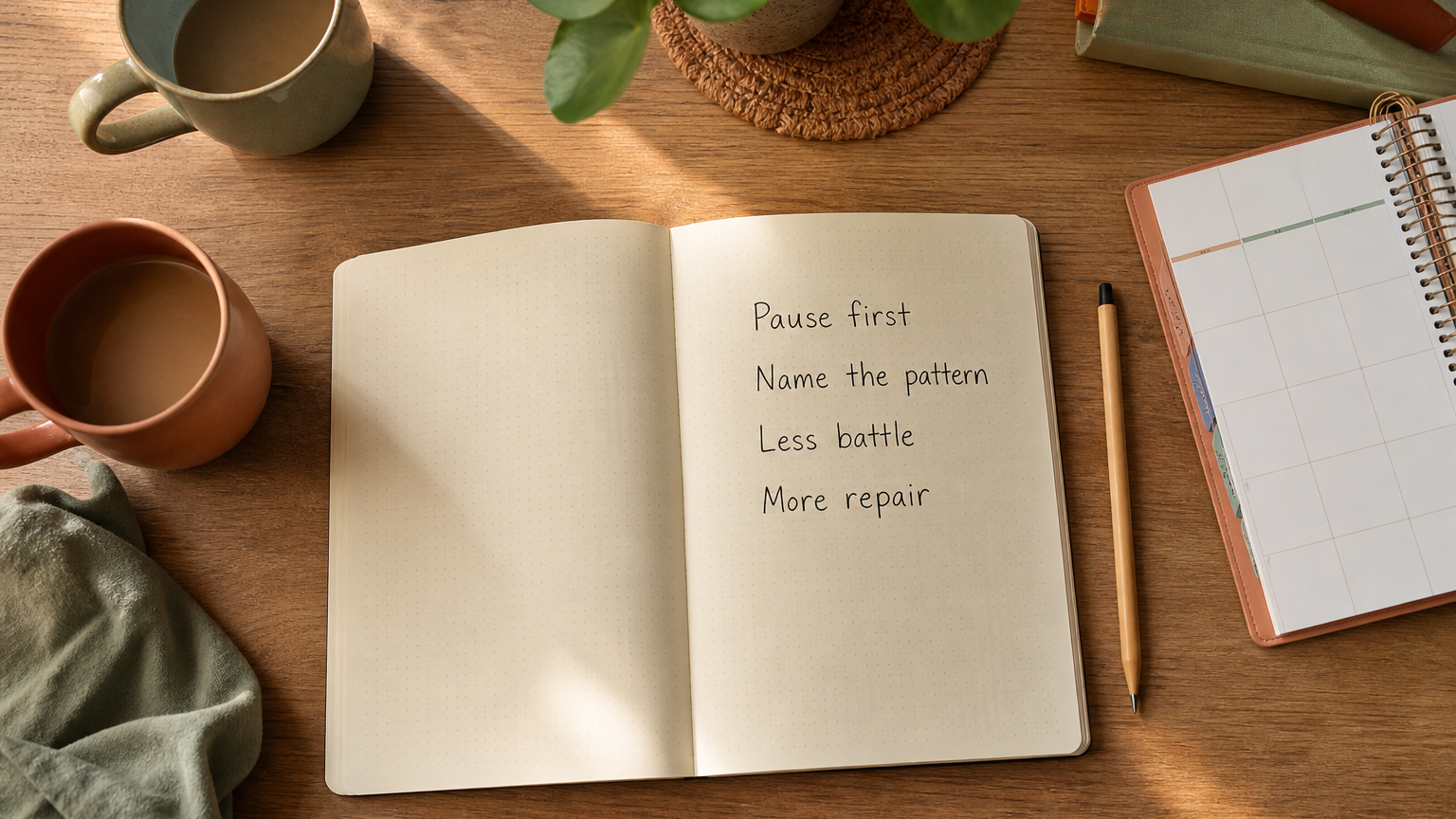
“I am going to pause because I do not want to make this worse.”
These sentences do not solve adolescence. Nothing does. But they protect the bridge.
And with teenagers, the bridge matters.
Practical Takeaways
- Look for the loop before you look for the solution. What keeps repeating? Who does what first? What do you usually do next? A pattern is easier to change once you can see its shape.
- Ask whether your help is landing as help. Your intention matters, but so does the effect. If every reminder becomes a fight, the reminder system may need changing.
- Stop doing more of what is not working. More explaining, more checking, more repeating and more emotional force often strengthen the pattern. Try doing less, but more clearly.
- State boundaries without entering every debate. A calm boundary does not need a ten minute defence. Say it once if you can, then step away from the tug of war.
- Use repair quickly and simply. You do not need a perfect speech. Try: “That came out wrong” or “I do not want us to fight like this.” Repair keeps the relationship bigger than the issue.
- Protect the bridge. The goal is not to win against your teenager. The goal is to stay connected enough that they can still come back to you.
Why This Belongs in Heart
Heart on this blog is about relationships: the people we love, the patterns we repeat and the skills that help us stay connected when life gets messy.
Mon ado, ma bataille belongs here because adolescence is not only a parenting stage. It is a relationship transition. The child is changing. The parent has to change too. The old tools do not always work, but the need for connection is still there.
This post belongs alongside How to Talk So Kids Will Listen, Siblings Without Rivalry, Hold On to Your Kids and On ne se comprend plus. They are all, in different ways, about the same thing: how to keep love available when communication becomes difficult.
I do not think the goal of parenting teenagers is to avoid every conflict. That would be impossible and probably not very honest.
The goal is to notice when conflict has become a pattern. To stop mistaking control for connection. To remember that the sharp sentence in front of us is not the whole child and the worried reaction inside us is not always the whole truth either.
Mon ado, ma bataille is useful because it gives parents permission to step out of the fight without stepping out of the relationship.
That distinction matters.
Especially on the days when everyone is tired, the tone is wrong and the battle is just about to begin.
Notes from Soph | Learning, not perfection.
Et toi? Do you recognise the moment when a normal parenting conversation starts turning into a battle? Come and talk about it in the Notes from Soph community on Skool. Quiet, honest parenting conversations are exactly what Heart is for.
Book Details:
Mon ado, ma bataille by Emmanuelle Piquet Published by Payot
📚 Amazon France https://www.amazon.fr/s?k=Mon+ado+ma+bataille+Emmanuelle+Piquet&tag=websitenotesf-21
Disclosure: affiliate link. If you buy through this, I earn a small commission at no extra cost to you. Thank you!

