Mon Rovîa: 3 Surprising Reasons Making Peace With Yourself Is the Best Work You’ll Ever Do
For as long as I can remember, I have been “too much.”
Too intense. Too sensitive. Too in my own head. Too quick to feel things that other people seem to shrug off. Too slow to forgive myself for getting things wrong.
At some point I started treating this as a project to fix. If I just read enough books, did enough inner work, practised enough NVC, took enough notes, surely I would become a calmer, more measured version of myself.
I listened to Mon Rovîa in conversation with Mel Robbins on a drive home from Draguignan. By the time I pulled into the driveway, I was questioning the whole project.
There was also something about his voice and pace that disarmed me. Mon Rovîa is a beautiful singer, and his songs have that same chilled, transporting quality, like they slow the room down around you. No shiny performance. No aggressive “be your best self” energy. More like someone sitting beside you saying, gently, “what if the thing you keep trying to erase is actually asking to be understood?”
I needed that tone. I am very good at turning personal development into another measuring stick. Have I healed enough? Have I journaled enough? Have I become calm enough? It sounds ridiculous when I write it out, but this is how the inner critic sneaks into even the most well-intentioned work.
Mon Rovîa made me notice that I was still trying to improve myself from a place of rejection. Different tools, same war.
Table of Contents
Who Is Mon Rovîa?
Mon Rovîa is a singer, songwriter and artist whose work circles identity, self-worth and the deeply embedded stories we carry about who we are. He does not talk in platitudes. He talks about the specific, lived mechanics of how we come to believe we are not enough, or too much, and what it actually takes to begin undoing that.
What struck me immediately was the distinction he draws between self-improvement and self-acceptance. We tend to treat them as part of the same project. They are not. Self-improvement says: I need to become different in order to be acceptable. Self-acceptance says: I am acceptable right now, as I am, while I grow.
Those feel like subtly different framings. They are not. They produce completely different inner lives.
Why Making Peace Is Not Giving Up
This is the first surprising reason I think Mon Rovîa’s work matters so much: making peace with who you are is not the same as settling.
I spent years confusing acceptance with resignation. If I accepted that I was sensitive, wouldn’t I just give myself permission to stay reactive? If I accepted that I overthought everything, wouldn’t I just become more of an overthinker?
Mon Rovîa turns this around. He points out that the resistance, the constant low-level war against parts of yourself, is actually what keeps you stuck. The energy you spend fighting your own nature is energy that cannot go into growing, connecting, or creating anything.
The Chimp Paradox talks about the emotional brain acting before the rational brain can catch up. Mon Rovîa’s work operates in that same territory. You cannot reason yourself out of a shame response. But you can begin to know yourself well enough that you stop being surprised by it.
Where the Narrative Comes From
The second surprising thing is how early the story starts.
Mon Rovîa traces most of our deepest self-beliefs, I am too much, I am not enough, I need to be a certain way to be loved, back to childhood. Not necessarily dramatic trauma (though sometimes that), but the ordinary, accumulative experience of learning which version of you was welcomed and which version made people uncomfortable.
I thought about my teenage daughters constantly during this conversation. When I read Hold on to Your Kids, I understood how attachment shapes everything. Mon Rovîa adds the interior dimension: the stories those attachment experiences plant, and how long they run on autopilot before we even notice them.
The question he invites you to ask is not “what is wrong with me?” but “whose voice is that, actually?” When the inner critic speaks, it is rarely your own adult voice. It usually belongs to someone, somewhere, from a long time ago.
That reframe alone was worth the entire drive.
What It Changed in My House
The practical shift for me has been small but surprisingly uncomfortable. I am trying to stop apologising for normal needs. Needing quiet after a full teaching day. Needing time to process before answering. Needing to write things down because my brain works better on paper. None of those are character flaws. They are operating instructions.
This matters with my teenage daughters too. If I keep modelling self-rejection, they will learn that womanhood means constantly editing yourself into acceptability. I do not want that for them. I want them to see a mother who grows, yes, but who does not hate herself into growth.
That is not easy for me. The old reflex is still there: explain, justify, soften, make myself easier to digest. But I am beginning to hear it now. And once you hear the old performance voice, there is no turning back.
Making Peace in Practice
The third surprising reason this matters is the most practical: people who have made peace with themselves are easier to be around.
Not because they are serene or untroubled. Because they are honest. They do not need you to validate them constantly, because they have stopped outsourcing their sense of okayness. They can hold space for you because they are not using all of their bandwidth managing their own anxiety about being acceptable.
I want to be that person for my children. I am not there yet. But I understand now that the path is not about fixing the difficult parts of myself first. It is about making a relationship with them, curiosity rather than war.
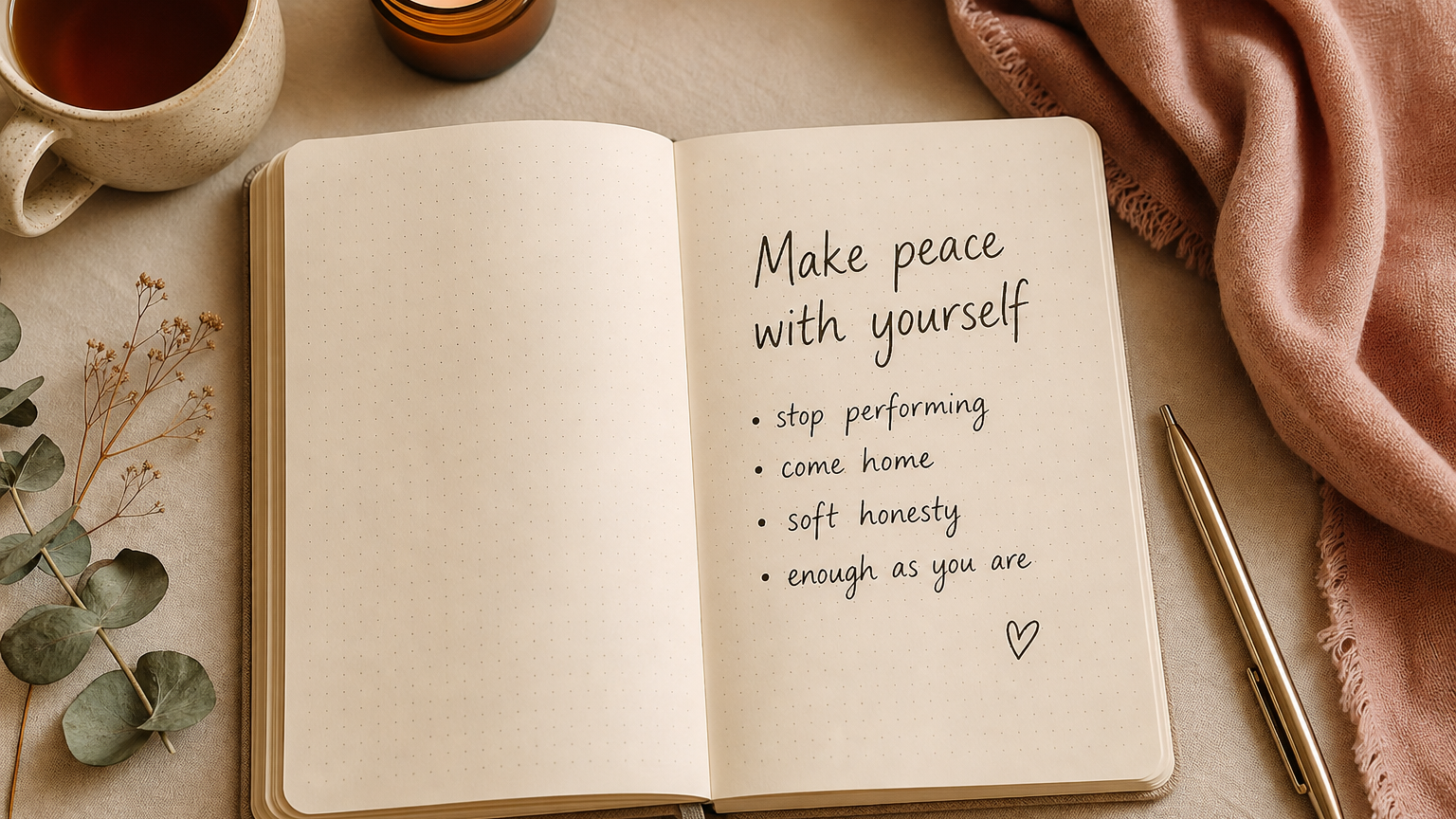
Practical Takeaways
- Name the narrative you’re living inside. “I am too much,” “I am not enough,” “I have to earn love”, write it out. You cannot work with something you cannot see.
- Trace where it came from. Whose voice is the inner critic using? Understanding the source reduces its authority.
- Notice when you are performing rather than being. There is a felt difference. Begin to recognise it.
- One act of radical self-acceptance per week. Not grand gestures, small moments of choosing not to apologise for a legitimate need.
- Separate growth from self-rejection. You can want to grow without hating where you currently are. The Let Them Theory applies to yourself too, let yourself be where you are, while you move forward.
Why This Belongs in Heart
This is in my Heart section because making peace with who you are is, at root, a relational skill. Your relationship with yourself shapes every relationship you have with other people. The war inside leaks out. So does the peace.
I am still a work in progress. I am still too much, some days. But I am beginning to think that “too much” might be the interesting part.
Notes from Soph | Learning, not perfection.
Et toi? What part of yourself have you been at war with the longest? Come and share it, gently, no pressure, in the Notes from Soph community on Skool. You are not alone in this.
Source Details: The Mel Robbins Podcast, “This Life-Changing Conversation Will Help You Make Peace With Who You Are” Mel Robbins | 2025
🎙 Listen to the exact episode on Apple Podcasts or search “Mel Robbins Podcast” on Spotify

