Emotional Suppression: The Worst Thing You Can Do to Your Brain, According to Jim Kwik
I thought I was good at this.
I journal. I have done EFT tapping every day for months. I have read NVC three times in two languages. I have attended workshops. I take notes on everything I hear and read.
Surely all of that adds up to being someone who processes their emotions well?
Jim Kwik made me question every single part of that assumption.
Table of Contents
What Emotional Suppression Actually Does
The Kwik Brain episode on trauma and emotional suppression is not a gentle listen. Jim Kwik walks through the neuroscience of what happens when we experience something difficult and, instead of feeling it, we push it down, hold it together, get on with things.
Here is what I had completely misunderstood: emotional suppression does not make the feeling go away. It stores it.
The amygdala, the brain’s threat-detection system, what Steve Peters calls the Chimp, encodes emotional experiences. When you suppress the emotion rather than process it, the amygdala registers the event as unresolved. It stays on high alert. The body keeps the score, as the phrase goes, but so does the brain.
And this matters for cognitive performance in a very direct way. A chronically activated amygdala suppresses the prefrontal cortex, the part of the brain responsible for decision-making, focus, learning, and emotional regulation. In other words: emotional suppression is not just an emotional problem. It is a brain performance problem.
This distinction hit me because I can mistake functioning for healing. I can teach a lesson, answer emails, make dinner and keep the house moving while something inside me is still clenched. From the outside, that looks like resilience. From the inside, it often feels like storage.
And storage has a cost. It comes out as tiredness, snapping, foggy thinking, insomnia, overexplaining, or the sudden need to cry over something tiny because the body has been waiting for a safe moment. Emotional suppression is sneaky like that. It lets you get through the moment, then sends the invoice later.
I do not think the answer is to fall apart in every difficult moment. Life does not always allow that. Children need feeding. Students need teaching. Bills need paying. But I do think the feeling needs an appointment somewhere, otherwise it keeps knocking.
The Difference Between Managing and Processing
This was the moment I had to stop and sit with something uncomfortable.
I am very good at managing my emotions in public. I stay calm in a crisis. I hold it together in front of my students, the difficult moments that teaching and parenting throw at you regularly. I have developed an impressive capacity for not falling apart.
But managing, Jim Kwik explains, is not the same as processing. Managing means keeping the feeling contained. Processing means actually moving through it, feeling it in the body, acknowledging it, allowing it to complete its physiological cycle, and then releasing it.
The physiological cycle matters here. According to the neuroscience, the stress response, the cascade of cortisol and adrenaline that fires when we feel threatened, lasts approximately 90 seconds in the body if you allow it to move through. If you interrupt it by suppressing or distracting, the charge does not disappear. It goes into storage.
I have a lot in storage, I think.
Why Body-Based Practices Matter
This is why I believe EFT tapping and NVC combined work where talking alone sometimes does not. Both are body-based. Both engage the nervous system directly rather than just working through the cognitive layer.
The Kwik Brain episode is clear on this: the brain and the body are one system. Trauma and emotional suppression live in both. You cannot think your way out of a felt experience that never finished completing itself.
Jim Kwik talks about emotional hygiene in the same way he talks about brain hygiene, as a daily practice, not an occasional event. Just as you would not let physical tension accumulate for weeks and then try to release it all at once, emotional processing works better when it is regular and small rather than sporadic and overwhelming.
This reframed my journaling practice entirely. I was using it to analyse and understand. That has value. But it is different from using it to feel, to sit with something uncomfortable long enough for the nervous system to complete the cycle and move on.
My New Rule: Do Not Skip the Body
The change I am making is to stop beginning with analysis. My instinct is always to write the story first: why I feel this, who triggered it, what it means, what pattern it belongs to. Useful, sometimes. But it can also become a very elegant way of avoiding the actual sensation.
So now I am trying to begin more simply. Where is it? Chest, throat, stomach, jaw? Is it hot, tight, buzzing, heavy? Does it want movement, breath, tapping, a walk, or five minutes with my notebook and no performance?
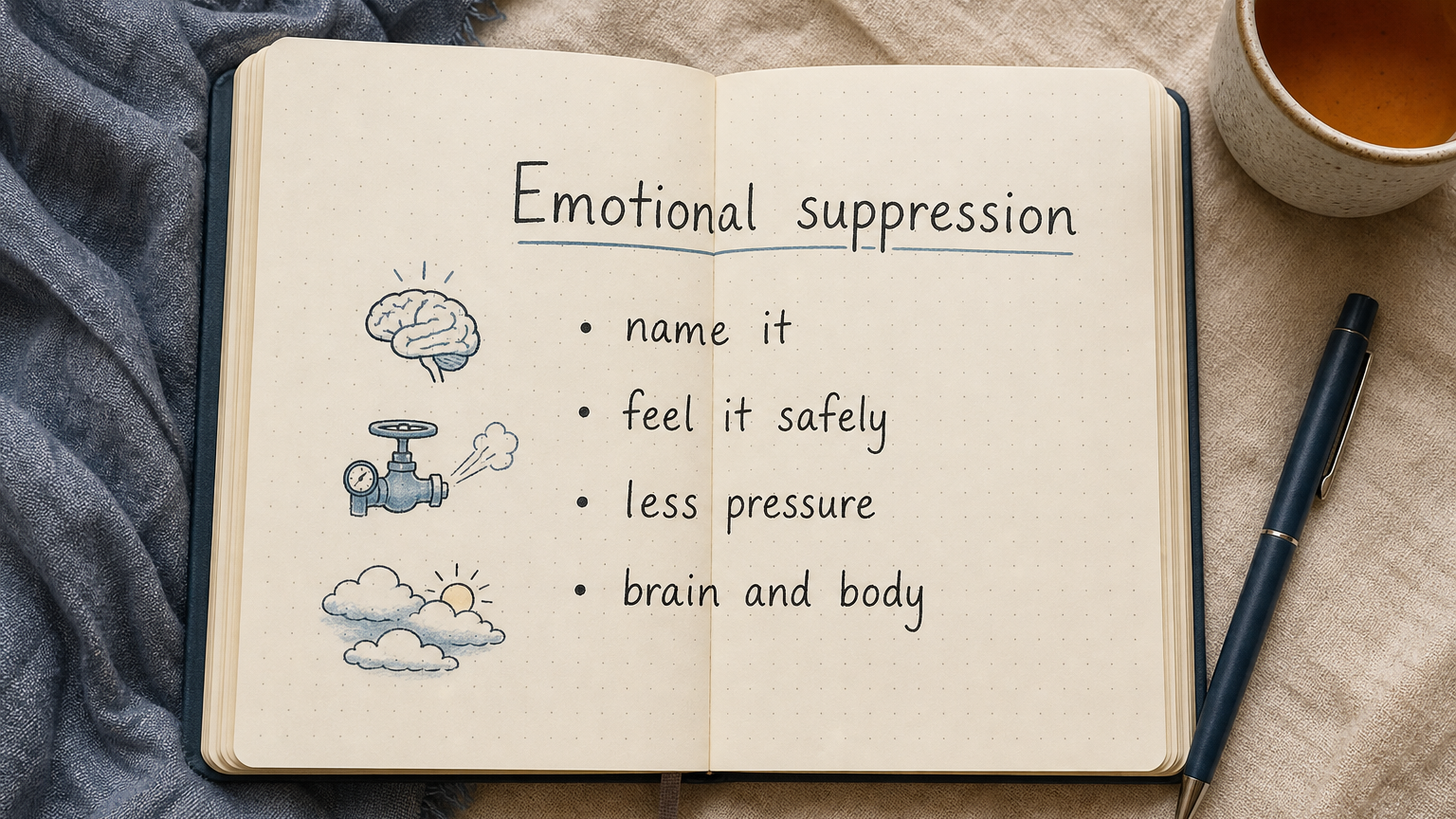
This is not glamorous work. It is not the kind of personal development that looks beautiful on Instagram. But it is real. And if Jim Kwik is right, it is also brain care. Naming the feeling is not indulgence. Feeling it safely is not weakness. It is maintenance. Full stop.
Practical Takeaways
The Limitless framework gave me the tools to learn better. This episode gave me the reminder that brain health is not just about sleep and nutrition and focus techniques. It also requires tending to the emotional backlog.
Practically, this is what I am working on:
- Name the emotion precisely, not “stressed” but “afraid,” not “annoyed” but “embarrassed.” Research shows that precise emotional labelling reduces amygdala activation. You cannot process what you have not named.
- Find it in the body first. Where is the feeling sitting? Chest? Throat? Stomach? Going to the body before the brain changes the processing entirely.
- Let the 90 seconds happen. When something triggers a strong response, the hardest thing is to not immediately suppress or distract. The physiological response will pass in about 90 seconds if you allow it. That is very short. It just feels very long.
- Distinguish managing from processing. Staying calm in the moment is sometimes necessary. But schedule the processing for later, do not just leave the feeling in storage indefinitely.
- Use body-based tools regularly. Tapping, breathwork, movement, not as a crisis response but as a daily emotional hygiene practice. The DOSE Effect framework reinforces this: dopamine, oxytocin, serotonin, and endorphins are all influenced by whether we are processing or suppressing.
Why This Belongs in Mind
Emotional health is brain health. That is the thing I keep coming back to. The suppression of feeling does not leave the mind untouched, it directly impairs the cognitive functions I care most about: learning, focus, decision-making, connection.
Taking care of the emotional backlog is not separate from optimising the brain. It is part of it.
I still journal. I still tap. I still take notes. But I am doing all of it a little differently now.
Notes from Soph | Learning, not perfection.
Et toi? Is there something you have been managing rather than processing? Come and share, no performance required, in the Notes from Soph community on Skool. Figuring this out together is the whole point.
Source Details: Kwik Brain, “What Trauma and Emotional Suppression Are Doing to Your Brain” Jim Kwik | 2026
🎙 Listen at jimkwik.com or search “Kwik Brain” on Apple Podcasts / Spotify

