If You’re Feeling Uncertain and Stressed, You Need to Hear This
Uncertainty and stress have a very particular flavour, don’t they?
It is not always dramatic. It is not always sobbing on the floor or making enormous life decisions at 2am. Sometimes it is much quieter than that. It is standing in the kitchen with one hand on the kettle, thinking about money, family plans, a work email, a child who needs something, the washing that has become a small mountain and the question you keep avoiding because you still do not know the answer.
It is that feeling of wanting life to pause until you feel certain.
I know that feeling well. I want to know how things will turn out before I choose. I want the tidy plan, the right timing, the reassurance that nobody will be disappointed and the guarantee that I will not look back in six months and think, “Well, Soph, that was a questionable choice.”
But life rarely gives us that kind of certainty upfront.
For me, uncertainty and stress become easier to handle when I stop demanding a complete answer and look for one honest next step.
The awkward truth is that uncertainty is not usually solved by thinking harder. Sometimes thinking is useful, of course. I am not suggesting we all become wildly impulsive and call it spiritual growth. But there comes a point where thinking becomes circling. You are not gathering information anymore. You are trying to manufacture a level of safety that real life cannot offer.
When uncertainty and stress are high, the brain often wants certainty before action. It wants the whole path lit up before it agrees to take one step. It wants proof that the decision will work, that the conversation will go well, that the move will be worth it, that the family will adjust, that the work thing will settle, that the money will stretch and that everyone will be okay.
I understand why. Certainty feels safe. But sometimes the way through is not a grand answer. Sometimes it is the next kind, visible step.
Table of Contents
Why Uncertainty and Stress Feel So Heavy
Uncertainty is hard because it asks us to live without the thing our nervous system is often begging for: control.
If you are waiting on news, trying to make a family decision, wondering whether to change direction at work or holding several people’s needs in your head at once, your mind can become a very noisy room. Every possible outcome wants attention. Every risk wants a chair at the table. Every past mistake decides this is the perfect time to reappear and offer completely unhelpful commentary.
You might find yourself doing things that look sensible from the outside but feel exhausting on the inside:
- Rechecking the same options again and again
- Asking for reassurance but not really absorbing it
- Imagining worst case scenarios as if rehearsing them will prevent them
- Delaying small tasks because the bigger question feels unresolved
- Snapping over tiny things because your system is overloaded
- Feeling guilty for not being more calm, clear or grateful
The stress is not only about the decision itself. It is also about the mental load of trying to predict the future while still functioning in the present.
And real life does not stop being real life just because you are uncertain. This is also where EFT tapping has been useful for me – not as a solution to uncertainty, but as a way to stop the nervous system from treating it as an emergency.
Dinner still needs making. The school form still needs sending. The invoice still needs chasing. The family group chat still exists. Someone still cannot find their shoes. Work still expects replies. Your body still needs rest even if your brain thinks rest should be cancelled until further notice.
This is why uncertainty can feel so unfair. It arrives on top of everything else.
The Brain Wants the Whole Map
When I am uncertain, I often notice a part of me looking for the whole map. Not just the next turn. The whole thing.
I want to know whether saying yes to one opportunity will make life too stretched. I want to know whether saying no will close a door I might need later. I want to know if a home decision will feel right in a year. I want to know if a family conversation will create relief or tension. I want to know whether the thing I am worried about is actually a problem or just my tired brain having a little festival of anxiety.
The problem is that the whole map is rarely available. Most of the time, we get a torch, not floodlights. We get enough light for the next few feet. We get one honest conversation. One email. One budget check. One appointment. One boundary. One list. One walk around the block so we can come back to the problem with a slightly less frazzled mind. That can feel too small when the stress feels big.
But small does not mean meaningless. Small is often how life becomes manageable again.
The Next Kind, Visible Step
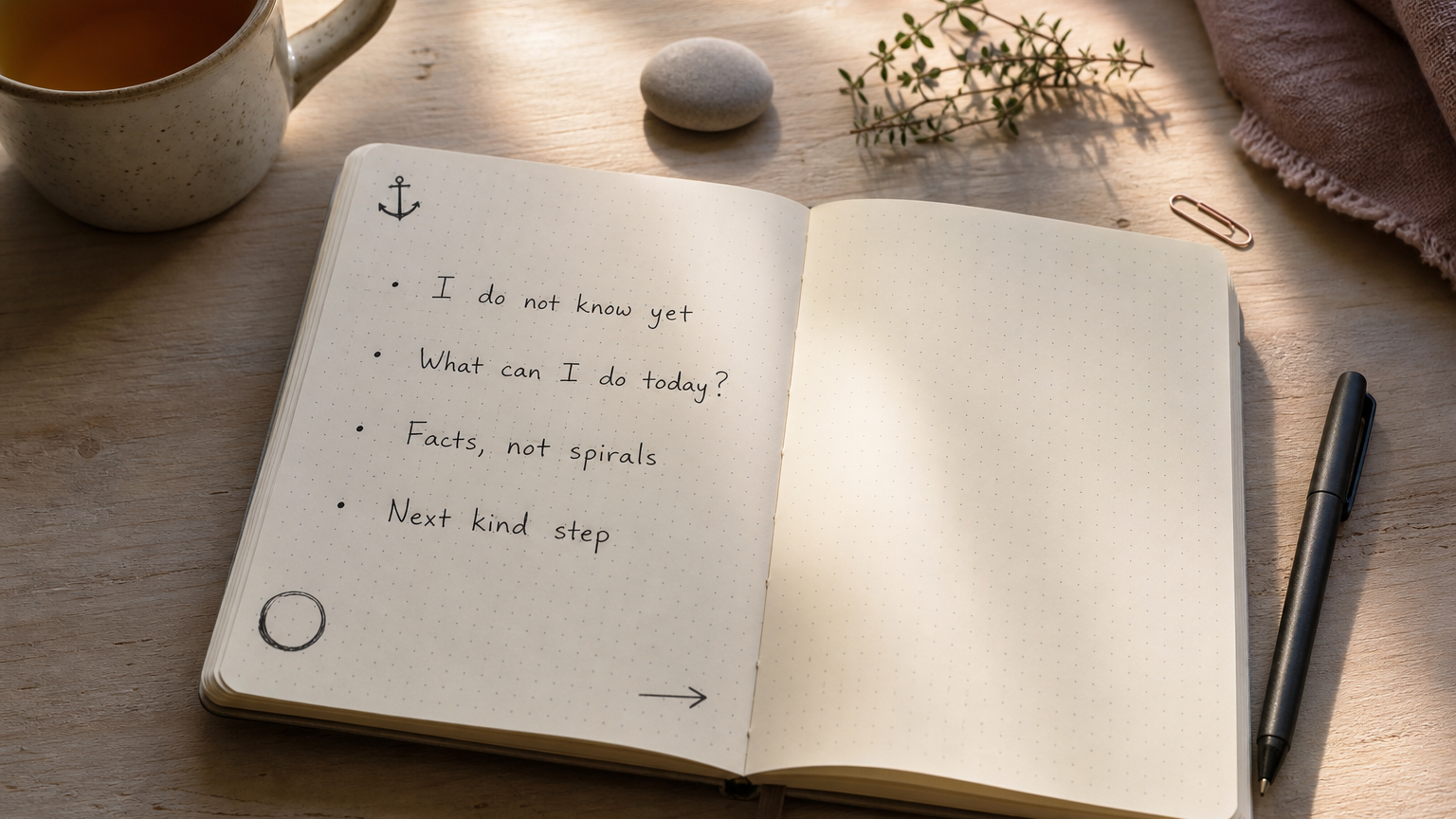
The phrase I keep coming back to is this: the next kind, visible step. Not the perfect step. Not the step that fixes the whole situation. Not the step that makes you look impressive, spiritually evolved or suspiciously calm. The next kind, visible step.
Kind matters because stress can make us brutal with ourselves. We start speaking internally like a terrible manager. “Sort it out. Hurry up. Why are you like this? Everyone else seems to cope.” None of that actually helps. It might create motion for a while, but it usually comes with resentment, panic or burnout attached.
Visible matters because uncertainty loves vagueness. “I need to sort my life out” is too big. “I need to understand what we can afford this month” is visible. “I need to deal with work” is too big. “I need to reply to that one message and ask for the deadline in writing” is visible. “I need to be a better parent, partner, daughter, friend and functioning adult” is too big. “I need to apologise for being sharp this morning and put my phone away for tea” is visible.
A visible step is something you can actually do. A kind step is something that does not abandon you while doing it.
What This Looks Like at Home
At home, uncertainty can show up in very ordinary clothes.
Maybe you are wondering whether to move house, change a routine, adjust childcare, spend money on something necessary but uncomfortable or have a conversation you have been putting off. None of these things need to be dramatic to feel heavy. Family decisions often carry more than logistics. They carry everyone’s feelings, preferences, histories and little unspoken fears.
A next kind, visible step might be:
- Looking at the actual numbers instead of carrying a vague money fog around all day
- Asking, “What do we know for sure?” before spiralling into what ifs
- Choosing one evening to talk rather than trying to solve it in irritated snippets
- Writing down the three options, not twenty seven
- Admitting, “I do not know yet, but I am paying attention”
Sometimes the kindest thing is not forcing a decision before it is ready. Sometimes the kindest thing is giving the decision a container so it stops leaking into every part of the day. This is why uncertainty and stress need practical containers, not just more thinking.
For example, instead of letting a house question haunt you from breakfast to bedtime, you might say, “We will talk about this on Sunday for forty minutes. Before then, I will gather the costs and you gather the practical questions.”
That does not solve everything. But it gives your nervous system a little proof that someone sensible is in charge. Even if that someone is you in leggings with yesterday’s mug still on the side.
What This Looks Like at Work
Work uncertainty has its own special talent for following you home.
It can be a contract question, a change in direction, a difficult colleague, a project that keeps shifting shape or the quiet worry that you are either doing too much or not enough. Sometimes the stress is not even from one clear problem. It is the constant low level hum of needing to be available, competent and cheerful while your mind is privately opening seventeen tabs of concern.
Again, the next step probably will not be “solve career forever”. It might be:
- Asking for clarity on what is actually expected
- Sending the email you have made enormous in your head
- Blocking one hour to finish the thing instead of touching it ten times
- Naming what is in your control and what is not
- Updating your CV quietly, not from panic but from self respect
- Speaking to someone sensible before making a stress based decision
There is a big difference between avoiding reality and refusing to panic.
The next kind, visible step lets you engage with reality without handing your whole body over to alarm.
When Other People Are Involved
One reason uncertainty and stress can feel so tangled is that we are rarely only deciding for ourselves.
We worry how our choices will affect our children. Our partner. Our parents. Our team. Our friendships. We imagine everyone’s reactions before anyone has even had one. We try to pre manage disappointment, confusion, inconvenience and judgement.
This is where I have to remind myself that care and control are not the same thing.
Care says, “I will think about how this affects people.”
Control says, “I must find a way for nobody to ever feel uncomfortable.”
That second one is impossible, and it will run you into the ground. The Let Them Theory helped me with this – letting people have their feelings while I remain responsible for mine.
A kind step might be telling the truth earlier. It might be saying, “I am not ready to decide, but I wanted you to know where my head is.” It might be asking for what you need without over explaining it into a legal document. It might be accepting that someone can be disappointed and you can still be doing your best. Nonviolent communication helped me with this – the idea that honesty and care can coexist without one sacrificing the other.
That is not selfish. That is adulthood with a pulse.
A gentle note before the takeaways: this is a personal reflection, not mental health advice. If uncertainty, anxiety or stress feels persistent, unsafe or bigger than ordinary support can hold, please speak to a qualified professional. You do not have to be heroic about being human.
Practical Takeaways
- Uncertainty feels stressful because the brain often wants certainty before action.
- You do not need the whole map to take the next honest step.
- Make the step kind, because self punishment does not create real clarity.
- Make the step visible, because vague problems become heavier the longer they stay vague.
- Separate care from control. You can consider other people without managing every feeling for them.
- Give big decisions a container, such as a time to talk, a list to gather or a specific next action.
- If you are overwhelmed, start with your body: food, water, sleep, fresh air and a slower breath are not silly. They are foundations.
- If stress feels unmanageable, persistent or unsafe, it is okay to ask for proper support. You do not have to be heroic about being human.
A Small Practice for Uncertain Days
If you are in the thick of uncertainty and stress today, try this before you ask your brain for another answer. Write down three columns:
- What I know
- What I do not know yet
- My next kind, visible step
Keep it plain.
What I know might be, “We need to reduce spending this month” or “I am tired and not thinking clearly” or “This conversation matters.”
What I do not know yet might be, “Whether the job will change” or “How they will respond” or “What the best long term option is.”
The next kind, visible step might be, “Check the account tonight” or “Ask for a meeting” or “Sleep before deciding” or “Talk to one person who is calm and honest.”
This practice will not make life certain. But it can make the next hour less foggy. And sometimes that is enough to begin.
Uncertainty and stress do not mean you are failing. They usually mean your brain is trying to protect you by predicting everything, controlling everything and keeping you away from regret. That makes sense, but it can also keep you stuck.
You are allowed to move without being completely certain. You are allowed to go slowly. You are allowed to make a decision with the information you have, then adjust when new information arrives. You are allowed to choose the next kind, visible step instead of demanding a life changing revelation from a tired Tuesday afternoon.
Final Thoughts
I wish I could tell you that certainty always arrives before the difficult bit. But most of the time, it does not. Most of the time, we become steadier by participating in our own lives while they are still unresolved. We learn that we can have the conversation, send the email, check the numbers, apologise, rest, ask for help or make the small brave choice without feeling perfectly ready.
Maybe the point is not to become someone who never feels uncertain. Maybe the point is to become someone who knows how to be kind to herself inside the uncertainty. So if you are feeling uncertain and stressed, you do not have to solve your whole life today. Look for the next kind, visible step. Then take that.
Why This Belongs in Soul
Soul is where I keep returning to steadiness, meaning and the small kind step when life feels too noisy. This belongs here because uncertainty and stress are not only planning problems. They are also moments where I have to remember how to stay with myself while life is still unfinished.
Notes from Soph | Learning, not perfection.
Et toi? When uncertainty and stress are high, what is one next kind, visible step you could take today? Come and share it in the Notes from Soph community on Skool.
Source Details: The Mel Robbins Podcast, If You’re Feeling Uncertain & Anxious, You Need to Hear This, Mel Robbins, 2025. Listen on Apple Podcasts.

