Exhausted Doing Everything Right? What Robin Malmasson Made Me Question
The title of this Limitless Project episode almost made me laugh, but not in a light way: “Pourquoi tu es épuisé alors que tu fais tout bien.” Why are you exhausted when you are doing everything right?
Well, well, well.
That question has followed me around in different forms for years. Why am I still tired if I am eating better? Why am I still wired if I have reduced sugar, taken the supplements, done the training, read the books, done the meditation, made the lists and tried to become the kind of woman who has a routine for everything? Why does trying to be well sometimes feel like another full-time job?
Robin Malmasson’s answer is not that healthy practices are useless. That would be too simple. In this episode with David Nicolas, he talks about spending around fifteen years exhausted while believing he was doing things properly: sport, cold baths, intermittent fasting, breathing, meditation and the whole stack of “good” practices that are supposed to optimise you.
Table of Contents
What changed for him was not abandoning every tool. It was changing the relationship with the tools. Instead of forcing a protocol because it is supposed to be optimal, he describes asking a much softer and more difficult question: what do I need this morning?
I found that annoyingly relevant.
Exhausted Doing Everything Right Can Mean Too Much Stress
The episode description says Malmasson realised that calming stress is not always enough to regulate the nervous system deeply. That distinction matters. I have often treated stress like something to manage on top of my life. Add breathing. Add supplements. Add exercise. Add better food. Add a tracking habit. Add one more thing that should help.
But what if the adding becomes part of the load?
In the early part of the conversation, Malmasson talks about the phase where he tried to combine everything in a very “military” way. Cold exposure plus intermittent fasting plus intense sport plus breathwork, all because each tool was supposed to be good. He says something very simple: more is not automatically better. Some tools are not complementary in the wrong context. Combined together, they can overload the nervous system.
That feels like a missing piece in so many health conversations. We often ask whether a practice is good. Cold baths, fasting, hard training, breathwork, strict food rules, productivity routines. But “good” is not enough information. Good for whom? Good when? Good on top of what? Good for a body that is already calm, or for a body that is running on fumes?
This is where the episode connects with what I have been exploring in Body posts, from Paléobiotique to Pleine Santé and Georgia Ede on diet and brain health. A practice does not exist in isolation. It lands in a real body, with hormones, sleep, digestion, stress, training, age, family life and emotional history all present at the same time.
The Trap of “Optimal”
I understand the appeal of optimal. It sounds safe. It sounds like if you follow the right protocol, you can stop guessing. This is probably why I am drawn to books, podcasts, functional medicine, nutrition, training plans and any system that promises a cleaner answer.
There is nothing wrong with wanting guidance. I need guidance. I am an eager learner, and I would much rather have a framework than float around vaguely hoping to feel better.
The problem begins when optimal becomes rigid.
Malmasson says his mornings are now less about a fixed stack and more about listening. Does he need movement? Breathing? Hydration? Meditation? Mobility? Rest? The important part is not that he has no structure. It is that the structure is in collaboration with the body rather than imposed on it like a punishment.
That word, collaboration, stayed with me.
I am not naturally good at collaboration with my body. I am much more likely to treat my body as a project that is being slightly uncooperative. I want to know the system, apply the system and get the result. If the result does not come, I tend to assume I have missed a step.
But sometimes the missing step may be listening. Not the lazy version of listening, where “my body wants this” becomes an excuse to avoid every effort. David Nicolas challenges that in the episode too, pointing out that humans are also creatures of habit and energy conservation. Malmasson agrees. Body listening is not simply obeying the first impulse. It is learning to distinguish between habit, avoidance, genuine need and the longer-term feedback of symptoms.
That is much more mature than “follow the protocol” or “just listen to your body.” It asks for attention over time.
Hormesis Has a Context
One of the themes named for the episode is hormesis. The idea, in simple terms, is that small doses of stress can make the body stronger. Exercise is hormetic. Cold exposure can be hormetic. Fasting can be hormetic. The dose matters.
This is where I think many of us get confused. If a little controlled stress can be good, and if the internet rewards dramatic discipline, it is easy to assume that more controlled stress means more resilience. But resilience is not built by endlessly adding stressors to a body that is already overwhelmed.
A cold bath might be a useful stimulus for one person and one more demand for another. Fasting might feel clean and stabilising in one season, then become too much in another. Hard training might build strength when recovery is available and drain you when recovery is not.
I keep thinking about my own health experiments here. Keto has helped me in some ways, but it has also raised questions about whether strictness is always safety for my body in this season. Training has been a big part of how I care for myself, but I also had to admit that CrossFit started to feel too brutal for recovery. Supplements and protocols can support me, but they can also become another list of things I must perform correctly.
The point is not to become suspicious of every healthy habit. The point is to stop treating the body as if it should respond to “healthy” stress without considering the total stress load.
Discipline Is Not the Same as Rigidity
The episode promises a discussion of the difference between discipline and rigidity, and that distinction feels very Notes from Soph.
Discipline can be loving. It can mean keeping a promise to yourself. It can mean going to bed, lifting weights, eating food that supports you, getting outside, doing the thing that future you will be grateful for. I do not want a life without discipline. I know myself too well for that.
But rigidity is different. Rigidity is when the rule becomes more important than the feedback. It is when the protocol continues even though the body is sending warning signals. It is when the identity of being disciplined matters more than the effect of the discipline.
That is where health can become strangely performative. Not necessarily for other people, although social media makes that worse, but for the part of ourselves that wants to prove we are not lazy, not weak, not failing.
I have to be careful here. I am not writing this as someone who has floated through life with perfect moderation. I am writing as someone who likes clear rules because clear rules quiet the noise. But I am learning that a rule can be useful without becoming a cage.
A flexible discipline might ask: what is the purpose of this practice today? Is it still serving that purpose? What is my body’s response afterwards? Do I feel steadier, clearer and more alive, or more depleted, brittle and wired?
That feels like a better question than “did I do it perfectly?”
Symptoms Are Feedback, Not Betrayal
One part of the transcript preview that stood out was Malmasson saying that if we cannot listen to the body in the moment, it will eventually show us through chronic symptoms: fatigue, sleep, digestion, metabolism or body composition. I do not want to turn that into a simplistic “all symptoms are messages” cliché, because bodies are complicated and people need proper medical support.
But I do think symptoms are information.
If I am constantly exhausted while doing everything right, then perhaps “right” needs to be examined. Not abandoned automatically, but examined. Maybe the timing is wrong. Maybe the dose is wrong. Maybe two useful tools are clashing. Maybe my nervous system does not need more stimulation today. Maybe the practice is fine, but my interpretation of the practice is too harsh.
This is the part that feels most useful for daily life. Instead of collecting more protocols, I can start collecting better feedback. How did I sleep after that? How was my digestion? Did training leave me pleasantly tired or flattened? Did the breathing help me come back to myself, or did I turn it into another task to complete? Did the routine support my life, or did my life shrink around the routine?
None of those questions gives an instant answer. But they give me a better direction.
Before the practical notes, a small reminder: I am not a doctor or health practitioner. This is a personal reflection on a podcast episode and my own body-listening questions, not medical advice. Please speak to a qualified professional before changing diet, supplements, training, medication or treatment, especially if you are dealing with ongoing symptoms, burnout, hormones or chronic fatigue.
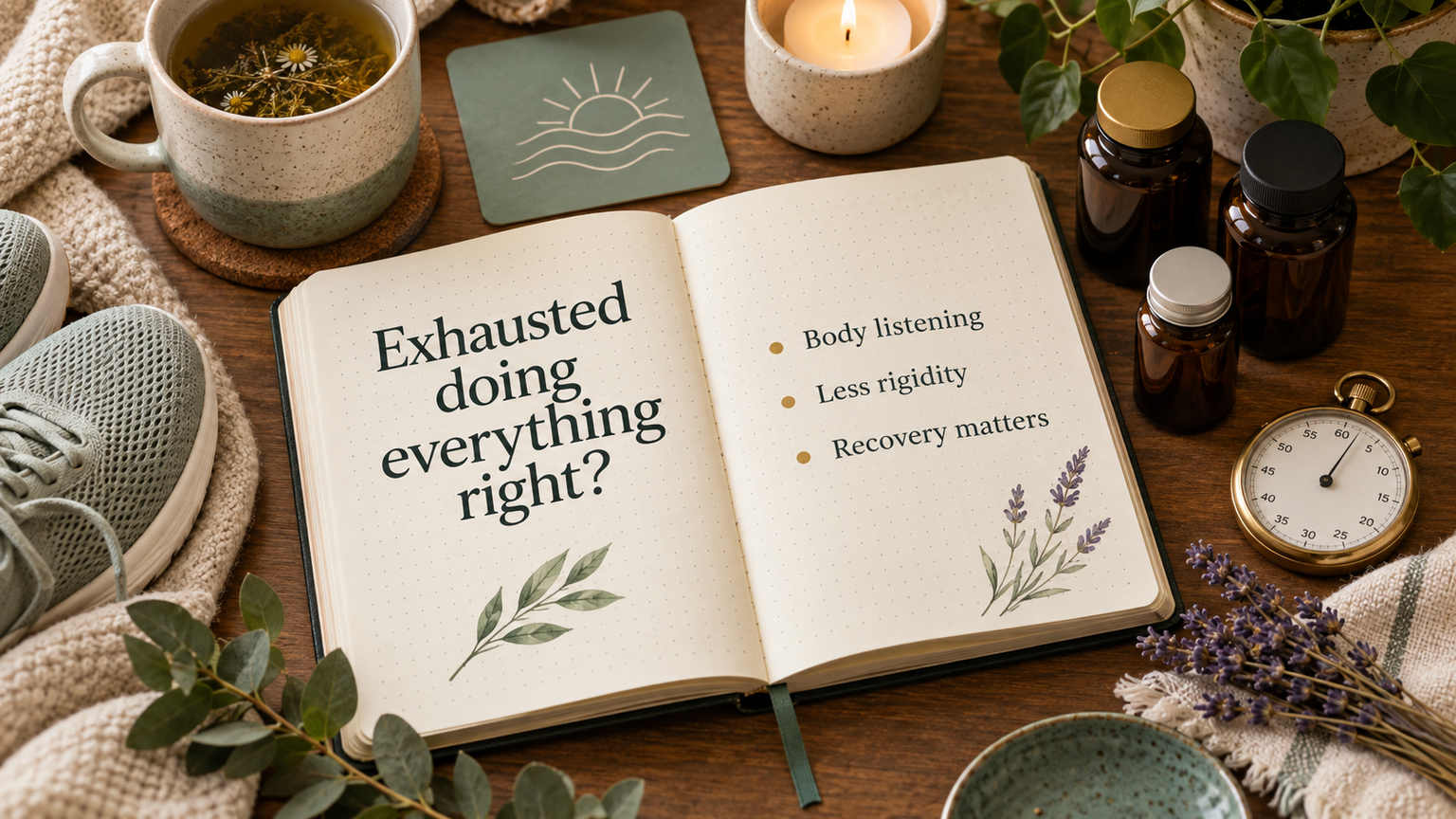
Practical Takeaways
- Ask what the practice is costing. A healthy tool can still become too much if it lands on top of chronic stress, poor sleep, hormone shifts or under-recovery.
- Separate discipline from rigidity. Discipline listens to feedback and adjusts. Rigidity keeps going because the rule has become the point.
- Watch the total stress load. Fasting, cold, intense training, breathwork and strict routines are not neutral when stacked together. Context matters.
- Use symptoms as information. Fatigue, sleep, digestion, mood and recovery are not moral failures. They are data from the body you actually live in.
- Let routines collaborate with your body. “What do I need this morning?” may be more useful than forcing the same routine every day because it looks optimal on paper.
Why This Belongs in Body
This belongs in Body because it is about health without turning the body into another performance project. That is a difficult balance for me. I want energy, strength, good ageing, calmer hormones, better digestion, clearer thinking and more physical freedom. I also know how quickly the pursuit of all that can become another pressure system.
Malmasson’s episode reminds me that body care is not only about choosing better tools. It is also about noticing when the tools have become too heavy.
The Notes from Soph version is this: health should make life more liveable, not smaller. A routine should support the body, not prove that I can override it. If I am exhausted while doing everything right, maybe the next step is not another protocol. Maybe it is a quieter question.
What is my body asking for now?
Notes from Soph | Learning, not perfection. Soph x
Et toi? Have you ever realised that a “healthy” habit had become another source of pressure? Come and share your experience in the Notes from Soph community on Skool. I would love to hear what helped you tell the difference between discipline and rigidity.
Source Details
Podcast: Limitless Project, “Pourquoi tu es épuisé alors que tu fais tout bien – Robin Malmasson”<br>Host: David Nicolas<br>Guest: Robin Malmasson<br>Published: 8 August 2026<br>Length: 1h34<br>Source: Limitless Project episode page · Podscan episode page · Apple Podcasts

