Addicted to Anxiety: How to Break the Anxiety Loop Without Blaming Yourself
Addicted to anxiety is a phrase that sounds dramatic until you have lived with a brain that keeps looking for the next thing to solve. Then it starts to make uncomfortable sense.
Not because anxiety is enjoyable. It is not. Not because anyone wakes up and thinks, “Lovely, I would like to spend today rehearsing everything that could go wrong.” But because worry can become familiar. The body can get used to the chemistry of alertness. The mind can mistake scanning for safety. And after a while, calm can feel strangely suspicious.
That is the part I find useful in Owen O’Kane’s framing. It takes anxiety out of the moral category. It is not a character flaw. It is not weakness. It is not proof that we are bad at life. It is a loop that the brain and body can learn, especially if being prepared, hyper-alert or one step ahead once helped us cope.
And if it was learned, it can be softened. Not by shouting at ourselves to calm down, because that never works for me. But by understanding the loop, interrupting it gently and teaching the body that safety is not the same as constant control.
Table of Contents
- What Addicted to Anxiety Helps Explain
- Why Worry Can Feel Like Responsibility
- The Body Needs Safety Before the Mind Believes It
- The Notes from Soph Version
- Practical Takeaways
- Why This Belongs in Mind
- Book Details
What Addicted to Anxiety Helps Explain
Owen O’Kane writes and speaks about anxiety, therapy, mental health and the practical work of becoming less ruled by old patterns. The idea behind Addicted to Anxiety is not that anxiety is a choice in the simplistic sense. It is that the brain can become attached to familiar cycles of threat, worry and relief.
That feels important.
Because anxiety often comes with so much shame. We think we should be more rational. We should know better. We should be able to relax when nothing terrible is happening. We should stop making everything into a problem.
But the anxious system is not usually trying to ruin our life. It is trying to protect it.
The problem is that protection can become over-protection. The mind checks, predicts, plans, rehearses and scans because uncertainty feels dangerous. Then the temporary relief of checking or worrying teaches the brain to do it again. The loop gets stronger.
That is why addicted to anxiety is such a useful phrase. It explains the pull of the pattern without blaming the person inside it.
Why Worry Can Feel Like Responsibility
One of the hardest parts of anxiety is that worry can feel virtuous.
If I am worrying, I am not being careless. If I am planning for every possible problem, I am being responsible. If I am tense, at least I am ready. If I am scanning everyone else’s mood, maybe I can prevent the explosion, the disappointment or the thing that tips the day over.
That is exhausting, but it can also feel necessary.
I see this especially in family life. There is always something to think about: children’s needs, school things, food, emotions, money, work, health, the house, the future, the invisible admin of being the person who remembers. A lot of what looks like anxiety is also a nervous system trying to hold too much.
This is where I need compassion, not another productivity system.
I have written before about uncertainty and stress and about why self-control is so hard when the brain is overloaded. This fits beside those ideas. Sometimes the answer is not to think better. It is to reduce the load, create safety and stop asking the mind to carry what the whole life structure needs to hold.
Worry can feel like love. It can feel like duty. It can feel like prevention.
But it is not the same as care.
Care can be practical, grounded and present. Anxiety drags the body into a future that has not happened yet, then asks it to live there.
The Body Needs Safety Before the Mind Believes It
I used to think calming down was mainly a thinking job.
Find the better thought. Reframe it. Be rational. Tell yourself it is fine. Look for evidence. All of that can help, but only up to a point. If the body is already in alarm, the mind does not always believe the nice sentence we are trying to give it.
The body needs proof.
It needs breath, food, rest, movement, warmth, steadiness, less caffeine if that is part of the picture, less doom-scrolling, fewer unnecessary inputs and more moments where nothing is demanded from it. It needs repetition too, because one calm evening will not convince a system that has been braced for years.
This is why I am interested in the phrase addicted to anxiety from a nervous-system angle. The loop is not only mental. It is physical. The body can start to expect the hit of urgency, and quiet can feel unfamiliar.
So the work is not to force calm. It is to make calm less foreign.
That might mean placing a hand on the chest and lengthening the exhale. It might mean walking outside before answering the message. It might mean writing the worry down and choosing one useful next step, rather than letting the brain run a whole imaginary court case. Or simply tapping it out or a mindfulness reset in my case.
Small, repeated signals of safety matter.
The Notes from Soph Version
The Notes from Soph version of this is: you are not broken because your brain learned to scan.
Maybe it learned that for a reason. Maybe anxiety once helped you stay alert, prepare, please, prevent, perform or survive emotionally. Maybe it became the way you tried to keep everyone and everything okay.
But you are allowed to outgrow a coping strategy that now costs too much.
That feels gentle to me. Not “stop being anxious”. Not “just relax”. Not “think positive”. More like: thank you, nervous system, I see what you have been trying to do. We are going to learn another way now. And another way does not have to be dramatic.
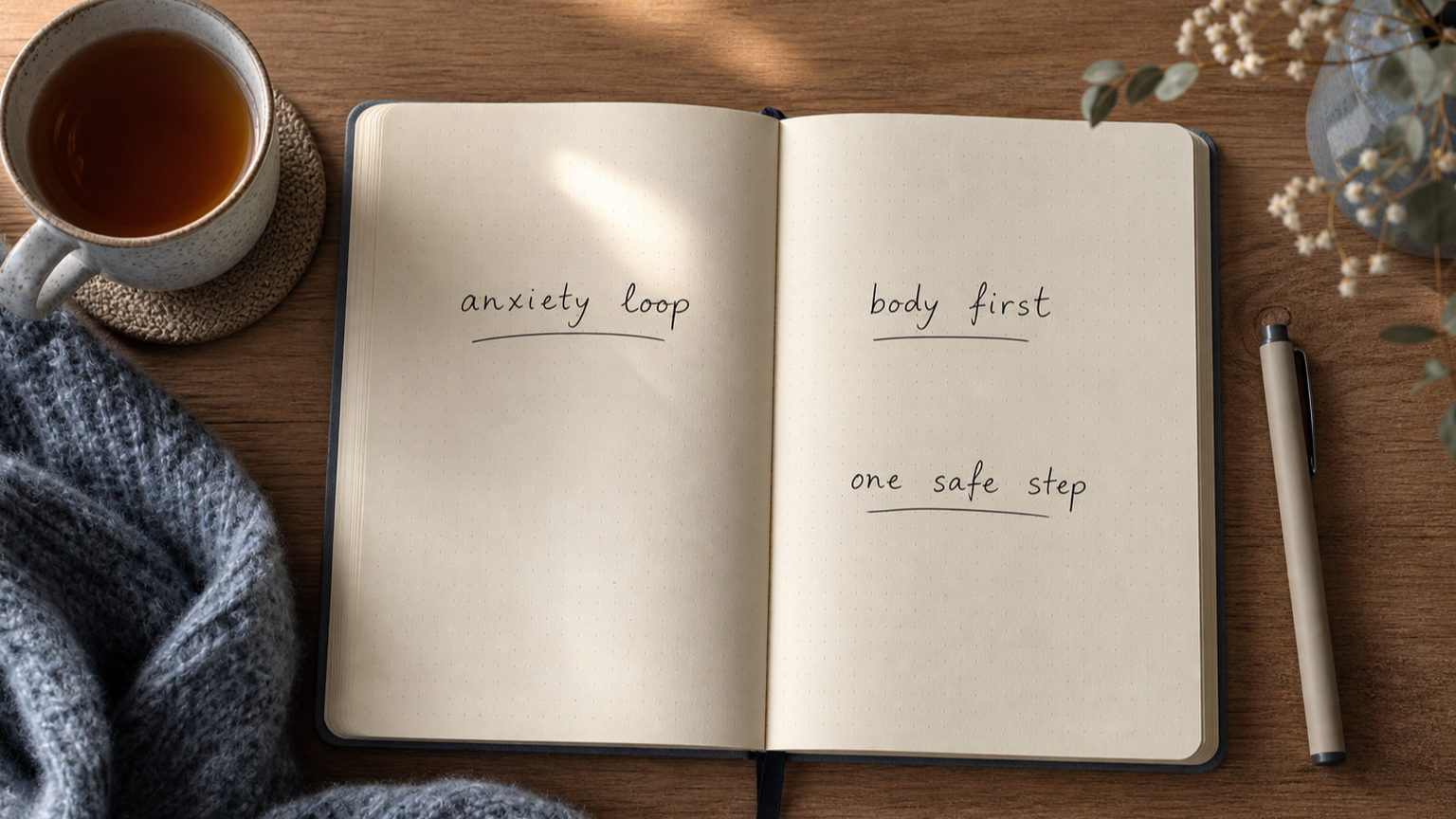
It can be one safe step. One honest no. One lower expectation. One less unnecessary input. One pause before the spiral. One moment where I choose care over control.
That is how I want to think about anxiety now. Not as an enemy to defeat, but as a signal to understand, a loop to interrupt and a body to reassure.
A quick note before the takeaways: I am not a doctor or therapist, and this is not mental-health advice. These are my book notes and personal reflections. If anxiety, worry or old emotional pain feels persistent, overwhelming or unsafe, please speak to a qualified professional and get proper support.
Practical Takeaways
- Name the loop without shaming yourself. Try saying, “This is the anxiety loop,” rather than “I am failing again.” Naming creates a little space.
- Ask what worry is trying to do. Is it trying to protect you, prepare you, keep people happy, avoid criticism or create certainty where there is none?
- Give the body a safety signal first. Before arguing with the thought, try breath, food, water, warmth, movement, stretching, a shower or stepping outside.
- Choose one useful action. If there is a real problem, write down the next practical step. If there is no useful action, practise letting the worry remain un-solved for a few minutes.
- Replace control with care. Ask, “What would care look like here?” It is often softer, smaller and more effective than control.
Why This Belongs in Mind
This belongs in Mind because anxiety can become a mental road we travel automatically.
The mind learns routes. It learns what to check, what to fear, what to rehearse and what to treat as dangerous. But the hopeful part is that the mind can also learn new routes when the body receives enough repeated evidence of safety.
For me, Addicted to Anxiety is not a label to trap anyone. It is a way of saying: this pattern makes sense, and it can change.
Notes from Soph | Learning, not perfection.
—
Et toi? Do you recognise the anxiety loop, especially the part where worry feels like responsibility? Come and share it in the Notes from Soph community on Skool.
Book Details
Addicted to Anxiety – Owen O’Kane
Published 2025 | Penguin Life
📚 Amazon.co.uk
Disclosure: affiliate link – if you buy through this, I may earn a small commission at no extra cost to you. Thank you!

