I have always found it strange when a book lands at exactly the right moment, then another completely different book seems to whisper the same thing from another doorway.
Not in a neat, prove-it-on-a-spreadsheet way. More in that funny life way where you realise you have been circling the same question without knowing it. How much of me is fixed? How much of my body, my mood, my reactions and my health is actually listening to the life I am living?
That is the question I kept coming back to while reading Bruce H. Lipton’s The Biology of Belief. It sits close to the question I was already circling in The Secret, but with more biology underneath it. I did not read it as a promise that thoughts magically cure everything. I read it as a much more useful invitation: stop treating the body as a closed machine, and start seeing it as a living system that is constantly responding to signals.
Food is a signal. Stress is a signal. Safety is a signal. Love is a signal. The beliefs we carry, especially the old ones running quietly underneath the surface, may also be signals the body takes seriously.
Table of Contents
Who Is Bruce H. Lipton?
Bruce H. Lipton, Ph.D. is a cell biologist and former medical school professor who became known for writing about epigenetics, belief, consciousness and the relationship between mind and body. The Biology of Belief was first published in 2005, with a 10th anniversary edition in 2015.
It is one of those books that sits between science, personal development and spirituality. That means it needs a little discernment. Some parts are very grounded and practical, especially the sections on cells, environment, stress and subconscious programming. Other parts stretch into energy, spirit and consciousness in a way that may not be everyone’s cup of tea.
For me, the useful way to read it was not as a medical manual. It was as a lens. What if the body is less fixed than we were taught? What if the environment matters more than the label? What if “I am just like this” is not always the end of the story?
The Biology of Belief Begins With the Cell
The image that stayed with me most is simple: if cells are struggling in a laboratory dish, you do not blame the cells first. You look at the environment they are living in.
Lipton writes about cells as intelligent little beings. Each one is reading its surroundings, responding to signals and adjusting its behaviour in order to survive. In his view, the cell is not blindly obeying a fixed genetic script. It is listening.
That changed something for me because so much of modern life teaches us to locate the problem inside the person. You are anxious. You are tired. You are unmotivated. You are too sensitive. You are not disciplined enough. You are genetically unlucky. You are the problem.
The Biology of Belief offers a different question: what environment is this person responding to?
That does not remove responsibility. It makes responsibility more practical. If the signal is part of the problem, then changing the signal is part of the work.
Genes Are Not the Whole Story
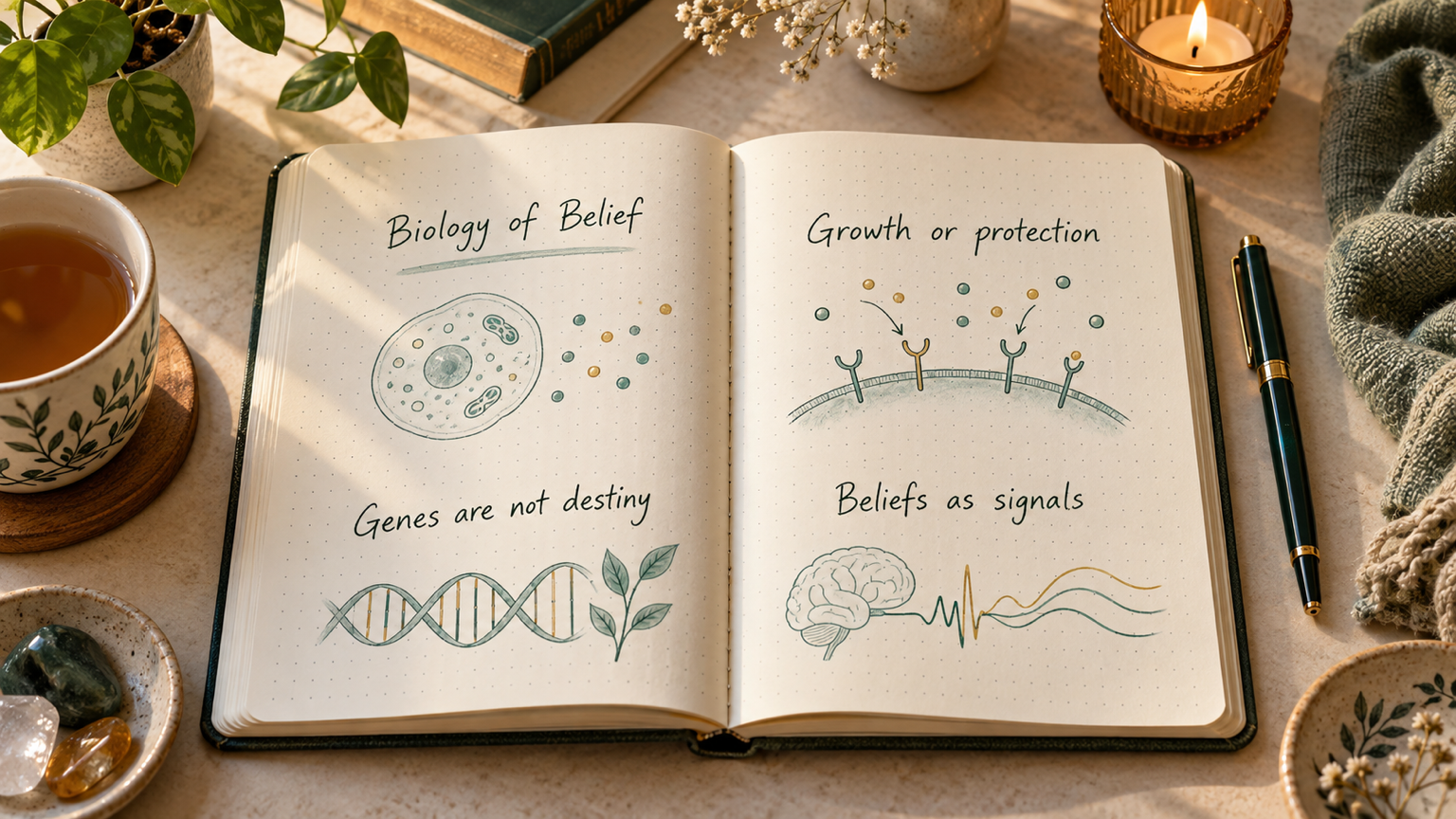
The epigenetics section is the part that feels most immediately useful. Lipton’s central point is that genes are not destiny. They are not tiny dictators sitting inside us deciding our whole future. They are more like possibilities that can be switched on or off by signals from the environment.
Nutrition, stress, emotions and lived conditions all matter because they influence how the body reads and expresses its genetic potential. That is a huge shift if you grew up thinking your biology was mostly fixed, or that family patterns were a life sentence.
I found this both comforting and confronting. Comforting because it means there is room for change. Confronting because it means my everyday life is not neutral. The way I eat, sleep, think, worry, love, move and recover is part of the environment my body is reading.
It made me think differently about all the unglamorous choices that do not look like transformation from the outside. Eating in a way that keeps my body calm. Going for a walk. Reducing avoidable stress. Creating a home that feels emotionally safer. Choosing what I let into my mind. None of those things are little if the body is listening.
The Subconscious Mind Is Not Impressed by Good Intentions
The part that made me laugh with recognition, in a slightly uncomfortable way, was Lipton’s explanation of the conscious and subconscious mind.
The conscious mind is the part that reads the book, feels inspired and says, “Right, we are changing now.” The subconscious mind is the huge old library of programmes that were installed through repetition, emotion and early life experience. It does not care that you bought a new notebook. It does not care that you made a plan. It runs what has been practised.
This explains that horrible gap between knowing and doing. You can understand the idea perfectly and still watch yourself repeat the old pattern. You can know you want calm and still move from anxiety. You can know you want confidence and still hear the old inner voice. You can know what helps and still not reach for it when the nervous system is already in charge.
That is not a character flaw. It is a level problem. Intellectual insight is conscious. The old pattern may be subconscious. If you are trying to rewrite a deep programme with surface-level willpower, no wonder it feels exhausting.
This is where the book helped me be kinder to myself. It also reminded me that the tools that work are often the ones that reach the body and subconscious directly. Repetition. Tapping. Visualisation. Emotional safety. Practice in the moment. Not just telling myself off with better vocabulary.
Growth and Protection Cannot Run the Show Together
One of the most practical ideas in The Biology of Belief is the distinction between growth and protection. Lipton explains that at the cellular level, a cell cannot be fully in growth and protection at the same time. If it perceives danger, it protects. If it perceives safety, it can grow, repair and renew.
That feels obvious until you apply it to normal life. How much of the day is spent in low-level protection mode? Not dramatic danger. Just the constant background hum of money worries, parenting worries, health worries, admin, noise, deadlines, guilt and “what if I am behind?”
The body does not necessarily know that the threat is an email, a bill, a messy kitchen or a thought about the future. It receives the signal. It prepares. It diverts energy. It keeps you safe in the short term, then quietly charges the bill if the alarm never switches off.
The lesson I took from this was not “never be stressed”, because that would be ridiculous. It was: do not treat joy, love, rest and connection as decorative extras. They are not rewards for finishing everything. They are the conditions that tell the body it is safe enough to grow.
The Notes from Soph Version
The version I want to keep from this book is simple: my body is not separate from my life.
That does not mean blaming myself for every symptom, every mood or every difficult season. I hate that version of wellness, the one that turns everything into a personal failure with nicer fonts. It means noticing the signals with more honesty. What am I repeatedly feeding my body? What am I repeatedly feeding my mind? What environment am I creating for my nervous system, my children and my future self?
It also means hope has a biological place. Not fake positivity. Not pretending everything is fine. Real hope. The kind that changes what you practise, what you notice, what you say yes to, what you stop rehearsing and what you allow your body to experience often enough that it becomes familiar.
If the body is listening, then the work is not to shout affirmations over a frightened nervous system. The work is to become a safer, truer environment for yourself, one small signal at a time.
Practical Takeaways
- Before blaming yourself, ask what environment your body or behaviour is responding to.
- Genes are not the whole story. Food, stress, emotions, safety and repetition all matter.
- The gap between knowing and doing may be subconscious programming, not laziness.
- Growth needs safety. Joy, love, rest and connection are biological inputs, not luxuries.
- Positive thinking is not enough on its own. The body needs repeated lived signals of safety and possibility.
A Small Practice to Try
Once today, pause and ask yourself:
Am I in growth mode or protection mode right now?
Do not turn it into another thing to fix. Just notice. If the answer is protection, choose one tiny signal of safety. A slower breath. A glass of water. A kinder sentence. A hand on your chest. A two-minute tidy. A message to someone safe. A walk outside.
The point is not to transform your whole biology before dinner. It is to teach your body, one believable signal at a time, that life is not only something to brace against.
Book Details
The Biology of Belief: Unleashing the Power of Consciousness, Matter & Miracles by Bruce H. Lipton, Ph.D.
First published 2005. 10th anniversary edition 2015. Hay House.
Amazon UK: The Biology of Belief by Bruce H. Lipton
Disclosure: this is an affiliate link. If you buy through it, I may earn a small commission at no extra cost to you.
If this made you think about the beliefs your body might be living inside, come and join me inside the Notes from Soph community on Skool. It is where I keep turning these books into small, practical experiments for real life.

