Why Self Control Is So Hard Right Now – and What the Science Actually Says
Anna Lembke self control teaching helped me stop seeing willpower as a character test. Before listening to her, I used to think self control was a character trait. That some people had more of it and some had less. That the people who consistently made good choices were just built differently.
Anna Lembke has spent years at Stanford studying addiction, dopamine and the science of why we do things we do not want to do. Her conclusion is both more compassionate and more challenging than the character-trait theory. And I found it useful in a way I did not expect.
That distinction matters because shame is a terrible teacher. If the only explanation I have for my behaviour is “I am weak”, then the only solution is to become harder on myself. That usually works for about three days and then collapses into the same pattern with an extra layer of guilt on top.
Anna Lembke offers a different explanation. Not an excuse, but an explanation. The modern environment is not neutral. It is engineered to keep offering tiny doses of relief, pleasure, novelty and distraction. Self control is not failing in a vacuum. It is being tested constantly by systems designed to bypass it.
Table of Contents
Who Is Dr. Anna Lembke?
Anna Lembke is a psychiatrist, professor and the author of Dopamine Nation – a book that spent time on the New York Times bestseller list and that I have seen referenced in more conversations about modern mental health than almost any other.
She runs the addiction medicine programme at Stanford and has spent her career studying the relationship between pleasure, pain and the brain’s reward system. She is not talking about addiction in the dramatic, Hollywood sense. She is talking about the quiet, everyday version – the compulsion to check your phone for the fourteenth time, the sugar that is never quite satisfying, the scroll that takes the edge off something uncomfortable without actually resolving it.
That is why I do not want to flatten her work into “dopamine is bad”. It is much more nuanced than that. Dopamine is part of motivation, learning and reward. The problem is not pleasure itself. The problem is the endless easy access to pleasure without effort, consequence or pause.
This is where Anna Lembke makes the subject feel less moral and more biological. If my baseline has shifted because I have trained my brain to expect stimulation at every empty moment, then the boredom I feel without the phone is not proof that the phone is necessary. It may be the discomfort of recalibration.
Anna Lembke Self Control and the Dopamine Balance
The central idea in Dopamine Nation – and in this conversation with Mel Robbins – is the dopamine balance.
When you experience something pleasurable – food, a like on a post, a compliment, a scroll through interesting content – your brain releases dopamine. But the brain is always trying to maintain equilibrium. So after the pleasure comes a dip. A small comedown. A subtle craving for more. The problem in the modern world is that we have an unprecedented number of things designed to trigger that dopamine release, rapidly, effortlessly and at almost no cost.
The result is that the dopamine baseline for many people has quietly dropped. What used to feel pleasurable now just feels normal. What used to feel normal now feels like deprivation. We are, without realising it, in a low-grade state of craving much of the time.
Anna Lembke’s argument is not that pleasure is bad. It is that the constant micro-dosing of pleasure – without ever tolerating the dip – trains the brain to be uncomfortable with anything that is not stimulation. And that discomfort is where self control goes to die.
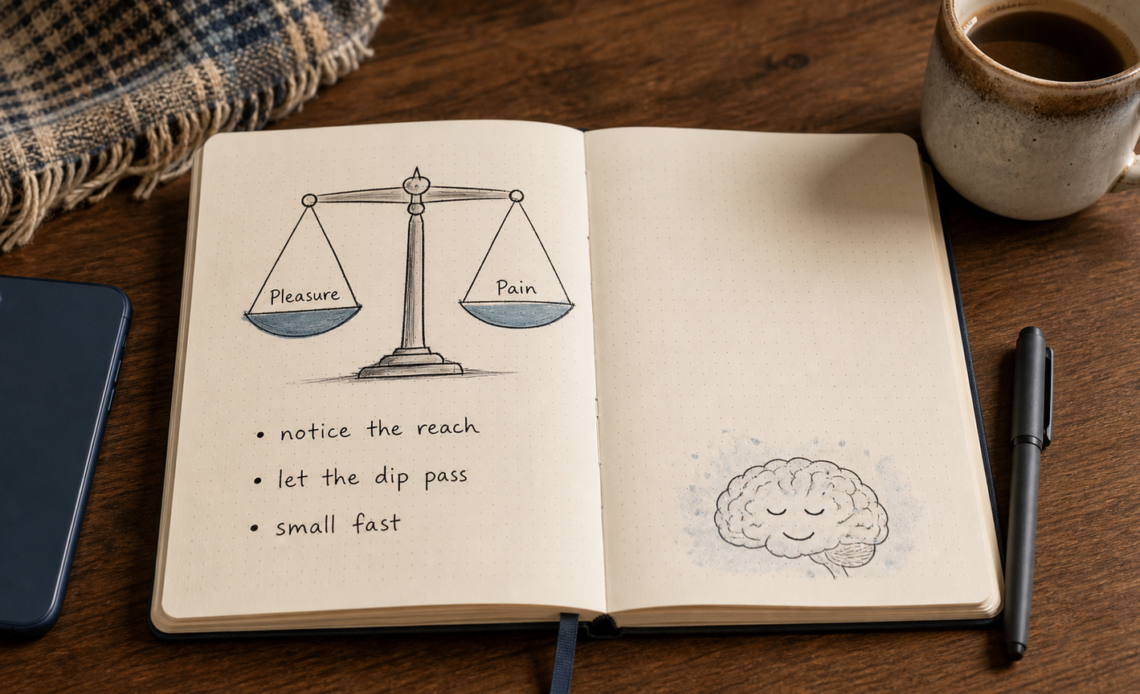
The phrase that helped me most is the pain-pleasure balance. It explains why the thing that soothes you can also leave you needing more soothing afterwards. A scroll can take the edge off for a moment and then make ordinary life feel flatter. A sweet thing can feel like comfort and then make the next hour less steady. None of this has to be dramatic to be powerful.
I also find this compassionate because it explains why “just stop” is not enough. When the brain is used to relief on demand, the first stage of change often feels worse, not better. The dip is not failure. The dip is the thing you are learning to tolerate.
Why This Hit Close to Home
I think about my phone. I think about how many times a day I reach for it not because I need something but because there is a second of emptiness and the hand moves before the brain decides.
I think about food – not in a dramatic sense, but in the sense of reaching for something sweet not because I am hungry but because something feels slightly flat and the brain knows what will shift that, briefly.
What Lembke says is that this is not weakness. It is neuroscience. But that does not mean nothing can be done about it.
The science suggests that the way to rebuild dopamine sensitivity – the capacity to feel genuine pleasure from ordinary things – is to introduce some discomfort voluntarily. To allow the dip without immediately filling it. To let the brain recalibrate. This connects with what I explored in the Chimp Paradox – the impulsive, comfort-seeking part of us is not our enemy, but it does need managing.
The Notes from Soph Version
What I find useful here is not the science of extreme addiction. It is the science of the ordinary kind. The small, socially acceptable, entirely invisible version that most of us live inside without naming it.
The habit of reaching for stimulation at the first sign of discomfort means I never have to sit with the discomfort. Which means I also never develop the capacity to tolerate it. Which means it grows, quietly, into something that runs my choices more than I would like.
Anna Lembke talks about radical honesty as a tool – not self-flagellation, but genuine, clear-eyed honesty about what you are actually doing and why. Not “I deserve a treat.” But “I am bored and uncomfortable and reaching for something to fix that.”
That honesty is not a punishment. It is a starting point. And the practical tool she suggests is a fast (a period of deliberately not reaching for the usual comfort). A walk without a podcast. A meal without a screen. Ten minutes of doing nothing and letting the discomfort just be there. It is uncomfortable. And then it is less uncomfortable. And then something else becomes possible. I am not doing this perfectly. But I am noticing the reaches more. And that, per Atomic Habits, is where change begins: in the moment before the automatic action, not after.
The useful question for me is not “how do I become someone with perfect self control?” It is “where am I outsourcing emotional regulation to stimulation?” That is a much more honest question.
Sometimes the answer is my phone. Sometimes it is food. Sometimes it is noise, a podcast, a task, anything that means I do not have to sit in the two minutes of flatness underneath. Anna Lembke’s work makes those two minutes look important. Not because discomfort is noble, but because every time I survive it without immediately medicating it with stimulation, I get a little bit of freedom back.
A quick note before the practical bits: this is my reading and podcast reflection, not medical or mental-health advice. If you are dealing with addiction, medication, a diagnosis, depression, anxiety or anything that feels bigger than a habit, please speak to a qualified professional.
Practical Takeaways
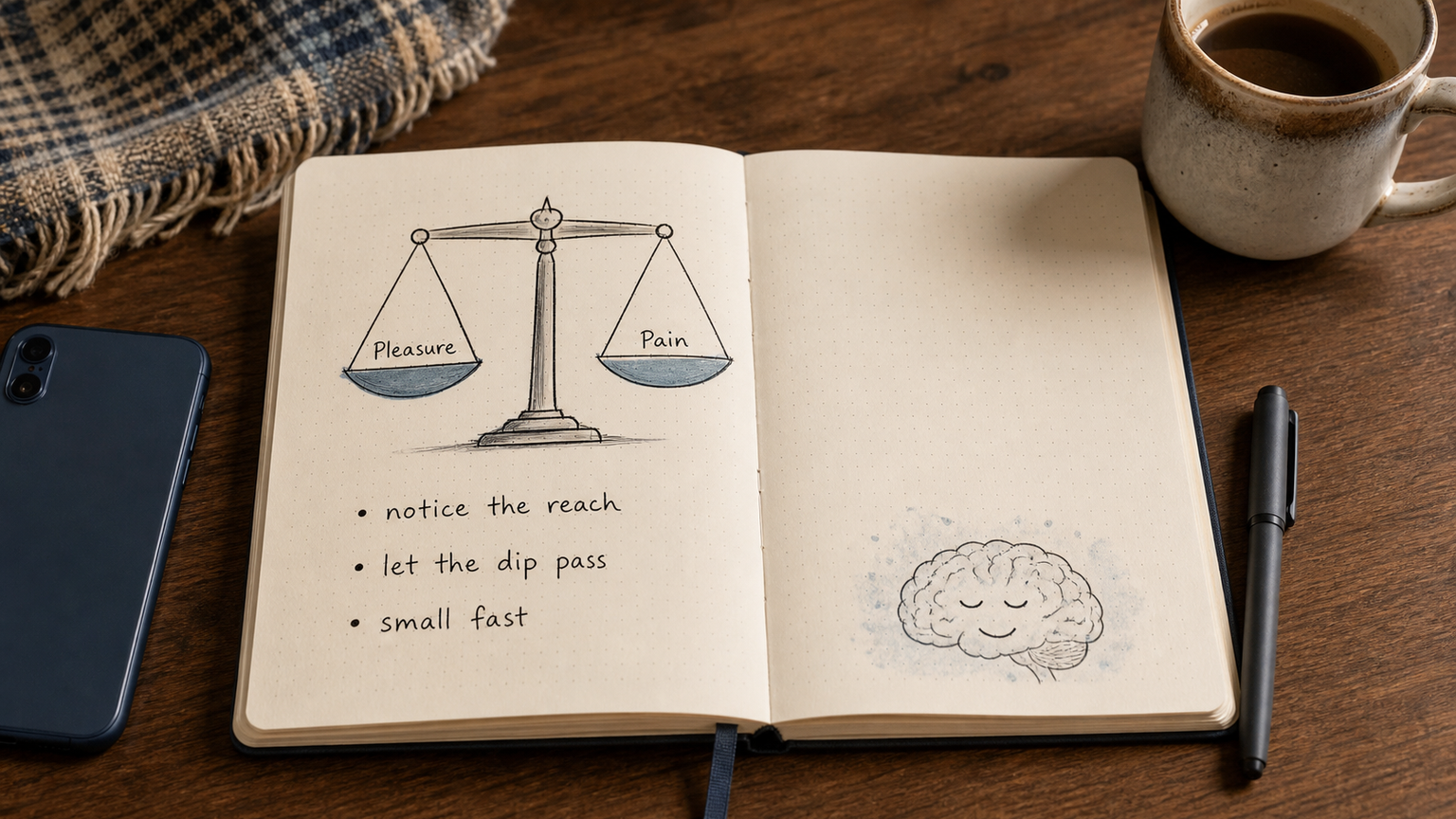
- Name the dopamine micro-habits. The scroll, the sugar, the second cup of coffee at a low moment, the phone check between sentences. Not to judge them: to see them.
- Let the dip happen sometimes. Not every discomfort needs to be immediately managed. Five minutes of tolerating the flat feeling without filling it is more useful than it looks.
- Try a small fast. One morning without the podcast. One drive without the radio. One evening without a screen after 8pm. The goal is not deprivation, it is recalibration.
- Use radical honesty. Not “I deserve this” or “it is fine” but “I am choosing this because I feel [the uncomfortable thing].” Just naming it accurately changes the relationship to it.
- Self control is built in the dip. Not by being someone who never wants to reach. By being someone who sometimes does not and survives it.
Why This Belongs in Mind
Mind is where I explore how the brain actually works, not the aspirational version, but the real, biologically-driven, often-inconvenient version. Anna Lembke’s work belongs here because it explains something most people feel but cannot name: the growing background restlessness, the difficulty concentrating, the hunger for stimulation that nothing quite satisfies.
This is not a moral issue. It is a neurological one. And that means it responds to neurological solutions which are, reassuringly, also very ordinary.
Notes from Soph | Learning, not perfection.
Et toi? What is one micro-habit you reach for when discomfort arrives? Even just noticing it is a useful first step. Come and share it in the Notes from Soph community on Skool.
Source Details
The Mel Robbins Podcast – “The Science of Self Control: Find Motivation, Build Willpower, and Increase Your Focus” Mel Robbins feat. Dr. Anna Lembke | 22 January 2026
📚 Dopamine Nation by Anna Lembke – Amazon.co.uk Disclosure: affiliate link – if you buy through this, I earn a small commission at no extra cost to you. Thank you!
🎙 Listen to the episode on Apple Podcasts or search “The Mel Robbins Podcast” on Apple Podcasts / Spotify

