Why I Couldn’t Get Motivated (And What It Was Really Telling Me)
I’ve had a complicated relationship with motivation and dopamine for most of my adult life — though I didn’t know that was what it was. Hormones? Perimenopause? Time of the month? Nutrition? Just me being me?
On a good day, I’m unstoppable. I wake up early, move through my morning routine, teach with energy, come home and still have something left for the books and the kids and the blog ideas that are piling up in my notebook.
On a bad day, I stare at my to-do list and feel nothing. Either overwhelmed or just… flat. Like there’s a glass wall between me and the things I know I want to do.
For a long time I thought that was a character flaw. That motivated people didn’t have this problem — that they woke up every day with drive and clarity and I was simply not built that way.
Then I listened to this episode. And Dr. K explained what’s actually happening. And I had to rethink the whole thing.
Who Is Dr. K?
Dr. Alok Kanojia — known online as Dr. K — is a Harvard-trained psychiatrist and the founder of HealthyGamer, a mental health platform originally built for gamers but now reaching far beyond that community. He spent years studying under Hindu monks in India before his psychiatry training, and this gives him a genuinely unusual perspective: rigorous Western science combined with ancient frameworks for the mind that most psychiatrists never encounter.
He talks about motivation in a way I haven’t heard anywhere else.
Motivation and Dopamine: The Myth We’ve All Believed
Here’s the first thing Dr. K said that stopped me in my tracks:
Motivation is not a prerequisite for action. It’s a reward for action.
We’ve got it backwards. We sit around waiting to feel motivated before we start — and then we feel guilty and broken when the motivation doesn’t arrive on schedule. But that’s not how the brain works.
The connection between motivation and dopamine is direct: dopamine is released during the activity, not before.
And dopamine is released during the activity and after a reward — not before. Which means the waiting-to-feel-motivated strategy is neurologically doomed from the start.
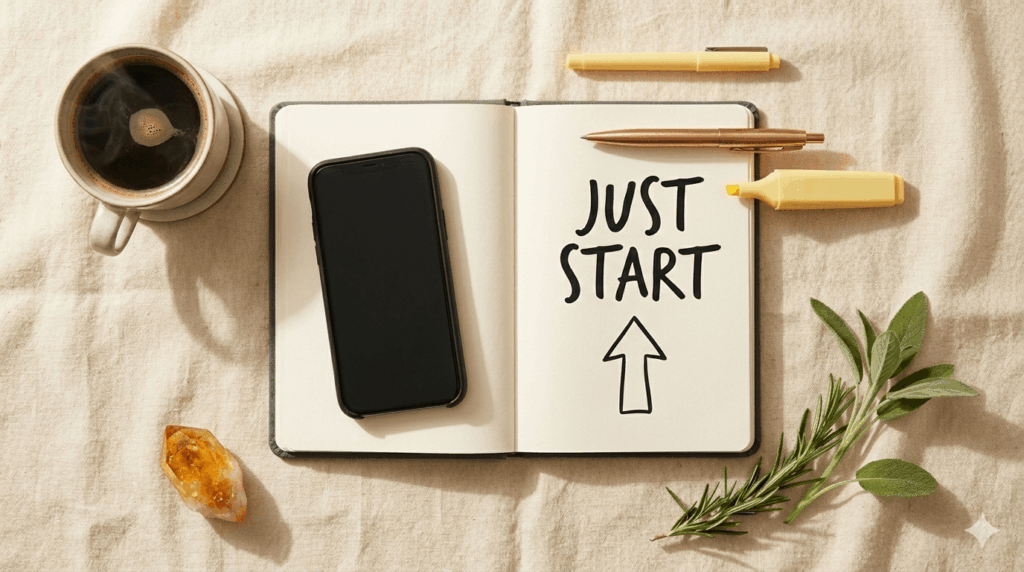
You don’t get motivated and then act. You act — even just the tiniest bit — and then motivation follows.
The action creates the feeling, not the other way around.
Why Modern Life Is Breaking Our Motivation Systems
This is the part that made me feel both seen and alarmed.
Dr. K argues that many people who struggle with motivation aren’t lazy or broken — they’re operating in an environment that is actively hijacking their dopamine system.
Social media. Instant entertainment. Snacks engineered for maximum craving. Notifications every few minutes.
Every time you get a tiny hit of dopamine from checking your phone, scrolling Instagram, eating something sweet, watching another episode — your brain recalibrates its baseline. It takes more stimulation to feel okay. And the quiet, slow burn of working toward something meaningful starts to feel impossibly dull by comparison.
He calls this “dopamine dysregulation” — and it’s the real reason motivation and dopamine get hijacked by modern life.
And it explains why so many perfectly capable, intelligent, genuinely motivated people find it impossible to sit down and do the work they care about.
It’s not a lack of discipline. It’s a damaged reward system — damaged by the constant low-level overstimulation of modern life.
This was uncomfortable to hear. I looked at my morning phone habit — picking it up before I’d even properly woken up — and understood something I’d been pretending not to.
What Dr. K Recommends
1. Protect your morning from stimulation
The first 30-60 minutes after waking are neurologically important. Your dopamine system is fresh. If the first thing it encounters is social media, news, notifications — you’ve already spent your most valuable cognitive currency on the lowest-value activity of the day.
Guard the morning. No phone. No scrolling. Let your brain start the day on its own terms.
2. Start so small it feels stupid
If you can’t start, make the starting point so tiny that your brain can’t object. Not “work on the blog post.” Not even “open the laptop.” Maybe: put your hands on the keyboard.
The nervous system needs an on-ramp. A tiny first action, repeated, builds the groove.
3. Notice the texture of what you’re avoiding
Dr. K talks about how avoidance is often protective. When we can’t start something, it’s worth asking: what am I actually afraid of here? What does this action represent?
Often, “I can’t get motivated to write” is actually “I’m afraid this isn’t good enough” or “I’m afraid of what it means if I try and fail.” Motivation isn’t the problem. Fear is the problem. And those need different solutions.
4. Distinguish between the types of unmotivated
Not all lack of motivation is the same. There’s the everyday resistance that dissolves once you start. There’s burnout-based depletion that needs rest, not pushing. There’s anhedonia — a clinical symptom that can indicate depression, where nothing feels rewarding — that needs proper support.
Knowing which one you’re dealing with changes what you do about it.
What Changed for Me
After listening to this episode, I made two changes.
First: I moved my phone charger far from my bedside table and purchased an old-school alarm clock. The morning is now phone-free until after my morning routine.
Second: I stopped waiting to feel motivated before writing. I open the notebook. I pick up the pen. Sometimes what follows is rubbish. Sometimes it’s not. But the waiting was never making it better.
The glass wall is still there sometimes. But now I know I don’t have to break it — I just have to walk through it, tiny step by tiny step, and trust that the feeling will catch up.
What to Take From This
Here’s what understanding motivation and dopamine actually changed for me:
- Stop waiting to feel motivated — The motivation comes after you start, not before. Pick the smallest possible starting action and do it.
- Protect your morning from stimulation — Try 30 minutes phone-free first thing. Your dopamine system will thank you.
- Name what you’re avoiding — When you can’t start, get curious. Is it resistance? Fear? Exhaustion? Each needs a different response.
- Audit your dopamine diet — How many small, cheap dopamine hits are you taking each day? (Scrolling, snacking, checking, refreshing.) These are borrowing against your motivation.
- Rest when you’re depleted — Pushing through burnout doesn’t work. If you’re genuinely depleted, the answer is restoration, not more willpower.
Why This Belongs in “Soul”
My blog is organised around my Tree of Life: Roots, Body, Mind, Heart, Soul, Purpose. Each section represents a part of my life that needs attention.
I put this in Soul because motivation and dopamine — real, deep, sustained — isn’t a productivity hack. It’s a question of being alive to what you care about and removing the obstacles that numb that aliveness. Soul is where I keep the things that fuel me from the inside out: mindset, spirit, the inner fire that makes it possible to keep going.
Dr. K gave me a framework that was both scientific and compassionate. He didn’t tell me to try harder. He told me to understand the system I’m operating in — and then work with it rather than against it.
That felt like exactly the kind of Soul work I needed. Understanding motivation and dopamine properly changed how I approach every single day.
Notes from Soph | Learning, not perfection.
Do you have a strategy for starting when you don’t feel like it? I’d love to hear what actually works for you — leave a comment or reach out.
Source Details:
Mel Robbins Podcast — Episode #208: “How to Get Motivated Even When You Don’t Feel Like It” 🎙 Motivation (Dr. K):https://www.melrobbins.com/podcasts/episode-208
Guest: Dr. Alok Kanojia (Dr. K), Harvard psychiatrist and founder of HealthyGamer

