Hell Yeah or No: Derek Sivers’ Brutal Filter for a Better Life
I am not good at saying no.
I want to be. I read the books about boundaries. I nod along to the podcasts about protecting your time and energy. I have, on multiple occasions, written “say no more” in my journal as a kind of intention, which is perhaps the least effective strategy ever documented.
So when someone mentioned Derek Sivers’ Hell Yeah or No to me, I picked it up with exactly the kind of mild curiosity that Sivers’ filter would classify as a no. It was fine. It seemed interesting. It was not hell yeah, that would be amazing.
Well. That was a mistake, and I am glad I made it.
Table of Contents
What Is This Book?
Derek Sivers is not a productivity guru. He is not a coach. He is a musician who built a company called CD Baby – one of the first music distribution platforms – grew it to $22 million in revenue, then sold it and gave the entire proceeds to a music education charity. He has since lived in twelve countries, learned programming in his fifties, and written some of the most-read short essays on the internet.
Hell Yeah or No is a collection of those essays. The book is around 130 pages. Some chapters are three paragraphs. Some are two pages. All of them are written the way Sivers appears to think: briefly, directly and without a single wasted word.
The central idea is this. Most of us say yes too easily – to requests, to projects, to habits, to roles we’ve outgrown. We do things because they seem fine. Because someone asked. Because we feel guilty saying no. Because we like the idea of doing them even if we never actually will.
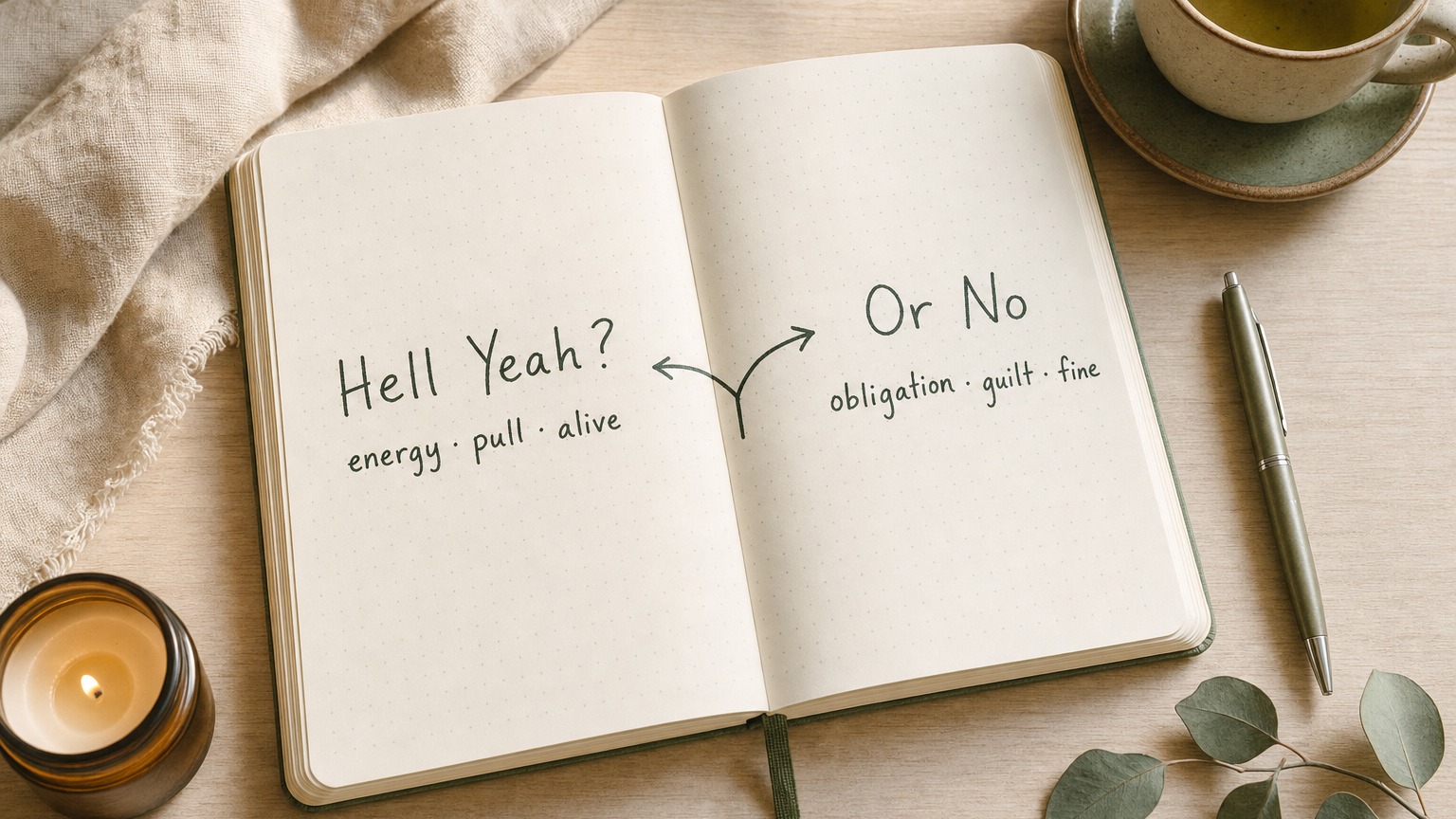
Sivers proposes a two-position filter. When someone asks you to do something, or when you’re considering something new, ask yourself honestly: does this make me feel hell yeah, that would be amazing? If not, the answer is no. Not maybe. Not “I’ll try.” No.
Full stop.
How This Changed My Life
I left CrossFit in March 2026 after two full dedicated years, barely missing any of my 2-3 sessions a week. Not because it wasn’t working. Because I realised, honestly, that I was going out of obligation more than desire. Every Sunday evening I would feel a faint dread about the Monday session. That is not a hell yeah. That is a no wearing a yes’s clothes.
The gym I switched to? I look forward to it. I think about the sessions between sessions. I have, on more than one occasion, rearranged my schedule to go on a day I hadn’t planned to. That is the difference.
Better than Before (Gretchen Rubin) helped me understand my own habits and what drives them. But Sivers’ filter is simpler and faster: does it make you feel hell yeah? No analysis required. No questionnaire. Just honesty.
This blog is a hell yeah. I have written over 60 personal development posts in the past year and I have never once sat down to write one feeling like I had to. I might sit down feeling uncertain about how to start, or tired, or like I don’t have enough ideas. But I never feel like I don’t want to do it. That’s the signal.
The Skool community? Hell yeah. Adding another social platform I’m not sure about? No, thank you.
Sivers gave me language for something I had been doing intuitively but without confidence. Now when something gives me that faint, familiar dread, I name it: this is not a hell yeah. And naming it makes it much easier to act on.
Identity Is What You Do
The section of the book that hit hardest for me was not the filter itself. It was the chapter on identity.
Sivers makes a quiet but radical argument: your identity is not a fixed thing. It is not what you were born with, or what you believe about yourself in theory. It is the running total of your daily actions.
Your actions always reveal your real values. No matter what you say, your actions reveal the truth.
This is uncomfortable in exactly the right way. Because I can say I am a writer. But if I don’t write, I am not a writer – I am someone who used to write, or who would like to write. Sivers suggests a clean solution: only claim the present tense for what you are actively doing right now. Everything else is past tense.
The related idea is about titles. We hold onto roles we used to perform because they give us the comfort of an identity without requiring us to live it. I notice this in myself with teaching – I spent fifteen years as a teacher in Wales, and there is still a part of me that uses that history as a measure of competence, even when it’s not what I’m actively building.
Sivers doesn’t say the history doesn’t count. He says: be honest about where you are now. Not where you were.
The Filter Applied: Do Almost Nothing, But All the Way
The hell yeah filter is not an argument against doing things. It is an argument against doing the merely fine things, which crowd out the genuinely important ones.
Do almost nothing. But the things you do, do them all the way.
This is a much higher standard than most of us operate at. Most of us say yes to enough things that we never fully commit to any of them. The filter is a way of protecting the things that matter by refusing to give time and energy to the things that don’t.
There is a related chapter about saying no to everything else once you’ve said yes to one thing. Not renegotiating every day. Not re-evaluating every time something new arrives. You already decided. That single commitment in advance means all the distractions already have an answer: no, until the current thing is done.
I find this genuinely liberating. Not as a rigid rule, but as permission to go deep.
Motivation Is Fragile: Stop Fighting It
One of the most practically useful sections of the book is on motivation. Specifically, that it is far more fragile than we tend to assume.
Sivers tells a story about cycling. He noticed that every time a car came up behind him, he unconsciously sped up – driven by some invisible need to not be seen going slowly. He tilted his rear-view mirror towards the ceiling so he couldn’t see the cars. The problem vanished. He rode at his own pace.
Notice that something is affecting your drive. Find a way to adjust your environment, even if that’s a little inconvenient for others.
The lesson is not complicated. The things that pull you off track (social media, other people’s opinions, comparison, email, the feeling of being watched) are not problems of willpower. They are design problems. Remove the trigger. The behaviour changes.
He also makes a point about effort that I have been thinking about for weeks: the difference between cycling at maximum strain and cycling at a relaxed but consistent pace is, in terms of time and distance covered, almost nothing. But the first leaves you exhausted and the second leaves you able to do it again tomorrow.
It’s amazing how often everything gets done just as well and just as fast, with what feels like half the effort.
I have been applying this to my writing rhythm. The posts I write at 5am in a state of strained effort are not noticeably better than the ones I write at a pace that feels easy. The strain is not signal. It is just noise.
What Do You Hate Not Doing?
Sivers asks a question near the end of the book that I think is the most useful diagnostic he offers. Not what do you love doing? – lots of things are enjoyable. Not what are your values? – we all have flattering answers to that.
What do you hate not doing?
What makes you feel depressed, irritable, or off-track when you’ve skipped it for too long? That answer : the thing that goes bad when it’s absent, is a more honest signal of your real priorities than any list of things you enjoy.
For me: writing. Reading. Movement. Time to think. These are not hobbies I like. They are things that go wrong inside me when I skip them for too long. Sivers’ question made me see them as requirements rather than luxuries.
He also offers a three-part test for anything worth doing well. It should sit at the intersection of:
- What makes you happy
- What is smart (valuable, strategically sound)
- What is useful to others
Lose any one of the three and you get a recognisable failure mode. Smart and useful without happiness: a machine that eventually breaks. Happy and smart without usefulness: a self-improvement hobby with no impact. Happy and useful without smart: good intentions going nowhere useful.
When my life or a plan feels ultimately unsatisfying, I find it’s because I’ve forgotten to find the intersection of all three.
Notes from Soph passes all three for me. When a week feels hollow, it’s usually because useful has slipped – I’m producing content for the sake of consistency rather than because it is genuinely adding something. That’s the signal to step back, not to push harder.
Practical Takeaways
1. Run the filter honestly. When someone asks you to do something this week, before you answer, ask yourself: is this a hell yeah? If you have to think about it for more than ten seconds, that’s useful information.
2. Audit your current yeses. What are you saying yes to out of obligation, guilt, or vague hope rather than genuine enthusiasm? One yes removed can free up more energy than you expect.
3. Tilt your mirror. What is the equivalent of cars behind you – the thing that subtly redirects your behaviour away from what you actually want? Name it. Then engineer around it. Atomic Habits (James Clear) has the tools for this. Sivers has the diagnosis.
4. Try the double-negative question. What do you hate not doing? Write the answer before you think too hard about it. That list is more honest than any values exercise.
5. Reduce the strain. Identify one thing you are doing at maximum, unnecessary strain and see what happens if you ease off by thirty percent. You might find, as Sivers did on his bicycle, that almost nothing changes except how you feel at the end.
6. Apply the three-part test. For any project, plan, or commitment you’re unsure about: does it make you happy? Is it smart? Is it useful to others? Which corner is missing? That’s where to start.
Why This Belongs in Mind
The Mind section is where I put the books and podcasts that change how I think, not just what I know. The Slight Edge (Jeff Olson) changed how I think about consistency. Mindset (Carol Dweck) changed how I think about ability. Limitless (Jim Kwik) changed how I think about learning.
Derek Sivers changed how I think about yes.
And it turns out that question – yes to what, exactly? – sits underneath almost every other question I’ve been wrestling with for the past five years. What to write. What to teach. What to pursue. What to let go of. What to protect.
Hell yeah. Or no.
It really is that simple. I just needed someone to say it plainly.
Notes from Soph | Learning, not perfection.
Et toi? What would you say hell yeah to right now – if you were being completely honest? Come and discuss it in the Notes from Soph community on Skool. That question has a way of producing very honest conversations.
Book Details: Hell Yeah or No: What’s Worth Doing by Derek Sivers Published 2020 | Hit Media
📚 Amazon https://www.amazon.co.uk/dp/1988575079/?tag=websitenote0f-21
Disclosure: affiliate link. If you buy through this, I earn a small commission at no extra cost to you. Thank you!

