A Changed Mind, David Bayer: The Practical Work of Becoming Someone New
I keep coming back to David Bayer because his work sits in that place I find most useful: spiritual enough to open a door, practical enough to actually walk through it.
For me, A Changed Mind is the phrase that best describes that middle space between insight and action.
A Changed Mind is a big title. It sounds like a promise. Maybe even a dramatic one. A new mind, a new life, a new way of being. But the part I find most useful is much quieter than that.
It is the moment you notice the thought before it becomes a mood.
The moment you realise the problem is not only the situation, but the state you keep entering every time you think about the situation.
The moment you see that your mind has been rehearsing an old future and calling it realism.
I do not have detailed chapter notes for this book in front of me, so I am not going to pretend this is a precise chapter by chapter summary. This is a Notes from Soph reflection on Bayer’s recurring framework: thoughts create states, states shape behaviour, behaviour repeated over time becomes reality.
That sounds simple. It is not easy.
Table of Contents
What I Think A Changed Mind Is Really About
The phrase “change your mind” can sound light, as if you are choosing between tea or coffee.
But Bayer’s work points to something deeper. A changed mind is not just a different opinion. It is a different internal operating system.
It is the shift from:
This always happens to me.
to:
This is a pattern I am learning to interrupt.
It is the shift from:
I am behind.
to:
I can take the next useful step.
It is the shift from:
I need this to work or I am not safe.
to:
I can do the work from trust rather than panic.
None of those thoughts magically fixes the situation. That is not the point. The point is that each thought creates a different state, and each state gives you access to different choices.
When I am in fear, I become narrow. I scan for threat. I overthink messages. I make everything mean something. I try to control outcomes I cannot control and ignore the small action I actually could take.
When I am in a steadier state, I still have the same life. Same children, same work, same bank account, same laundry mountain, same unanswered email. But I am different inside it.
And sometimes that is enough to make the next move possible.
The Problem Is Often the State
One of the most useful things I have taken from David Bayer is the idea that we do not solve problems well from a primal state.
That language appears again and again in his podcast work too. There is the powerful state, where you are connected, creative and capable. Then there is the primal state, where fear takes over and the nervous system starts running the show.
I know the primal state well.
It is the tight chest. The sudden urgency. The need to fix everything immediately. The feeling that if I do not solve this today, everything will fall apart. It is not always dramatic. Sometimes it just looks like scrolling, snapping, procrastinating or trying to do twelve things at once because doing one thing calmly feels too vulnerable.
The frustrating part is that the primal state often feels truthful. It feels like realism. “I am just being sensible.” “I am just seeing the facts.” “I am just preparing for the worst.”
But when I look honestly, some of my worst decisions have come from that state.
Not because I am stupid. Because fear makes the world smaller.
A changed mind, then, begins before the action plan. It begins with state change. It begins with asking: what state am I in right now, and is it one I want to create from?
Old Beliefs Feel Like Truth
The hardest thoughts to change are the ones that do not feel like thoughts.
They feel like the room you live in.
“I am not good with money.”
“I’m always moody.”
“I am too late.”
“People like me do not get to have that.”
“If I relax, everything will collapse.”
These are not just random sentences. They are beliefs with history. They may have protected us at some point. They may have helped us make sense of chaos, rejection or disappointment. They may even have been passed down through family systems without anyone meaning harm.
But if we do not question them, they become instructions.
This is where Bayer’s work feels very close to purpose. Because purpose is not only about finding the thing you are here to do. It is also about becoming the person who can do it.
And that person cannot be built on an old belief that says visibility is unsafe, success is selfish or rest must be earned through exhaustion.
A changed mind is not a decorative mindset shift. It is structural.
It asks: what belief keeps making this old life feel inevitable?
A Changed Mind Is Not Fake Positivity
I always want to be careful with this kind of work because it can so easily become another stick to hit ourselves with.
If your life is hard, it is not because you failed to think correctly.
If you are anxious, tired or overwhelmed, the answer is not to paste an affirmation over the top and pretend everything is fine.
That is not a changed mind. That is performance.
The useful version is much more honest.
It says: yes, this is hard. Yes, this has happened before. Yes, I can feel my body going into the old pattern. And also, I do not have to let the oldest thought in the room make the next decision.
That is the sentence I want to keep.
I do not have to let the oldest thought in the room make the next decision.
There is something deeply practical about that. You do not need to become enlightened by Thursday. You do not need to clear every belief from childhood before sending the email, starting the project or having the conversation.
You just need enough awareness to create a pause.
In that pause, the mind can change.
The Purpose Question
The question this book leaves me with is not “what do I want?”
It is “who am I being while I want it?”
Because wanting from fear and wanting from trust produce very different lives.
This connects with Bayer’s teaching on The Backwards Law too. The more desperately we grip the outcome, the more we live in the energy of not having it. We may still work hard, but the work becomes contaminated by panic.
I have seen this in myself with the blog.
When I write from love, curiosity and the genuine desire to explain something useful, the whole thing feels alive. When I write from “will this rank, will anyone care, am I doing enough?”, the work gets smaller. Technically, I may be doing the same task. Internally, it is completely different.
Purpose needs the right inner weather.
Not perfect confidence. Not constant calm. Just enough trust to keep moving without turning everything into proof of your worth.
That, to me, is the real invitation of A Changed Mind. Not to force a new identity overnight, but to stop feeding the one that keeps making life feel smaller than it is.
Practical Takeaways
1. Name the thought exactly. Do not stop at “I feel stressed.” Ask what sentence is creating the stress. Is it “I am behind”, “I cannot handle this” or “this always goes wrong”?
2. Check the state it creates. Does the thought make you tight, rushed, defensive or small? Your body will often tell you whether a thought is helpful before your mind admits it.
3. Choose a believable replacement. Do not jump from “everything is falling apart” to “my life is perfect.” Try something your nervous system can accept, like “I can handle the next step” or “this is uncomfortable, not impossible.”
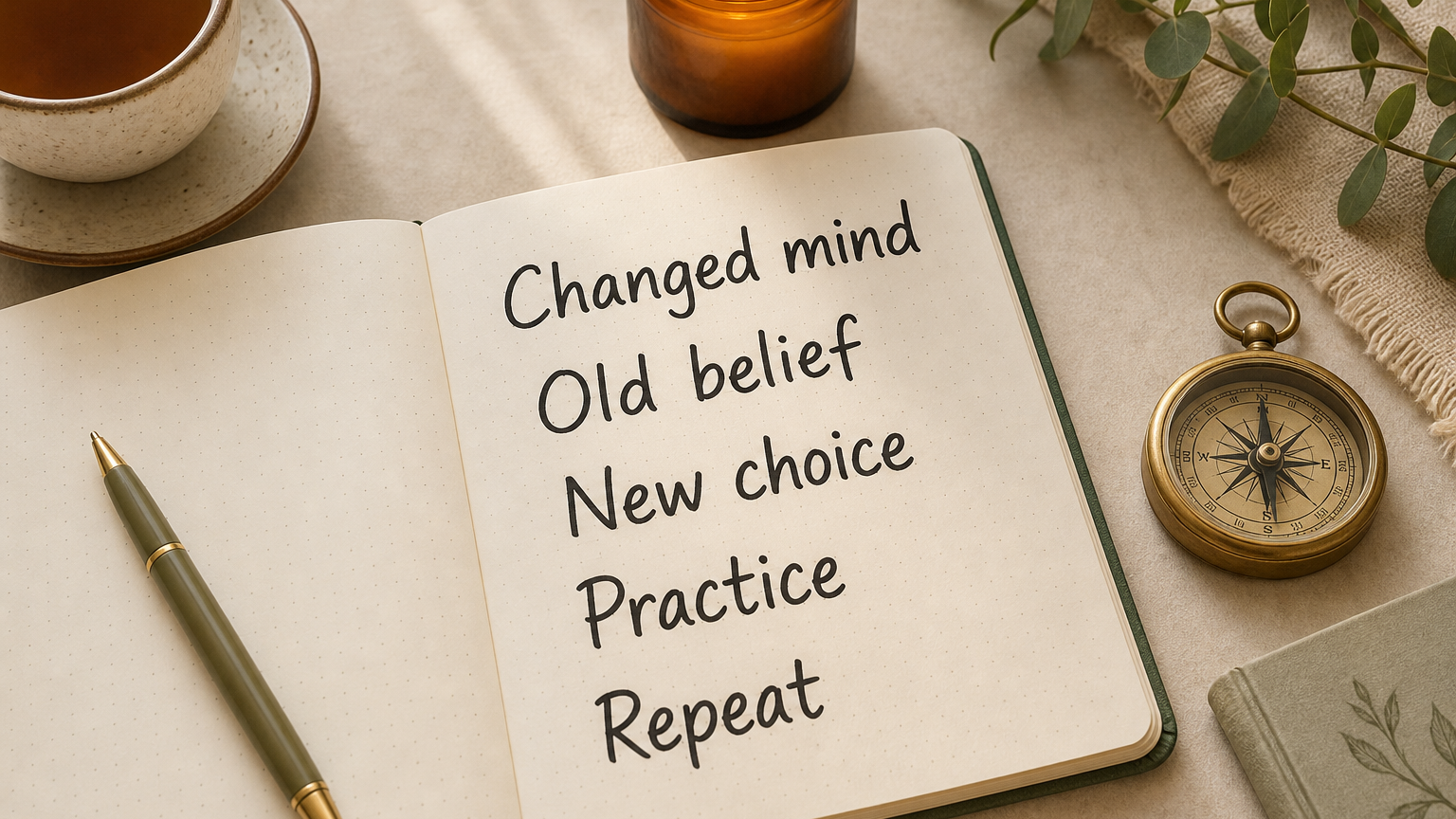
4. Pair the new thought with action. A changed mind becomes real through behaviour. Send the message. Open the document. Drink the water. Go outside. Make the small move that belongs to the new state.
5. Watch for familiar futures. If you keep ending up in the same situation, ask what belief is making that outcome feel normal. The pattern may be old, but it is not necessarily true.
6. Do not weaponise mindset. This work is not about blaming yourself for hard things. It is about finding the place where you still have agency.
Why This Belongs in Purpose
Purpose is not just the big mission. It is the way we meet the work in front of us.
A changed mind matters because every purpose led life will ask us to become someone new. Someone braver. Someone less ruled by old fear. Someone who can act before certainty arrives.
David Bayer’s work reminds me that transformation often begins in a very ordinary place: with the next thought we choose to stop rehearsing, and the next thought we are willing to practise instead.
Not perfectly.
Just honestly.
Notes from Soph | Learning, not perfection.
Et toi? What is one old thought that might be shaping your future more than you realised? Come and talk about it in the Notes from Soph community on Skool.
Source Details: A Changed Mind by David Bayer David Bayer | Book and podcast framework used as reflective source.

