How To Use Your Thoughts to Change Reality: David Bayer’s Practical Reframe
The phrase “change your reality” can make me suspicious.
Not because I do not believe our thoughts matter. I absolutely do. But because it can sound a little too shiny, as if you are meant to think positively over the top of real life and call that growth.
David Bayer’s Episode 198 of A Changed Mind, How To Use Your Thoughts to Change Reality, feels more useful than that. At least, the way I hear it, it is not about denying the problem in front of you. It is about understanding the chain reaction that begins with a thought.
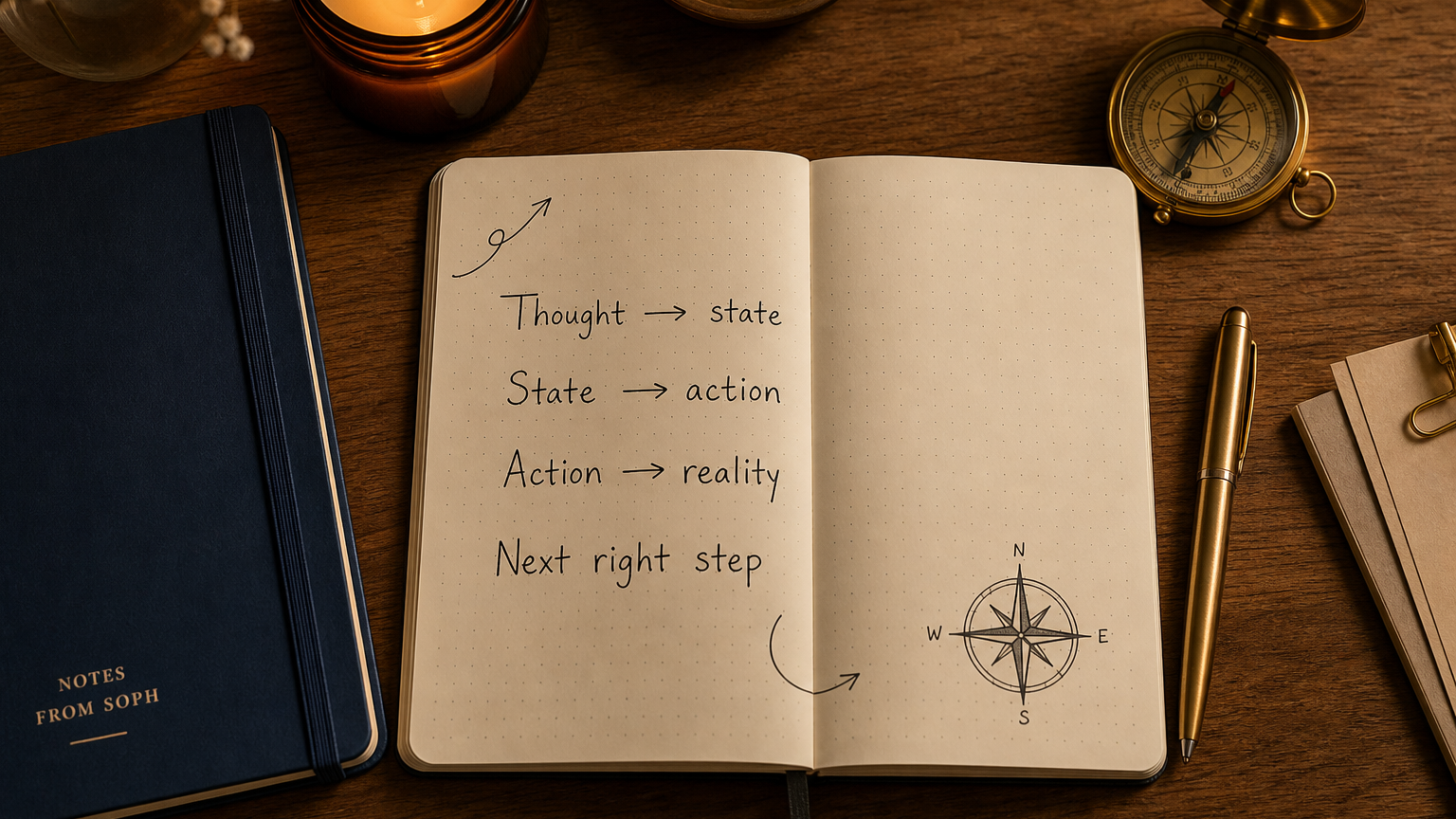
A thought creates a state. A state changes what you notice. What you notice changes what you choose. What you choose, repeated over time, changes the shape of your life.
That is not magic in the theatrical sense. It is much more practical than that. It is the quiet architecture of a day.
Table of Contents
What David Bayer Means by Changing Reality
David Bayer often talks about the relationship between thoughts, emotions, beliefs and the results we create. In this episode, the title is bold: how to use your thoughts to change reality.
I do not hear that as “think a nice thought and the universe delivers accordingly”. We all now this doesn’t work and it’s way more complicated than that!
I hear it as something more grounded: your thoughts are instructions to your attention and your nervous system. If you repeatedly think, “this never works for me”, your brain starts filtering for evidence that confirms it. You feel discouraged before you begin. You act with less courage. You miss invitations, ideas and openings because your mind has already filed them under “not for me”.
If the thought changes, the state changes. If the state changes, the options you can perceive often change too.
That is why this episode sits so close to purpose for me. Purpose is not just about the big mission statement. It is about the inner atmosphere you bring to the work that matters. If the atmosphere is fear, lack and self protection, you build one kind of life. If the atmosphere is trust, clarity and willingness, you build another.
Same person. Different inner starting point.
The Thought Is Not Small
One of the most useful things Bayer does is treat thought as a creative force, not a private detail.
Most of us think of thoughts as invisible, harmless little sentences that float through the mind. But they are not neutral. A thought can tighten your chest, change your posture, make you avoid the email, snap at someone you love, delay the thing you said you wanted to start or convince you that tomorrow would be safer.
This is why “just change your thoughts” is both too simple and also not entirely wrong.
The thought is not small because it has a body. It becomes chemistry. It becomes behaviour. It becomes a repeated path.
This made me think about those ordinary moments where a whole morning bends around one sentence. “I am already behind.” “I cannot handle this today.” “Everyone else knows what they are doing.” None of those thoughts needs to be dramatic to be powerful. They just need to be repeated. Mine is: “I’ve had a guts-full of this”. This is what goes round and round my mind like a broken record. And it is broken…
And the alternative does not have to be fake positivity. It can be much gentler:
I can take the next right step.
I do not need to solve the whole thing today.
This is information, not a verdict.
Those thoughts create a different internal room. You still have the same inbox, same responsibilities, same human mess. But you are standing in it differently.
Old Beliefs Create Familiar Futures
Bayer’s work often comes back to unconscious beliefs: the old assumptions quietly running underneath our conscious goals.
This is the part that feels most important to me. Because you can write a beautiful goal in your journal, put a date on it and make a plan. But if underneath that plan there is a belief like “people like me do not succeed at this” or “it is not safe to be visible” or “I always ruin things when they start going well”, the plan has a leak in it.
Not because you are weak. Because the nervous system likes familiar.
A familiar future can feel safer than an unknown better one.
That sentence is uncomfortable, but useful. It explains why we sometimes repeat patterns we say we hate. The familiar argument. The familiar procrastination. The familiar overworking. The familiar shrinking just when things begin to open.
In The Backwards Law, Bayer talks about the grip of desperate wanting and how it can keep us stuck in lack. This episode feels like a companion piece. It asks us to look even earlier in the chain: what thought or belief is creating the state that makes the old pattern feel inevitable?
Once you can see that, there is a choice point.
The Purpose Question: Who Am I Becoming?
Purpose can sound grand, as if it belongs to people with TED talks, company missions and a five year plan printed on thick paper.
But purpose is also built in small identity moments.
Who am I becoming when I keep rehearsing this thought?
That is the question this episode gave me.
If I keep thinking, “I am not ready”, I become someone who waits. If I keep thinking, “I am bad at this”, I become someone who avoids practising. If I keep thinking, “it is too late”, I become someone who stops looking for doors.
But if I practise a more useful thought, not a perfect thought, just a truer and more helpful one, the identity begins to move.
“I am learning.”
“I can be visible before I feel fully ready.”
“One brave action counts.”
These are not affirmations in the mirror sense, although they could be. They are orientation points. They tell the brain what to organise around.
This connects with The 7 Habits of Highly Effective People, especially beginning with the end in mind. Your thoughts are not separate from that end. They are part of how you walk towards it.
A Practical Way to Interrupt the Pattern
The danger with this kind of idea is that it can become vague. You listen, nod, feel inspired and then return to the same thought loop by breakfast.
So I like to make it embarrassingly practical.
When a thought is creating a state you do not want to live from, try this:
1. Name the thought exactly. Not “I feel awful”. What is the sentence? Maybe it is “I am behind” or “this will not work” or “I always mess this up”.
2. Notice the state it creates. Tight? Heavy? Rushed? Small? Defensive? This step matters because the body often tells the truth before the mind is ready to.
3. Ask what the thought makes you do. Avoid? Overwork? Scroll? Snap? Give up? Say yes when you mean no?
4. Choose a better thought that you can actually believe. Not “everything is perfect” if it clearly is not. Something like “I can do the next ten minutes” or “I have handled hard things before”.
5. Take one action from the new state. Send the email. Open the document. Drink the water. Apologise. Walk outside. Make the call. One small reality changing action.
This is where I think Bayer’s teaching becomes very usable. The new thought is not the whole change. It is the doorway into a different state, and the state makes a different action possible.
That action is where reality begins to move.
Practical Takeaways
1. Catch the sentence, not just the feeling. When your mood shifts, ask: what thought just went through my mind? Write the exact sentence down if you can.
2. Do not replace truth with fluff. A useful thought has to be believable. Choose something steadier and more honest, not something shiny that your nervous system rejects immediately.
3. Watch your attention filter. If you believe something will not work, you will notice proof. For one day, deliberately look for evidence that a more helpful thought could also be true.
4. Pair the thought with action. A new thought without action can become another mental loop. Ask: if I believed this even five percent more, what would I do next?
5. Use your body as feedback. If a thought makes you clench, shrink or rush, it is worth questioning. If a thought helps you breathe and take responsibility, it may be a better guide.
6. Practise before the big moment. Do not wait until you are in crisis to change your thoughts. Practise on ordinary mornings, small annoyances and low stakes decisions. That is where the pathway is built.
Why This Belongs in Purpose
The Purpose section is where I put the books and podcasts that help me think about direction: what we are building, how we show up and who we are becoming through our daily choices.
This episode belongs here because thoughts are not separate from purpose. They are part of the engine.
A purpose led life is not only made of big decisions. It is made of tiny repeated internal decisions: what meaning you give to a setback, what identity you rehearse before you begin, what state you choose to return to when fear starts driving.
David Bayer’s point, as I understand it, is that reality does not only change when the outside changes. Often, the outside begins to change because the inner pattern changes first.
That is hopeful. Not because it makes life easy, but because it gives us somewhere concrete to begin.
With the next thought.
With the next state.
With the next small action that belongs to the person we are becoming.
Notes from Soph | Learning, not perfection.
Et toi? What thought has been shaping your reality more than you realised? Come and talk about it in the Notes from Soph community on Skool. This is exactly the kind of quiet, honest work that is easier when we do it together.
Source Details: A Changed Mind: Episode 198, How To Use Your Thoughts to Change Reality David Bayer | 2025
🎙 Listen on achangedmind.com or search “A Changed Mind” on Apple Podcasts / Spotify
📚 Amazon (book: A Changed Mind by David Bayer) https://www.amazon.co.uk/dp/B0CQMSDVHB/?tag=websitenote0f-21 Disclosure: affiliate link. If you buy through this, I earn a small commission at no extra cost to you. Thank you!

