Intellectual Humility: 3 Surprising Reasons Being Wrong Is the Best Thing for Your Growth
I had just had one of those arguments with my eldest daughter.
You know the kind. The one where you are absolutely, completely, one hundred per cent certain that you are right, and she is equally certain that you are not. Neither of you budges. The conversation ends badly. And you go to bed still replaying your bullet points.
The next morning, I put on Change ma vie for my drive and landed on episode 097: Avoir tort. Being wrong.
By the time I parked the car, I was replaying the previous night’s argument, but differently. Not to build my case. To ask myself honestly: what if I had it wrong?
Before I listened to this episode, I would have said I was open-minded. Of course I would. I read, I listen, I take notes, I change my mind about food, health, habits and parenting all the time.
But intellectual humility is not tested when the subject is abstract. It is tested when the person in front of you is your child, your husband, your friend, or someone whose opinion presses on a tender little part of your ego. It is tested when being wrong would mean apologising, rethinking a decision, or admitting that your tidy story is not the whole story.
That is why this episode landed so hard. Clotilde was not inviting me to become vague or indecisive. She was inviting me to become less attached to the performance of certainty. That is a completely different thing.
Table of Contents
What Intellectual Humility Has to Do With “Avoir Tort”
Clotilde Dusoulier has been exploring the inner life through her podcast since 2018. I listened to episodes 1 to 96 in the order they were released, one a day, it was one of the things that pulled me out of a very dark period in my life. So when I circled back to her catalogue and found this episode, I already trusted her deeply.
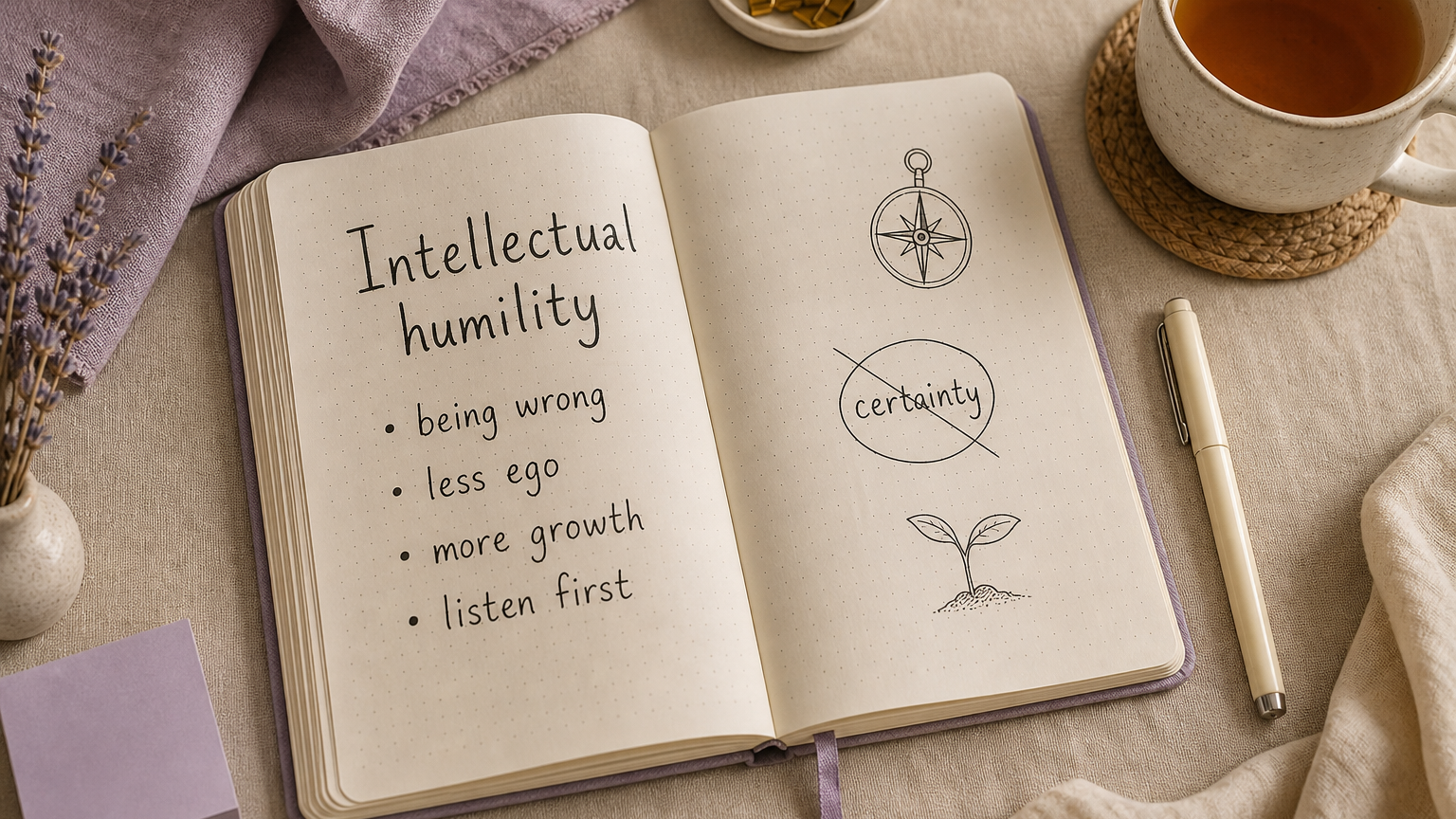
Episode 097 is about intellectual humility, the capacity to be wrong, to know you might be wrong, and to not let that threaten your sense of self.
Clotilde draws a distinction that stopped me mid-journey: there is a difference between being wrong and discovering you were wrong. The first is an abstract fact. The second is a felt experience, and it feels nothing like you’d expect. It can feel like relief. It can feel like shame. It can feel oddly freeing.
What she explores is why so many of us avoid getting to that second moment at all.
Why the Ego Hates Being Wrong
The brain experiences social threat in the same way it experiences physical threat. When someone challenges your position, your opinion, your decision, your version of events, the limbic system lights up. You go into defence mode. Not because you’re weak or childish, but because your nervous system is wired to protect you.
The problem is that the defence mechanism kicks in before you’ve had time to ask whether you actually deserve to be defended.
I recognised this in myself instantly. I can update my beliefs about nutrition without much ego involvement, I moved from one dietary approach to a completely different one and felt nothing but curiosity. But being wrong with my daughters, my husband, my colleagues? The ego steps in immediately. The case-building begins.
Clotilde argues that intellectual humility is not the absence of ego, it’s the capacity to notice when the ego is running the show and choose something different. That choice is available to us. It’s just uncomfortable.
The Tiny Practice I Am Trying Now
The practice I took from this episode is embarrassingly simple: when I feel myself tightening, I try to ask one extra question before I defend myself.
What am I protecting here?
Sometimes I am protecting a real boundary. Sometimes I am protecting my pride. Sometimes I am protecting the idea that I am a good mother, a good teacher, a good person, and the other person’s feedback has brushed against that identity. The question does not solve everything, but it creates a little space. And in that space, I am slightly less likely to turn a conversation into a courtroom.
I have also started practising smaller admissions of wrongness. Not dramatic confessions. Just ordinary sentences: “I misunderstood that.” “I reacted too fast.” “You were right about that detail.” These sentences still feel scratchy in my mouth, but they also feel clean.
Well, well, well. Apparently being wrong is not the end of the world. It might even be the beginning of better conversations.
What Changes When You Get Comfortable Being Wrong
There is something deeply freeing about this. And there are three reasons I think intellectual humility might be the most underrated personal development skill there is.
First: it accelerates learning. If I can only be right, I can only learn things that confirm what I already think. The moment I open the door to being wrong, everything becomes information.
Second: it transforms relationships. People trust you more when you can admit you were mistaken. Not less, more. The strongest leaders, the best parents, the most trusted friends I know are all people who can say “I got that wrong” without falling apart. The growth mindset research confirms this: the belief that intelligence and character are fixed is what makes being wrong feel so catastrophic. Shift the belief, and the sting disappears.
Third: it calms the inner critic. Here’s the one I didn’t expect. When I’m rigidly certain I’m right, I’m also rigidly certain that everyone who disagrees with me is wrong, and a small, anxious part of me is always waiting to be found out. Intellectual humility dissolves that. If I’m allowed to be wrong, the stakes are lower. I can breathe.
Practical Takeaways
- Notice the defensive feeling before you act on it. That tightening in the chest when someone challenges you? It’s useful data, not a verdict. Pause there.
- Separate your opinion from your identity. You are not your position. You can hold a view and release it without losing yourself.
- Say “I was wrong” out loud, regularly. It gets easier with practice, and it sets a powerful example for the people around you.
- Ask yourself: would I rather be right or be close? Sometimes those two things are mutually exclusive. Knowing which matters more to you in a given moment is clarifying.
- Collect your wrong moments like badges. Every time you discover you had something backwards, you’ve just learned something. That’s not a failure, that’s the whole point of being here.
Why This Belongs in Soul
Change ma vie is in my Soul section because it changed how I think, not just what I do. This episode specifically sits there because being wrong, really allowing yourself to discover it and feel it, is inner work. It asks you to loosen the grip on the story of who you are and what you know.
That kind of loosening is uncomfortable. It is also, in my experience, the beginning of everything good.
Notes from Soph | Learning, not perfection.
Et toi? Is there a belief you’ve been holding onto longer than is useful? A conversation where you were more interested in being right than being heard? Come and share it in the Notes from Soph community on Skool, we’re all figuring this out together.
Source Details: Change ma vie, Épisode 097: Avoir tort Clotilde Dusoulier | 2019
🎙 Listen at chocolateandzucchini.com or search “Change ma vie” on Apple Podcasts / Spotify

