Understand This to Outsmart the Matrix: David Bayer on Beliefs, Attention and Reality
The phrase “outsmart the matrix” sounds dramatic.
It makes me think of black coats, glitching screens, secret codes and people on the internet telling you that everything you believe is a lie. Which, depending on the corner of the internet you are in, can become exhausting quite quickly.
But David Bayer’s work usually brings these big concepts back to something much more useful: the mind.
Not just the thinking mind, but the whole operating system. Thoughts, beliefs, nervous system patterns, emotional habits, attention, identity and action.
So when I hear Understand This to Outsmart the Matrix, I do not hear, “Become paranoid about reality.”
I hear, “Stop being unconsciously programmed by the same old thoughts.”
That is a different thing entirely.
And far more practical.
Table of Contents
What It Means to Outsmart the Matrix
When people talk about “the matrix,” they often mean some external system controlling how we think, live, work and want.
There is truth in that.
We are constantly being trained. By culture. By advertising. By family systems. By school. By social media. By fear. By status. By the endless pressure to want more, prove more, buy more and compare more.
But the most interesting matrix is not only outside us.
It is the one inside.
The mental matrix is the network of beliefs that tells you what is possible, what is safe, what you are allowed to become and what people like you can expect from life.
It is the voice that says:
“Do not try that.”
“You are not that kind of person.”
“Money is always hard.”
“People leave.”
“You will be judged.”
“You are too late.”
“This is just how life is.”
The strange thing is that these thoughts can feel like reality, when often they are only rehearsed interpretations.
That, for me, is the heart of how to outsmart the matrix. You begin to separate what is actually happening from the meaning your mind has been trained to assign to it.
This connects closely with Bayer’s episode on how to use your thoughts to change reality. If thoughts shape what we notice and how we act, then the thoughts we never question become the edges of our world.
The Program Is Often a Belief
A belief does not always announce itself as a belief.
It often sounds like common sense.
“I am bad with money.” “Relationships are hard.” “I never finish things.” “People like me do not get opportunities like that.” “I am not creative.” “I am too anxious.” “I have to work twice as hard to be safe.”
If you have thought something for long enough, it stops feeling like a sentence and starts feeling like the weather.
Bayer often points to beliefs as the hidden mechanism behind repeated results. Not because beliefs are magical stickers we put on vision boards, but because beliefs organise perception and behaviour.
If I believe I am not good with money, I may avoid looking at my accounts. Avoidance creates more chaos, which then confirms the belief.
If I believe I am not creative, I may stop practising. Lack of practice creates weaker work, which then confirms the belief.
If I believe people leave, I may become guarded, testing or clingy. The relationship becomes strained, which then confirms the belief.
The matrix feeds itself through confirmation.
This is why it can feel so convincing. The belief creates behaviour. The behaviour creates evidence. The evidence strengthens the belief.
Round and round. Until something interrupts it.
Attention Is the Doorway
One of the most powerful things we can reclaim is attention.
Your attention is not a small thing. It is the lens through which reality becomes personal.
Two people can live through the same situation and collect entirely different evidence from it. One sees rejection. One sees redirection. One sees proof that nothing works. One sees information. One sees danger. One sees an invitation to grow.
This does not mean all interpretations are equally easy. If your nervous system has been trained by real pain, the fearful interpretation may arrive first. That is not failure. That is protection.
But attention is still a doorway.
Where you place it repeatedly becomes the world you experience most often.
Social media understands this. Advertising understands this. News cycles understand this. Old family patterns understand this. Your own anxious mind understands this.
If your attention is constantly placed on what is missing, threatening, humiliating or unavailable, your body will respond as if that is the whole truth.
To outsmart the matrix, you have to become less available for automatic attention.
You ask:
“What am I being trained to look at?”
“What am I ignoring because this old belief is loud?”
“What else is true?”
That last question is one I come back to constantly.
Not “what is the positive spin?”
What else is true?
Because there is nearly always something.
Why the Nervous System Keeps Choosing the Old Reality
This is where I think the whole conversation has to become compassionate. It is easy to say, “Just change your beliefs.” It is harder to live it when the old belief is tied to safety.
The nervous system does not care about your vision board if it thinks the old pattern is protecting you. This is why we repeat things that make no logical sense.
We say we want visibility, then hide.
We say we want love, then choose unavailable people.
We say we want rest, then fill every quiet space.
We say we want success, then sabotage the opportunity when it arrives.
From the outside, it can look irrational. From the inside, it may be the body trying to keep you in familiar territory. Familiar does not always mean good. It means known. And known often feels safer than new.
This is why Bayer’s work around state is so important. You do not change the matrix only by thinking harder. You change it by entering a new state often enough that the body starts to believe it can survive there.
A calmer state.
A more trusting state.
A more empowered state.
A more honest state.
A state where you can take the practical action without dragging the entire past into the room.
This is also where The Backwards Law is relevant. If you try to escape your current life from panic and lack, you may accidentally reinforce the same matrix. The exit is not frantic control. It is conscious creation.
The Practical Way Out
I do not think we outsmart the matrix through one big revelation. I think we do it through repeated moments of noticing. The mind says, “This always happens.”
You notice. The body tightens before a brave step.
You notice. You start checking for proof that you are not enough.
You notice. You compare your beginning to someone else’s chapter twenty.
You notice. This noticing is not passive. It is the moment the program becomes visible.
Once visible, it is no longer running completely on its own.
A practical process might look like this:
1. Name the matrix thought. What is the sentence? “I am not ready.” “This will not work.” “People will judge me.” “I cannot trust myself.”
2. Identify the belief underneath. What would I have to believe for this thought to feel so true? Maybe, “I am only safe if I am perfect,” or “mistakes are dangerous,” or “success creates rejection.”
3. Look for the behaviour it creates. Do I delay, overwork, shrink, people please, avoid, spend, control, numb or quit?
4. Ask what else is true. This is not about denial. It is about widening the lens. “I have been scared before and still acted.” “Some people may judge me, but some people may need this.” “I can make a mistake and repair it.”
5. Take one action from the new belief. The nervous system learns through experience. A new thought becomes stronger when paired with action.
If the old belief says, “I am not visible,” post the thing.
If the old belief says, “I cannot handle money,” open the account and look.
If the old belief says, “I never finish,” complete one small piece.
Small actions are not small when they contradict an old identity.
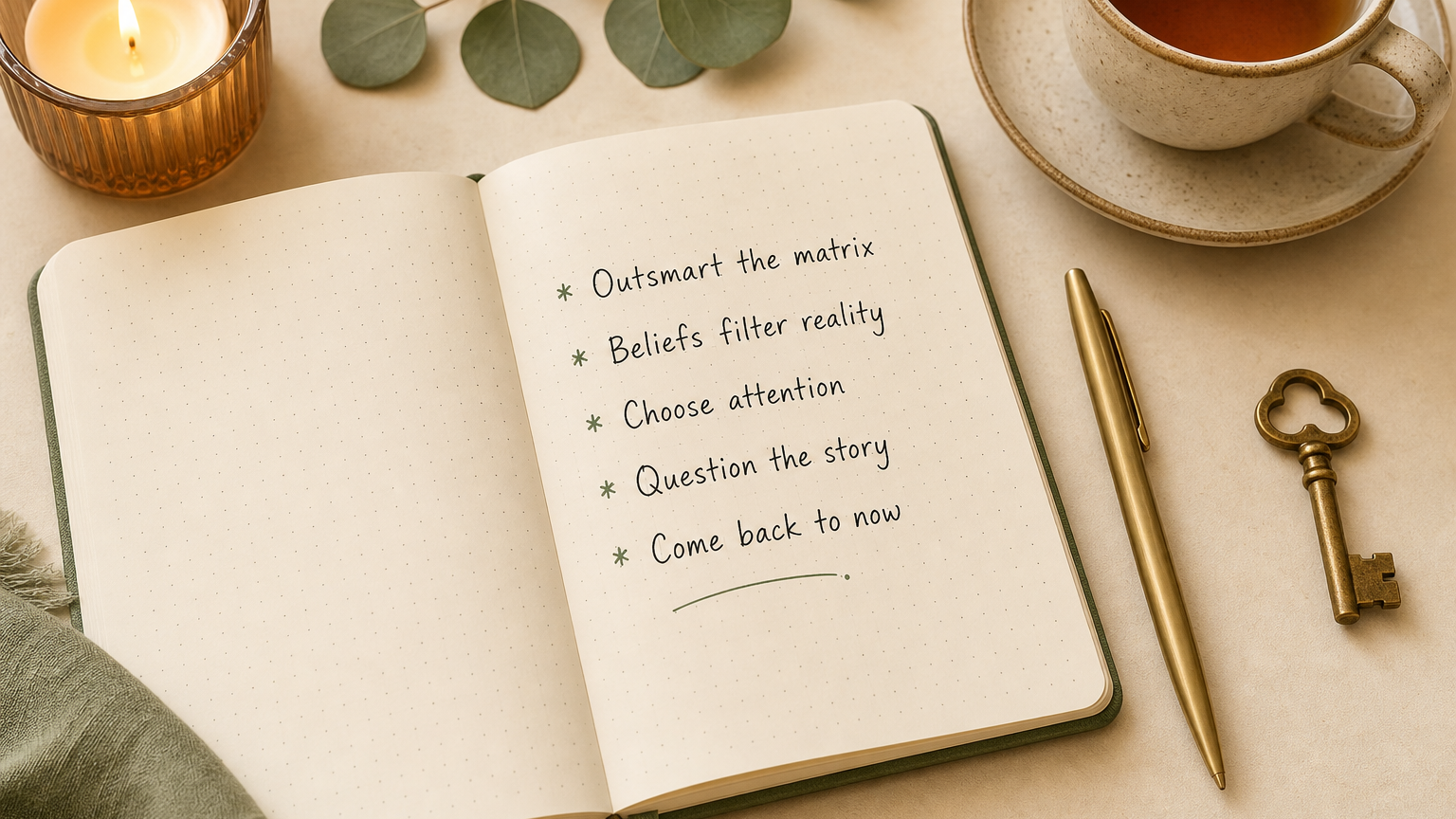
Practical Takeaways
1. Treat “the matrix” as your automatic programming first. It is easy to blame the outside world. Sometimes that is valid. But the most powerful place to start is with the beliefs and reactions you can actually observe.
2. Question thoughts that sound like facts. “I always mess this up” is not a fact. It is a thought wearing a judge’s wig. Write it down and cross examine it.
3. Your attention is valuable. Guard it. Notice what trains you into fear, lack and comparison. Then decide how much access it gets to your mind.
4. Do not shame the old pattern. The pattern probably began as protection. Thank it if you can, then choose something more current.
5. Pair new beliefs with new behaviour. Thinking “I am safe to be seen” is useful. Letting yourself be seen in one small way makes it real.
6. Use your body as evidence. If your chest tightens every time you approach a goal, the issue may not be laziness. It may be safety. Regulate first, then act.
7. Look for the loop. Belief creates behaviour. Behaviour creates evidence. Evidence strengthens belief. Find one place in the loop where you can interrupt it today.
Why This Belongs in Mind
This belongs in Mind because it is about perception.
Not vague mindset. Not pretending life is easy. Actual perception.
What do I believe? What do I keep noticing? What meaning do I keep assigning? What behaviour follows? What reality does that behaviour keep recreating?
To outsmart the matrix is to become conscious at the level where your life is being interpreted. It is to stop taking every thought as truth simply because it arrived with confidence.
For me, the power of this episode title is that it makes the work feel active.
Not “escape your life.” Not “fight the world.” But understand the program.
See the pattern. Choose your attention. Regulate your state. Act from the new belief before the old one has finished arguing.
That is a very practical kind of freedom.
Notes from Soph | Learning, not perfection.
Et toi? What is one old belief you are ready to interrupt? Come and talk about it in the Notes from Soph community on Skool.
Source Details: A Changed Mind, Episode 185, Understand This to Outsmart the Matrix David Bayer | Search “A Changed Mind David Bayer Episode 185” on Apple Podcasts, Spotify or YouTube.

